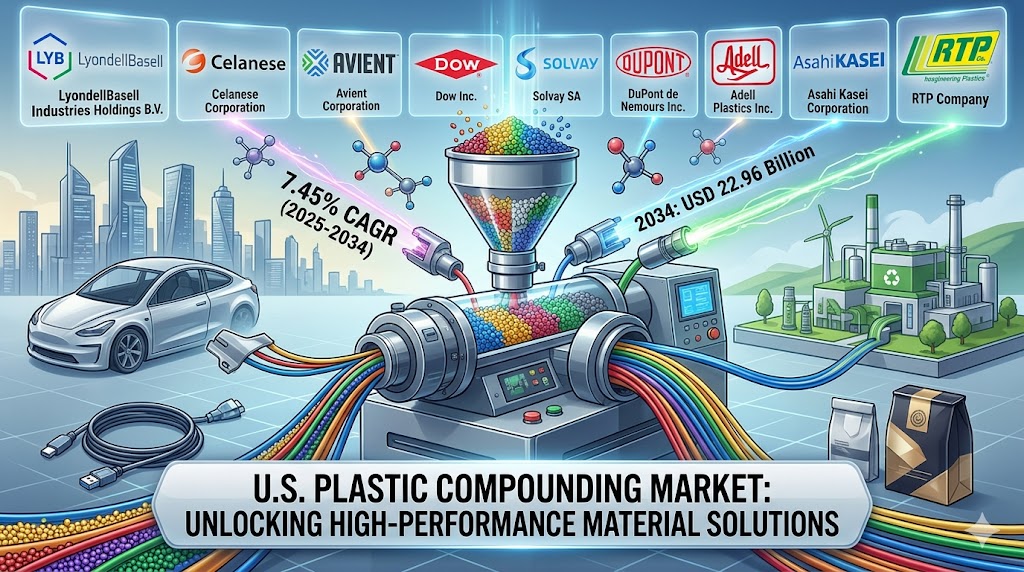
The U.S. plastic compounding market is witnessing a profound evolutionary phase, fundamentally driven by high-performance engineering applications and a shifting regulatory landscape. Valued at USD 12.02 billion in 2025, the market is officially marked at USD 12.92 billion in 2026. Projections indicate that the sector will reach approximately USD 22.96 billion by 2034, advancing at a steady Compound Annual Growth Rate (CAGR) of 7.45% over the forecast period from 2025 to 2034. This report explores structural market transitions, emphasizing the rapid growth of bio-based formulations, electrification demands, and stringent compliance standards driving material performance.
What is the Current State of the Market Overview?
Plastic compounding represents the crucial manufacturing bridge between raw polymer synthesis and final industrial product shaping. By blending primary base polymers with specialized additives, reinforcement agents, and fillers, compounders unlock specific physical properties like enhanced tensile strength, thermal resistance, and structural flexibility. In the United States, this sector has graduated from a standard commodity supply chain into a highly specialized technology matrix. The domestic demand is currently dictated by three structural pillars: high-precision automotive components, smart packaging solutions, and complex electrical and electronic components that require tailored insulation profiles.
What is Driving the Growth of the U.S. Plastic Compounding Market?
The overarching growth vector for U.S. plastic compounding centers around weight reduction and structural consolidation within industrial applications. The push for performance optimization across various engineering fields requires polymers that deliver metal-like structural integrity without the corresponding weight penalty. Furthermore, the massive digital infrastructure buildup across North America requires compounders to deliver high-purity, low-dielectric materials that can handle high-frequency data transmission while maintaining long-term physical integrity in varied operational environments.
Strategic Market Dynamics
What Are the Key Factors Driving the Market?
-
Automotive Structural Weight Reduction: The automotive industry’s aggressive push for lightweight, ultra-durable components remains a premier driver. To extend travel ranges and maximize efficiency, automotive engineers are systematically replacing heavy metal structures under the hood, across interiors, and throughout exterior body panels with highly reinforced compounded plastics.
-
Packaging and Electrical Sophistication: The expansion of advanced electronics and performance-driven consumer packaging necessitates compound formulations that offer superior chemical resistance, moisture barriers, and long-term stability.
What Are the Key Market Trends?
-
The Rapid Integration of Electric Vehicles (EVs): The localized surge in EV manufacturing across the U.S. is redefining compound specifications. EVs require complex battery enclosures, busbars, and high-voltage connector systems that rely on flame-retardant, thermally conductive, and electrically insulating plastic compounds to guarantee passenger safety and battery life.
-
The Circular Economy Framework: Large-scale industrial consumer brands are implementing strict sustainability mandates, causing a dramatic surge in continuous R&D investments centered on recycled polymer blending and post-consumer resin stabilization techniques.
What Are the Market’s Recent Government Initiatives?
U.S. federal and state regulatory policies are profoundly steering the compounding formulation matrix. Strict clean energy acts, transportation efficiency mandates, and state-level restrictions on single-use un-compounded plastics are forcing manufacturers to actively alter their chemical baselines. Government financial incentives aimed at establishing localized chip manufacturing facilities and domestic EV battery supply chains have also provided structural momentum, directly increasing the volume of specialty flame-retardant engineering compounds processed domestically.
Market Segmentation and Value Breakdown
Which Segment Accounted for the Largest Market Share?
The processing and application landscape reveals distinct structural leadership across various categories:
-
By Source Type: The fossil-based segment maintained a commanding 65-70% market share in 2024, heavily supported by deeply entrenched manufacturing habits and widespread feedstock availability. Conversely, the bio-based segment is positioned to achieve the fastest growth rate, fueled by an industry-wide transition toward eco-friendly manufacturing platforms.
-
By Base Polymer Type: The polyethylene (PE) segment captured a top-performing 18-20% industry share in 2024, thanks to its balance of cost-efficiency, chemical resistance, and toughness. Moving forward, Polyethylene Terephthalate (PET) is expected to lead upcoming demand schedules due to its crucial role in next-generation structural packaging and technical textiles.
-
By Additives/Fillers Type: Mineral fillers dominated the 2024 landscape with a 30-35% share, utilized because low-cost options like calcium carbonate and glass fibers effectively maximize stiffness and dimensional stability. Looking ahead, flame retardant/specialty additives are projected to claim the largest growth portion due to escalating safety codes.
-
By Application: The automotive sector led with a massive 35-40% share in 2024 due to large internal, external, and under-hood material volumes. Meanwhile, the optical media and data infrastructure segment is poised for the fastest expansion due to rising technical demand across communication and electronics networks.
What Are the Key Benefits of Using Compounded Plastics?
Compounded plastics provide unmatched compounding design freedom, allowing material scientists to manipulate molecular structural outcomes precisely. They allow for the tailored customization of thermal expansion coefficients, impact strength, and electrical properties within a single matrix. By replacing traditional monolithic materials, these advanced formulations improve overall operational life cycles, lower logistics and transportation costs due to reduced weight, and reduce manufacturing complexity by supporting single-step injection molding configurations.
Competitive Landscape & Key Player Profiles
What is the Market’s Recent Developments by Major Companies?
The U.S. competitive arena is shifting from traditional volume manufacturing toward specialized material co-development. Top-tier compounders are establishing dedicated customer innovation hubs to engineered custom formulations directly in sync with original equipment manufacturers’ (OEM) product timelines. Major industrial players are pursuing vertical integration strategies, acquiring niche recycling processors or specialty additive houses to safeguard supply chain continuity and secure proprietary compounding architectures.
Top Companies Profile Matrix
-
LyondellBasell Industries Holdings B.V.
-
About: A global licensing and petrochemical cornerstone driving extensive polyolefin compounding globally.
-
Products: Hostacom and Hifax high-performance polypropylene compounds.
-
Market Capitalization: Approximately USD 20.85 billion.
-
-
Celanese Corporation
-
About: A global chemical and differentiated chemistry expert leading the production of high-end engineered polymers.
-
Products: Hostaform® Acetal Copolymer (POM) and Celanex® PBT compounds.
-
Market Capitalization: Approximately USD 5.39 billion.
-
-
Avient Corporation
-
About: A premier provider of specialized polymer materials, specialized colorants, and functional additive formulations.
-
Products: Complexx™ long fiber reinforced compounds and reSound™ bio-based formulations.
-
Market Capitalization: Approximately USD 3.35 billion.
-
What is the Future of the Market?
The future of the U.S. plastic compounding market lies at the intersection of reactive extrusion capabilities and smart chemical formulation. The integration of advanced artificial intelligence into compounding plants will enable real-time tracking and adjustment of additive feeding configurations, maximizing batch consistency even when utilizing volatile recycled feedstocks. As corporate supply networks continue prioritizing environmental neutrality, compounders who master the blending of reliable bio-resins with high-performance synthetic matrices will command the structural value chains of tomorrow.
About Us
Towards Chemical and Materials is a leading global consulting firm specializing in providing comprehensive and strategic research solutions across the chemical and materials industries. With a highly skilled and experienced consultant team, we offer a wide range of services designed to empower businesses with valuable insights and actionable recommendations.
Our Trusted Data Partners
Precedence Research | Statifacts | Towards Packaging | Towards Healthcare | Towards Food and Beverages | Towards Chemical and Materials | Towards Consumer Goods | Nova One Advisor |
For Latest Update Follow Us: https://www.linkedin.com/company/towards-chem-and-materials/
USA: +1 804 441 9344
APAC: +61 485 981 310 or +91 87933 22019
Europe: +44 7383 092 044


Leave a Reply