Executive Summary
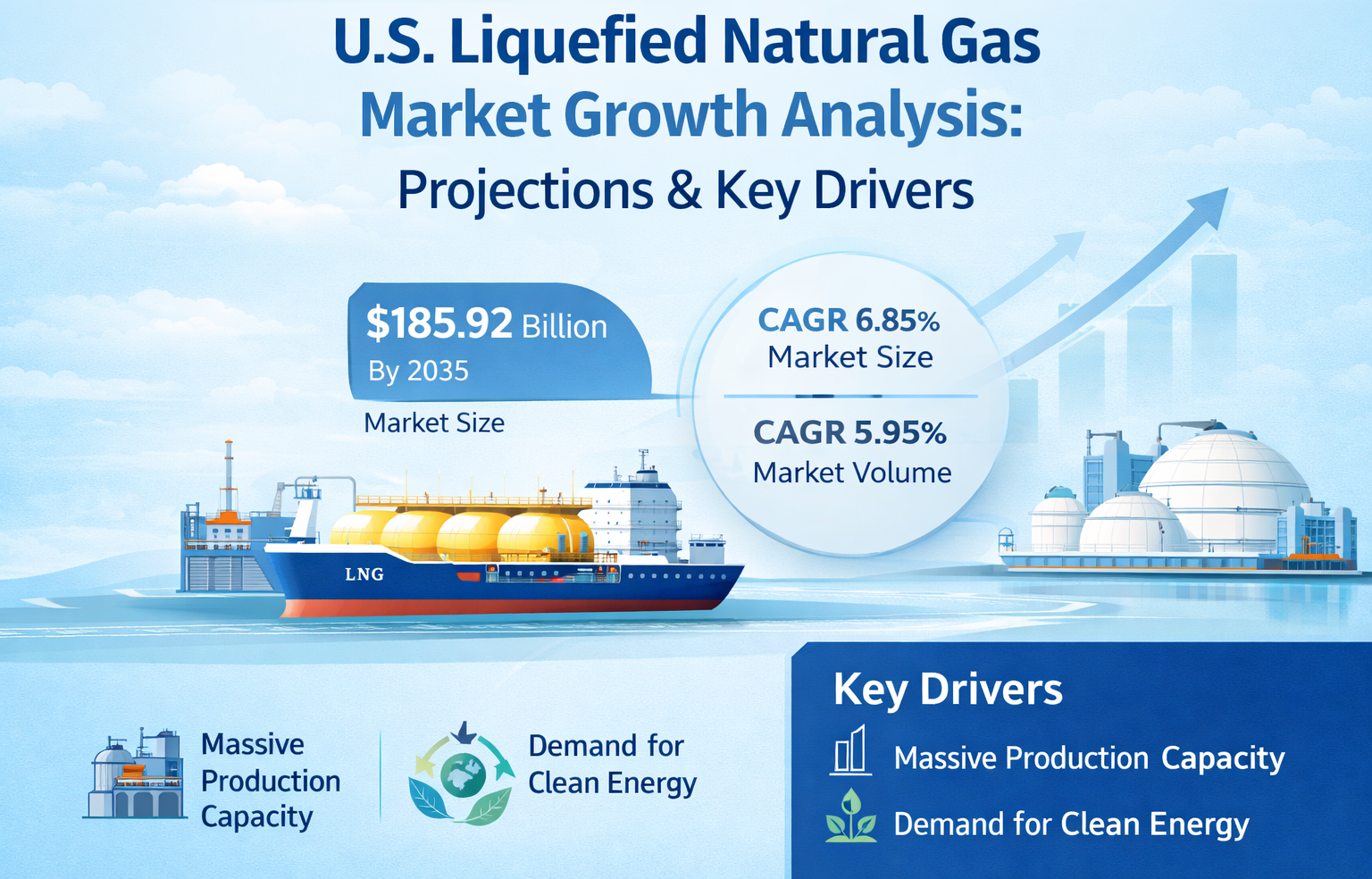
The U.S. Liquefied Natural Gas (LNG) Market has experienced significant growth over the past decade, shifting from zero exports to becoming the world’s largest LNG exporter by 2023. The market is projected to grow at a Compound Annual Growth Rate (CAGR) of 6.85% from 2025 to 2035, reaching a market size of USD 185.92 billion by 2035, up from USD 95.85 billion in 2025. This growth is underpinned by an increase in production capacity and the rising demand for cleaner, more sustainable energy alternatives.
Market volume is also expected to grow significantly from 92.85 million metric tons (MMT) in 2025 to 165.50 MMT by 2035, driven by a rapid increase in infrastructure and global LNG demand, particularly in Europe and Asia. Key drivers include technology advancements, regulatory changes, and geopolitical shifts that are reshaping the global energy landscape.
Market Growth Drivers
1. Infrastructure Expansion
- The continued development of new Liquefaction Terminals such as the Corpus Christi Stage 3 and Plaquemines LNG is increasing U.S. export capacity.
- The LNG Regasification Facilities segment is projected to grow the fastest between 2026 and 2035, driven by the need for more flexible and faster alternatives, like Floating Storage Regasification Units (FSRUs).
2. Energy Transition and Demand for Cleaner Fuels
- The transition from coal to natural gas is gaining momentum, with LNG providing a cleaner energy alternative for power generation, industrial use, and transportation.
- LNG is playing a key role in energy security in Europe and Asia, making it a preferred energy source for countries looking to reduce carbon emissions.
3. Technological Advancements
- Adoption of AI-driven terminal optimization, modular liquefaction technology, and carbon capture and storage (CCS) technologies is driving operational efficiency and lowering environmental impact.
Market Segmentation & Trends
By Infrastructure Type
- Liquefaction Terminals (40.00% share in 2025) dominate the market, driven by significant investments in large-scale onshore projects.
- The Regasification Terminals segment is expected to experience the fastest CAGR due to increased LNG demand, particularly from European countries seeking energy diversification.
Market Share Breakdown for Infrastructure Types (2025):
- Liquefaction Terminals: 40.00%
- Regasification Terminals: 20.00%
- LNG Storage Facilities: 15.00%
- Transportation Infrastructure: 25.00%
By End-Use Industry
- The Energy & Utilities sector holds the largest share (50.00%) due to its growing need for cleaner energy alternatives.
- The Transportation & Logistics segment is projected to grow rapidly, driven by the increasing use of LNG for marine bunkering and heavy-duty vehicles, which benefits from LNG’s lower carbon footprint.
Market Share Breakdown for End-Use Industries (2025):
- Energy & Utilities: 50.00%
- Industrial Sector: 22.00%
- Transportation & Logistics: 18.00%
- Commercial Sector: 10.00%
By Contract Type
- The market remains dominated by Long-term Contracts (55.00%) due to the revenue certainty they offer. However, the Spot Market (25.00%) is growing, driven by the flexibility it offers, particularly for short-term buyers.
Contract Type Share (2025):
- Long-term Contracts: 55.00%
- Spot Market: 25.00%
- Short-term Contracts: 20.00%
Competitive Landscape
Key Market Players:
- Cheniere Energy: The largest LNG exporter in the U.S., with major facilities like Sabine Pass and Corpus Christi.
- Freeport LNG: Key player in the LNG export terminal sector with one of the largest facilities in Texas.
- Sempra Infrastructure: Operator of Cameron LNG, developing both liquefaction and storage solutions.
- Venture Global LNG: Rapidly expanding with facilities like Calcasieu Pass and Plaquemines LNG, focusing on low-cost production.
- ExxonMobil, Chevron, and TotalEnergies: Major contributors to the U.S. LNG export capacity.
Recent Strategic Moves:
- In March 2026, Venture Global LNG and Vitol announced a significant 5-year, 1.5 MTPA LNG supply deal, strengthening Venture Global’s position in the market.
- Sempra Infrastructure and Freeport LNG have expanded their export terminals to meet growing demand, especially in Europe.
Technological Shifts and Innovations
The U.S. LNG market is undergoing a major transformation with the integration of cutting-edge technologies such as:
- Modular Liquefaction Technology: Reduces construction time and allows for flexible, small-scale facilities in remote regions.
- AI-driven Optimization: Used to enhance operational efficiencies at liquefaction and regasification terminals.
- Carbon Capture and Storage (CCS): Helps to decarbonize LNG production, making it more environmentally friendly and allowing for premium pricing in some markets.
Challenges and Opportunities
Key Challenges:
- Regulatory Uncertainty: Issues around permitting, methane emission standards, and pipeline safety are slowing down infrastructure development.
- Environmental Concerns: Addressing methane leaks during production and transportation remains a key challenge.
- Geopolitical Factors: Geopolitical instability, particularly in Europe, may affect LNG supply chains and pricing.
Growth Opportunities:
- Increased LNG Demand from Europe: The rising need for energy security in Europe is expected to drive demand for U.S. LNG exports.
- Expansion of Export Terminals: New terminals and infrastructure projects will double U.S. LNG export capacity by 2030.
- Decarbonization: The shift toward low-carbon LNG and marine bunkering presents significant growth prospects.
Market Size and Volume Forecast
Projected Market Size:
- 2025: USD 95.85 Billion
- 2035: USD 185.92 Billion
- CAGR (2025-2035): 6.85%
Projected Market Volume:
- 2025: 92.85 Million Metric Tons (MMT)
- 2035: 165.50 Million Metric Tons (MMT)
- Volume CAGR (2025–2035): 5.95%
Pricing Forecast:
- Average Manufacturing Price (2025): USD 5.25/MMBtu
- Average Selling Price (2025): USD 8.75/MMBtu
- Pricing CAGR (2025–2035): 3.29%
Conclusion: The Road Ahead for U.S. LNG
The U.S. LNG market is poised for continued growth, driven by the need for energy diversification, cleaner fuels, and innovative technologies. As the world’s largest LNG exporter, the U.S. plays a crucial role in global energy security, particularly in regions like Europe and Asia. The market faces challenges like regulatory hurdles and environmental concerns but also boasts significant opportunities through infrastructure expansion and technological advancements.
The U.S. LNG market will continue to be a vital player in the global energy transition, with strong growth prospects through 2035.
Contact Us https://www.towardschemandmaterials.com/contact-us
About Us
Towards Chem and Materials is a leading global consulting firm specializing in providing comprehensive and strategic research solutions across the chemical and materials industries. With a highly skilled and experienced consultant team, we offer a wide range of services designed to empower businesses with valuable insights and actionable recommendations.
Email: [email protected]
Web: https://www.towardschemandmaterials.com/
For Latest Update Follow Us: https://www.linkedin.com/company/towards-chem-and-materials/?viewAsMember=true


Leave a Reply