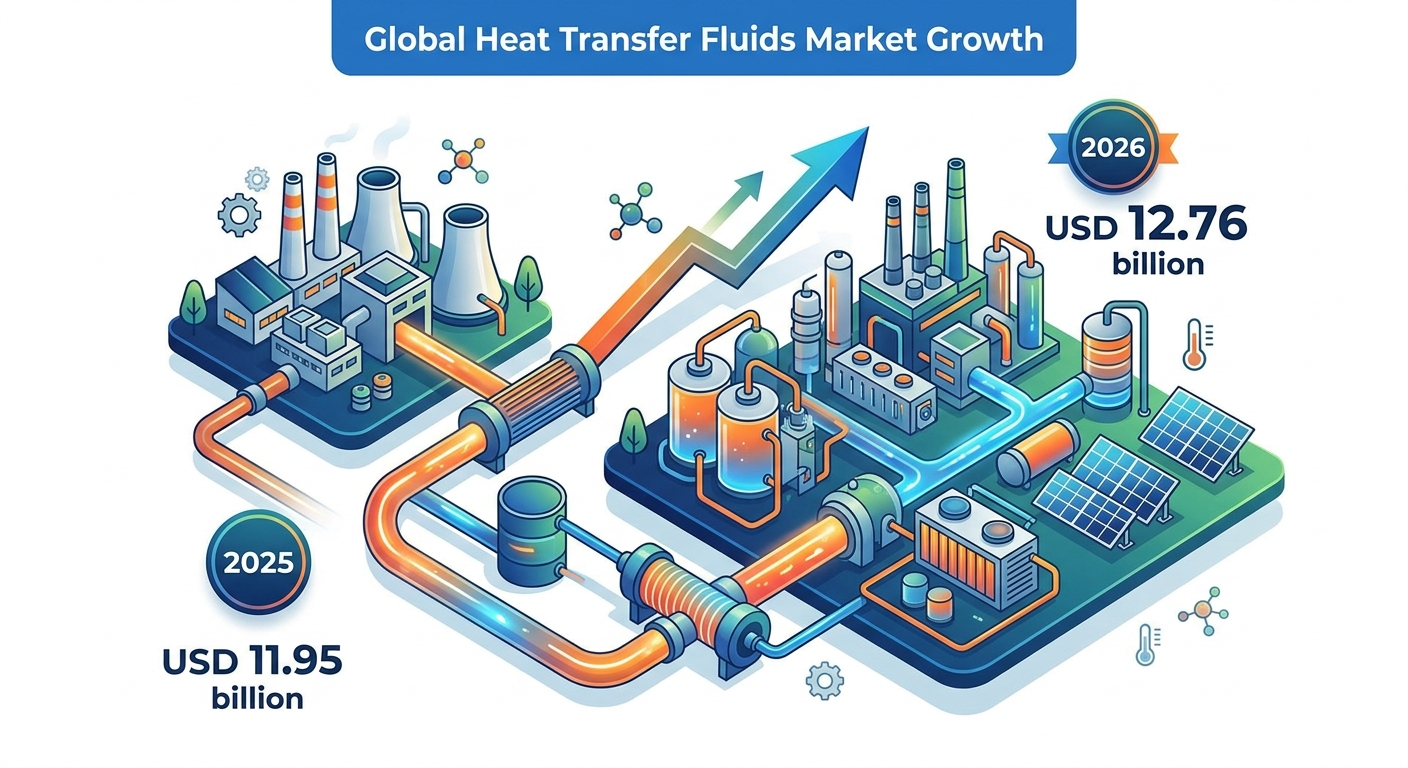
The global heat transfer fluids market is positioning itself for a decade of sustained, high-yield expansion. Valued at USD 11.95 billion in 2025, the market is estimated to reach USD 12.76 billion in 2026. Driven by an explosion in bio-based fluid alternatives and the rising demand for specialized cooling across heavy industries, the market is projected to reach USD 22.96 billion by 2035. This represents a robust value compound annual growth rate (CAGR) of 6.75% over the forecast period from 2026 to 2035.
In terms of volume, the industry is tracking a parallel upward trajectory, moving from 6.11 million tons in 2025 to a projected 10.49 million tons by 2035, exhibiting a volumetric CAGR of 5.55%. Looking at the interim horizon, the market is comfortably on track to hit an estimated valuation of USD 18.70 billion by 2032, propelled by structural shifts toward automated thermal management and eco-friendlier chemical profiles.
Market Overview: What is the Heat Transfer Fluids Market?
The heat transfer fluids market comprises the development, manufacturing, and distribution of specialized intermediate liquids engineered to transport thermal energy from one location to another within an industrial loop. These fluids act as the circulatory system for thermal regulation, ensuring that machinery operates within safe, optimal temperature bounds while actively preventing internal component corrosion.
Characterized by exceptional thermal stability, superior thermal conductivity, and excellent chemical compatibility with diverse piping materials, modern HTFs are formulated to exhibit low viscosity for easy pumping and high flashpoints to mitigate industrial fire risks. They serve as a foundational utility across critical global sectors, including beverage processing, automotive cooling systems, industrial refrigeration, heavy chemical manufacturing, and agricultural processes like vegetable oil deodorization.
Market Dynamics: What Are the Key Factors Driving the Market?
What are the primary drivers for this market?
The primary catalyst accelerating the HTF market is the massive infrastructure build-out in the chemical processing, oil & gas, and renewable energy sectors. Industrial facilities are operating at higher thermal capacities than ever before, requiring fluids that can withstand extreme temperatures without degrading. Additionally, the rapid expansion of concentrated solar power (CSP) plants and advanced energy storage systems relies heavily on synthetic and silicone-based HTFs to store and transfer heat efficiently, directly linking market growth to global clean energy transitions.
What are the critical market restraints?
Conversely, the market faces stringent headwinds from volatile raw material pricing and tightening environmental regulations. Traditional petroleum-based mineral oils and synthetic aromatic fluids are under intense scrutiny due to toxicity risks, low biodegradability, and stringent disposal laws. Leakage of these fluids poses significant environmental hazards, forcing manufacturers to navigate costly compliance frameworks and invest heavily in secondary containment systems, which can temporarily bottleneck market adoption in cost-sensitive regions.
Market Insights: Why Is the Heat Transfer Fluids Market Important?
Heat transfer fluids are fundamentally critical because they dictate the energy efficiency and operational lifespan of multi-million dollar industrial assets. Without optimized HTFs, industrial systems suffer from thermal localized hot spots, accelerated equipment degradation, and massive energy waste. In an era where carbon footprints and energy bills directly impact corporate bottom lines, the choice of a high-performance heat transfer fluid is a determining factor in achieving lean, sustainable manufacturing goals.
Furthermore, these fluids are vital for ensuring safety and product purity. In sensitive sectors like food, beverage, and pharmaceutical processing, a thermal system failure or fluid cross-contamination can ruin entire product batches and cause catastrophic operational downtime. The development of non-toxic, food-grade HTFs ensures that high-temperature sterilization and processing can occur safely, bridging the gap between heavy industrial output and consumer safety standards.
What are the Key Benefits of Using Modern Heat Transfer Fluids?
Modern formulated heat transfer fluids provide unparalleled operational advantages over rudimentary cooling mediums like uninhibited water or basic oils. Their high thermal stability prevents fluid cracking—the breakdown of chemical bonds at elevated temperatures—which drastically minimizes the formation of system fouling sludge and carbon coke deposits. This stability directly translates to extended fluid life, reducing the frequency of costly system flushes and fluid replacements for plant operators.
Additionally, their superior thermal conductivity allows for rapid heat absorption and release, significantly optimizing the thermodynamic efficiency of the entire system. Because they feature precisely engineered low viscosities even at low temperatures, they reduce the mechanical load on circulation pumps, saving electrical energy. Coupled with high flashpoints that prevent accidental ignition under high thermal stress, these fluids maximize workplace safety while providing continuous, active corrosion protection to internal metallic surfaces.
Market Segmentation: Which Segment Accounted for the Largest Market Share?
Product Type Insights
The synthetic fluids segment historically holds the largest share of the market due to its dominant deployment in high-temperature industrial manufacturing and concentrated solar power systems. Synthetic aromatic and glycol-based fluids offer operational thresholds well exceeding $300^\circ\text{C}$, a metric where standard mineral oils fail. However, the bio-based fluids segment is currently tracking the highest growth rate, fueled by industries actively seeking non-toxic, highly biodegradable alternatives derived from renewable agricultural feedstocks to satisfy corporate ESG (Environmental, Social, and Governance) targets.
Application and Regional Breakdown
From an application perspective, industrial processing and chemical manufacturing represent the largest volume consumers, followed closely by the automotive cooling and HVAC segments. Regionally, the Asia-Pacific region commands the largest market share and is projected to remain the fastest-growing geography through 2035, driven by aggressive industrialization, expanding automotive production lines, and massive chemical refining capacities in China, India, and Southeast Asia. North America and Europe follow as mature markets, where growth is heavily focused on premium synthetic adoptions, bio-based transitions, and high-tech electronic cooling applications.
Data Presentation: Market Breakdown and Visual Matrix
To understand the trajectory of the market, it is essential to map out how the core product segments stack against current industrial requirements. The table below outlines the core product landscape shaping the 2026–2035 forecast period.
What are the Recent Government Initiatives Shaping the Market?
Governments worldwide are implementing strict environmental and energy conservation policies that act as indirect structural drivers for the HTF market. In the European Union, the REACH (Registration, Evaluation, Authorisation and Restriction of Chemicals) regulations have accelerated the phase-out of certain toxic, chlorinated, or non-biodegradable synthetic fluids. This legislative pressure has directly forced chemical manufacturers to shift their R&D pipelines toward eco-friendly, bio-based alternatives to ensure continued compliance in Western markets.
Simultaneously, green energy subsidies like the U.S. Inflation Reduction Act (IRA) are pumping billions into clean energy infrastructures, specifically targeting concentrated solar power (CSP) projects and domestic chemical supply chains. These initiatives require massive volumes of thermal storage and transfer media, providing lucrative tax incentives for facilities that integrate advanced, high-efficiency synthetic and bio-derived heat transfer loops into their systems.
Competitive Landscape: Top Companies and Recent Developments
The global heat transfer fluids arena is highly consolidated, led by major chemical conglomerates with deeply integrated raw material supply chains. The market is defined by intense competition focused on product life extension, non-toxic formulations, and localized distribution networks.
1. Eastman Chemical Company
-
About: Headquartered in the United States, Eastman is a global specialty chemical company known for producing a vast array of advanced materials, additives, and functional fluids used across every major industrial sector.
-
Products: Eastman manufactures the world-renowned Therminol and Marlotherm synthetic and mineral oil-based heat transfer fluid lines, designed for precise temperature control across high- and low-temperature applications.
-
Market Cap: Approximately USD 11.5 billion.
2. The Dow Chemical Company
-
About: An American multinational chemical powerhouse, Dow is one of the largest chemical producers in the world, serving plastics, organics, and performance fluid markets globally.
-
Products: Dow commands the market with its DOWTHERM synthetic organic fluids, SYLTHERM silicone fluids, and DOWFROST inhibited propylene glycol fluids engineered specifically for food and beverage applications.
-
Market Cap: Approximately USD 34.2 billion.
3. ExxonMobil Corporation
-
About: A premier global energy and chemical giant, ExxonMobil leverages its vast petrochemical refining capabilities to deliver high-purity industrial lubricants and process oils worldwide.
-
Products: ExxonMobil supplies the Mobiltherm series, which consists of premium-quality mineral oils formulated for closed indirect heating and cooling systems requiring excellent thermal stability.
-
Market Cap: Approximately USD 465.0 billion.
4. Chevron Phillips Chemical Company
-
About: A joint venture between Chevron and Phillips 66, this company is a leading global producer of olefins, polyolefins, and highly specialized alpha-olefins and aromatics.
-
Products: They produce the Sunthene and highly specialized synthetic hydrocarbon-based HTF lines tailored for heavy-duty industrial processing loops.
-
Market Cap: Privately held Joint Venture (Parent companies Chevron and Phillips 66 trade publicly with market caps of ~$275B and ~$55B respectively).
What is the Future of the Heat Transfer Fluids Market?
What is the long-term outlook?
The future of the heat transfer fluids market points toward smart, ultra-efficient, and green thermal chemistries. As artificial intelligence and data center infrastructures swell globally, traditional air cooling is failing to meet thermal demands. This is opening up a massive, high-margin frontier for liquid immersion cooling and specialized dielectric heat transfer fluids capable of direct-contact cooling with live electronic components, altering the historical industrial footprint of the market.
Where is the innovation heading?
Innovation will be heavily dominated by nanotechnology and advanced bio-synthetics. Researchers are actively commercializing “nanofluids”—heat transfer fluids infused with metallic or carbon nanoparticles that exponentially boost thermal conductivity compared to standard base oils. Combined with the inevitable transition away from fossil-based feedstocks toward zero-carbon, plant-derived base fluids, the next decade will redefine HTFs as high-tech, sustainable eco-materials vital to the next-generation industrial economy.
About Us
Towards Chemical and Materials is a leading global consulting firm specializing in providing comprehensive and strategic research solutions across the chemical and materials industries. With a highly skilled and experienced consultant team, we offer a wide range of services designed to empower businesses with valuable insights and actionable recommendations.
Our Trusted Data Partners
Precedence Research | Statifacts | Towards Packaging | Towards Healthcare | Towards Food and Beverages | Towards Chemical and Materials | Towards Consumer Goods | Nova One Advisor |
For Latest Update Follow Us: https://www.linkedin.com/company/towards-chem-and-materials/
USA: +1 804 441 9344
APAC: +61 485 981 310 or +91 87933 22019
Europe: +44 7383 092 044
Email: [email protected]


Leave a Reply