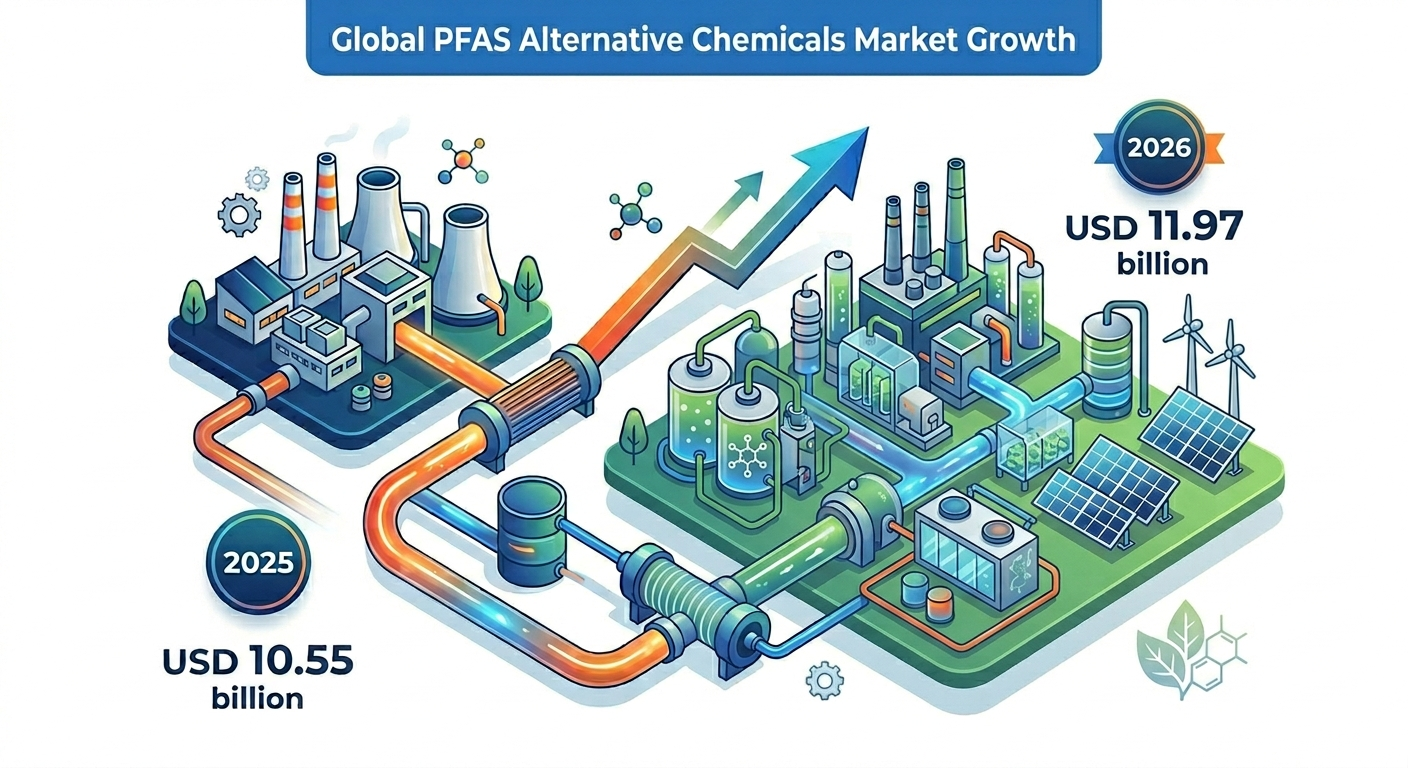
The global PFAS alternative chemicals market is on the cusp of an explosive, regulation-driven expansion. Valued at USD 10.55 billion in 2025, the market is estimated to reach USD 11.97 billion in 2026. Driven by a sweeping structural shift toward sustainable, non-hazardous material alternatives across major downstream industries, the market is projected to reach an impressive USD 37.26 billion by 2035. This represents a remarkable compound annual growth rate (CAGR) of 13.45% over the forecast period from 2026 to 2035.
In terms of physical production volume, the industry is tracing an equally aggressive upward path, moving from 4.85 million tons in 2025 to a projected 14.60 million tons by 2035, exhibiting a volumetric CAGR of 11.65%. Looking at the interim horizon, a standard market trajectory calculation establishes that the market will comfortably surpass an estimated value of USD 25.10 billion by 2032. This rapid scaling highlights a profound industrial transition away from traditional fluorochemical performance standards toward green chemistry frameworks.
Market Overview: What is the PFAS Alternative Chemicals Market?
The PFAS alternative chemicals market encompasses the development, synthesis, and distribution of non-fluorinated substitutes engineered to replace legacy per- and polyfluoroalkyl substances. These substitute materials are formulated to replicate the vital properties previously provided by PFAS—such as hydrophobicity (water repellency), oleophobicity (oil resistance), thermal stability, and low surface tension—without introducing bioaccumulative or toxic risks.
Characterized by complex molecular frameworks derived from silicones, hydrocarbons, polyurethanes, and emerging bio-based materials, modern PFAS alternatives are carefully designed to integrate seamlessly into existing manufacturing loops. They are deployed across critical global applications, including food packaging coatings, textile water-repellents, semiconductor manufacturing steps, automotive coatings, medical devices, and class-leading firefighting foams (AFFF replacements).
Market Dynamics: What Are the Key Factors Driving the Market?
What are the primary drivers for this market?
The primary catalyst accelerating the market is the wave of uncompromising global environmental legislation targeting fluorinated substances. Regulatory bodies like the U.S. EPA and Europe’s ECHA are pushing for total bans on non-essential PFAS uses, leaving industrial manufacturers with no choice but to reformulate their product portfolios. This legislative pressure is amplified by soaring corporate ESG (Environmental, Social, and Governance) mandates and heightened consumer awareness, which together compel brands to demand verified “fluorine-free” labels across consumer goods, textiles, and packaging materials.
What are the critical market restraints?
Conversely, the market faces significant headwinds from performance parity challenges and steep development costs. Replicating the extreme thermal and chemical resilience of carbon-fluorine bonds using alternative chemistries is technically complex, frequently resulting in trade-offs in durability or demanding specialized processing modifications. Additionally, the premium pricing of newly formulated alternative chemicals poses a barrier for cost-sensitive industries, temporarily slowing transition timelines in areas where legacy stockpiles are still legally permitted.
Market Insights: Why Is the PFAS Alternative Chemicals Market Important?
The PFAS alternative chemicals market is critically important because it underpins the regulatory compliance, operational viability, and supply chain continuity of modern manufacturing. PFAS have historically been woven so deeply into components—from microchip production to waterproof garments—that an abrupt ban without viable chemical alternatives would stall global supply chains. The successful development and scaling of these replacement technologies act as an economic insurance policy, allowing heavy industries to transition smoothly into an era of eco-safe manufacturing without sacrificing product output.
Furthermore, this market is essential from a public health and litigation mitigation standpoint. As municipal water filtration costs and corporate liabilities related to PFAS contamination soar into the billions, adopting non-fluorinated chemistry protects businesses from catastrophic legal and financial exposures. By cutting off contamination at the source, this chemical pivot represents a fundamental shift in how the industry approaches material longevity and environmental stewardship.
What are the Key Benefits of Using PFAS Alternative Chemicals?
Transitioning to modern PFAS alternative chemicals offers profound environmental, regulatory, and corporate advantages. The most significant benefit is their superior environmental profile; because these compounds are designed to be readily biodegradable or ecologically benign, they completely eliminate the risk of long-term environmental persistence and bioaccumulation in human and animal tissues. This helps manufacturing facilities drastically lower their hazardous waste footprints and ensure absolute alignment with emerging global chemical safety standards.
From a product marketing perspective, incorporating fluorine-free alternatives allows brands to successfully capture the rapidly growing eco-conscious consumer segment, unlocking premium branding opportunities. These alternatives often bring specific functional advantages, such as improved breathability in performance textiles compared to dense fluoropolymer membranes, or easier recycling profiles for cellulose-based food packaging coatings. By choosing modern alternatives, companies protect their supply chains from sudden regulatory bans while enhancing their standing with ESG-focused institutional investors.
Market Segmentation: Which Segment Accounted for the Largest Market Share?
Product and Regional Demographics
The food packaging and textile application segments historically command the largest market share, driven by rapid regulatory enforcement and immediate consumer contact risks. Silicone-based and specialized wax/hydrocarbon emulsions have quickly dominated these sectors, replacing historical paper-greaseproofing agents. Regionally, the Asia-Pacific region held the largest revenue share of 30% in 2025 and is projected to remain the dominant geographic region through 2035. This position is supported by massive electronics and textile manufacturing hubs centered in China, Japan, India, and South Korea, which are actively adapting to export standards required by Western nations.
Growth Pacesetters
While packaging leads in current volume, the semiconductor manufacturing and industrial electronics segments are tracking the highest growth rates over the forecast period. The microelectronics industry is under immense pressure to find high-purity, ultra-stable dielectric and surfactant substitutes for lithography and etching processes. As a result, premium alternative formulations are commanding high prices, driving rapid market value growth across advanced tech manufacturing regions in Asia-Pacific and North America.
Data Presentation: Comprehensive Pricing and Visual Performance Matrix
To map out the economics of this transition, it is critical to balance production volumes against the premium pricing commanded by advanced alternative solutions. The data points below outline the baseline market financials established in 2025 alongside a product application matrix.
Core Market Pricing Baseline (2025)
-
Average Manufacturing Cost: USD 5,429 per Ton
-
Average Selling Price (ASP): USD 7,186 per Ton
-
Pricing Compound Annual Growth Rate (2025–2035): 4.9%
| Alternative Chemical Base | Primary Application Focus | Performance Advantage | Market Adoption Pace |
| Silicone-Based Emulsions | Textiles, Industrial Lubricants | High thermal stability, excellent water repellency | Rapid / Mature adoption |
| Hydrocarbons & Waxes | Food Packaging Coatings | Biodegradable, excellent oil/grease barrier | High Volume / Established |
| Dendrimers & Polymers | High-Performance Apparel | Durable water repellency (DWR) without shedding | Steady / Premium growth |
| Specialized Polyurethanes | Automotive, Heavy Coatings | Excellent scratch resistance and surface tension | Emerging / High potential |
What are the Recent Government Initiatives Shaping the Market?
Governments around the world are continuously introducing stringent regulations that act as direct economic drivers for this alternative chemicals market. In the European Union, the proposed universal PFAS restriction under REACH continues to push industries toward total elimination, threatening to ban over 10,000 fluorinated substances across non-essential applications. This legislative pressure has turned alternative formulation development from a niche R&D experiment into a mandatory requirement for maintaining market access in Europe.
Simultaneously, in the United States, the EPA has finalized strict Maximum Contaminant Levels (MCLs) for key PFAS compounds in drinking water, forcing states to crack down on industrial wastewater discharges. Coupled with state-level bans on PFAS in food packaging and cosmetics across California, New York, and Washington, these domestic actions create a unified federal and state-level mandate that rewards chemical companies offering scale-ready, fluorine-free chemical alternatives.
Competitive Landscape: Top Companies and Recent Developments
The global PFAS alternative chemicals arena features a mix of traditional chemical leaders pivoting away from fluoropolymers and specialized specialty material innovators developing targeted solutions.
1. 3M Company
-
About: An American multinational conglomerate, 3M has taken a historic stance by choosing to completely exit all PFAS manufacturing, shifting its massive R&D infrastructure toward non-fluorinated materials.
-
Products: The company is aggressively commercializing advanced hydrocarbon, silicone, and polyurethane-based substitutes for industrial coatings, electronic components, and automotive fluid loops.
-
Market Cap: Approximately USD 80.9 billion.
2. Solvay S.A.
-
About: Headquartered in Belgium, Solvay is a global leader in specialty chemicals and advanced materials, heavily investing in sustainable chemical engineering to replace high-performance polymers.
-
Products: Solvay has built a robust line of non-fluorinated surfactants and high-performance polyethersulfone (PES) formulations designed to replace legacy fluoropolymers in aggressive chemical processing environments.
-
Market Cap: Approximately EUR 2.7 billion.
3. The Chemours Company
-
About: Spun off from DuPont, Chemours is a premier chemical manufacturer historically rooted in fluoroproducts, now rapidly expanding its sustainable, non-fluorinated performance offerings.
-
Products: Chemours markets the Zelan brand, which includes a family of renewably sourced, durable water-repellent finishes for textiles and packaging that completely avoid fluorinated platforms.
-
Market Cap: Approximately USD 3.4 billion.
4. Daikin Industries, Ltd.
-
About: A Japanese multinational manufacturing giant, Daikin is adapting its extensive chemical division to meet changing international environmental rules by exploring diverse chemical structures.
-
Products: Daikin is scaling production of its specialized non-fluorinated oil and water repellents, designed for paper packaging and textile coatings to ensure regulatory compliance for global exporters.
-
Market Cap: Approximately USD 43.4 billion.
What is the Future of the PFAS Alternative Chemicals Market?
What is the long-term outlook?
The future of the PFAS alternative chemicals market points toward a completely non-fluorinated industrial core, where sustainability is built directly into molecular design. As electronic architecture and battery technologies advance, the market will witness a massive wave of high-purity alternative chemical launches tailored specifically for data centers, green hydrogen membranes, and lithium-ion battery coatings. This will firmly establish the market as a pillar of the next-generation clean tech supply chain.
Where is the innovation heading?
Innovation will be heavily focused on bio-synthetics and advanced biomimicry. Researchers are actively working to scale plant-derived proteins, structural polysaccharides, and natural structural matrices that copy the water-shunning properties of lotus leaves and desert beetles. By combining these bio-derived structures with smart polymers, the next decade will deliver alternatives that match or exceed the durability of legacy chemicals, proving that global industries can thrive on green chemistry.
About Us
Towards Chemical and Materials is a leading global consulting firm specializing in providing comprehensive and strategic research solutions across the chemical and materials industries. With a highly skilled and experienced consultant team, we offer a wide range of services designed to empower businesses with valuable insights and actionable recommendations.
Our Trusted Data Partners
Precedence Research | Statifacts | Towards Packaging | Towards Healthcare | Towards Food and Beverages | Towards Chemical and Materials | Towards Consumer Goods | Nova One Advisor |
For Latest Update Follow Us: https://www.linkedin.com/company/towards-chem-and-materials/
USA: +1 804 441 9344
APAC: +61 485 981 310 or +91 87933 22019
Europe: +44 7383 092 044
Email: [email protected]


Leave a Reply