The polymers industry is experiencing a notable structural shift as industrial manufacturing moves away from legacy glass architectures. At the forefront of this evolution is the United States transparent plastics market—a segment seeing increased capital investment due to demanding optical specifications, lightweight structural needs, and rising sustainability mandates.
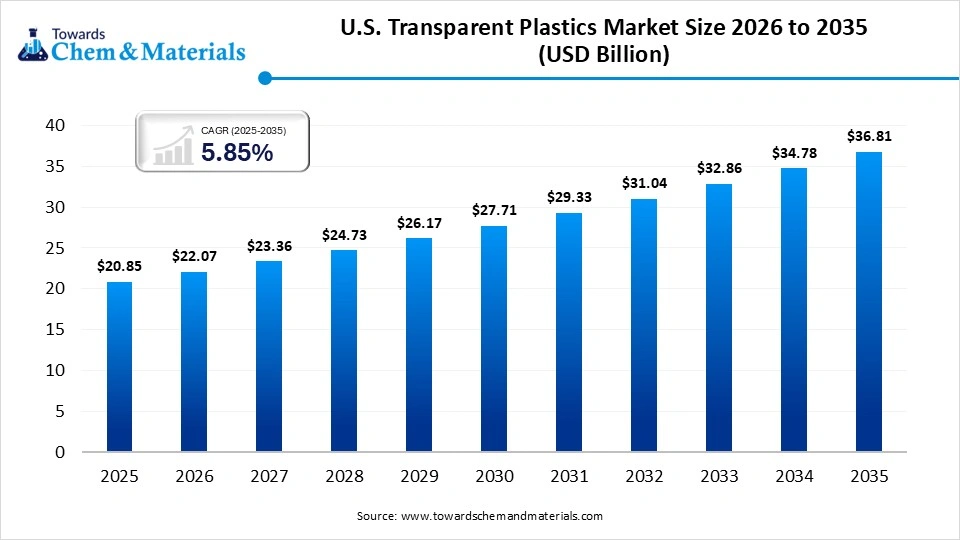
The U.S. transparent plastics market size is reached at USD 20.85 billion in 2025 and is expected to be worth around USD 36.81 billion by 2035, growing at a compound annual growth rate (CAGR) of 5.85% over the forecast period 2025 to 2035. The growth of the market is driven by the increasing demand from the packaging industry, which supports the growth of the market in the country.
Executive Summary: High-Level Strategic Outlook
A structural assessment of domestic polymer demand shows steady growth across the major end-use sectors in the United States.
-
2025 Market Valuation: USD 20.85 Billion
-
2026 Market Valuation (Estimated): USD 22.07 Billion
-
Projected Market Value (by 2035): USD 36.81 Billion
-
Compound Annual Growth Rate (CAGR): 5.85% (2025–2035)
By the year 2032, the domestic market value is on track to surpass the USD 31 billion threshold. This growth highlights an ongoing shift where high-clarity engineered polymers are expanding their role in the medical, automotive, and smart-packaging supply chains.
Market Dynamics: Drivers, Restraints, and Opportunities
What Are the Primary Drivers for This Market?
The market is primarily driven by the ongoing need for vehicular weight reduction in the automotive sector and an accelerating demand for specialized consumer and medical packaging. To maximize the range of electric vehicles (EVs) and optimize fuel efficiency in internal combustion engines, manufacturers are replacing glass windows, sunroofs, and headlight lenses with high-impact polycarbonates. Concurrently, the food, beverage, and pharmaceutical industries are expanding their use of high-clarity, shatterproof polymer structures. This shift is supported by consumers who favor clear product presentation, which provides visibility and reassures buyers of freshness and quality.
What Restrains the Expansion of Transparent Polymers?
The market faces ongoing challenges due to volatile upstream petrochemical feedstock prices and structural limitations in recycling clear polymers. Maintaining optical purity requires virgin or incredibly clean recycled resins; even minor particulate contamination can cause haze, discoloration, or structural defects.
Additionally, the environmental impact of single-use transparent packaging draws scrutiny from regulatory bodies and consumer groups. This pressure forces manufacturers to invest heavily in advanced chemical recycling methods to maintain the strict aesthetic and performance standards of the industry.
Where Do the Crucial Market Opportunities Lie?
The intersection of optical engineering and healthcare technology offers a promising avenue for growth. Transparent plastics are increasingly used in advanced diagnostic tools, microfluidic chips, surgical instruments, and clear medical packaging.
Furthermore, as the healthcare sector expands its clinical capabilities, it requires materials that can withstand frequent sterilization via autoclaving or gamma radiation without scratching, clouding, or losing structural integrity. This need creates profitable opportunities for specialized resins like Polymethyl Methacrylate (PMMA) and cyclic olefin copolymers.
Regulatory Landscape and Policy Shifts
What Is the Status of Market Recent Government Initiatives?
Federal policy is altering the operating parameters for domestic plastic producers. The U.S. Environmental Protection Agency (EPA) and state-level bodies are enforcing stricter regulations regarding post-consumer recycled (PCR) content in packaging materials.
Simultaneously, the Federal Sustainable Procurement directives favor bio-derived and chemically recycled plastics over traditional fossil-fuel resins. These initiatives encourage plastic manufacturers to accelerate their transition toward bio-based feedstocks and scale up molecular recycling facilities. This transition helps reduce the lifecycle carbon footprint of transparent resins without sacrificing optical clarity.
Material Benefits & Functional Performance
Why Is This Market Important to Modern Industry?
Transparent plastics solve a classic engineering challenge by combining the light transmission of glass with the impact resistance, flexibility, and light weight of synthetic polymers.
Without these materials, the modern consumer logistics network would face higher freight costs from shipping heavy glass containers. Similarly, the aerospace and automotive sectors would lack the design flexibility needed to form aerodynamic curved profiles, and electronics manufacturers would struggle to produce durable, impact-resistant touchscreens and display panels.
What Are the Primary Benefits of Modern Transparent Plastics?
-
Shatter Resistance: Polycarbonate displays up to 250 times the impact strength of standard glass, protecting electronic and automotive components.
-
Weight Reduction: These resins cut component weight by up to 50% compared to glass, lowering shipping emissions and boosting vehicle efficiency.
-
Design Versatility: Amorphous polymers lend themselves well to high-speed injection molding and complex thermoforming, allowing for intricate parts that would be impossible to replicate with glass.
Segmental Insights & Deep-Dive Analysis
Which Segment Accounted for the Largest Market Share?
Evaluating the market by polymer type shows that the Polycarbonate (PC) segment leads the industry, commanding roughly 28% of the total revenue share. This position is supported by its high impact durability and thermal resilience, making it a preferred material for automotive components and electronic housings.
When categorized by physical form, rigid transparent plastics dominate with a 68% market share, valued for their structural stability in protective barriers, visibility panels, and structural bottles.
From an application perspective, the packaging industry represents the largest single segment, holding 37% of the market. This dominance is driven by high-volume usage in food, beverage, and medical packaging, where barrier performance and clarity are critical. Finally, direct sales to Original Equipment Manufacturers (OEMs) remain the leading distribution channel, accounting for 57% of transactions due to large-volume contracts in the automotive, aerospace, and medical device sectors.
What Are the Key Emerging Trends in Sub-Segments?
While polycarbonates and rigid forms hold the largest current shares, the fastest growth rates are shifting toward specialized sub-segments. Polymethyl Methacrylate (PMMA) is gaining ground due to its excellent scratch resistance and weatherability in outdoor digital displays and architectural panels.
In terms of processing, thermoforming is growing rapidly because it offers a cost-effective way to manufacture large packaging trays and custom vehicle interior panels with short lead times. On the application side, the healthcare and medical device sector is expanding quickly, driven by the steady domestic production of diagnostic equipment and sterile single-use surgical supplies.
Structural Market Breakdown
The following data matrix outlines the current market breakdown, highlighting the dominant segments and the high-growth vectors shaping the industry.



Leave a Reply