TowardsChem&Materials

Insights Driving the Chemistry of Innovation

U.S. Ammonia Market Size, Share, and Strategic Forecast (2026–2035)

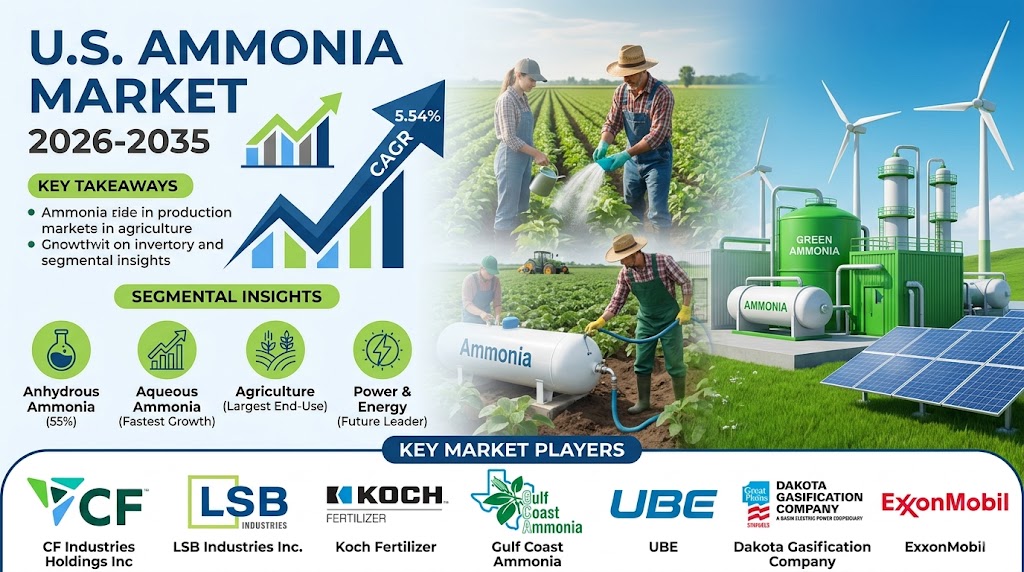
The U.S. ammonia market is entering a transformative decade fueled by rising fertilizer demand, energy transition initiatives, and large-scale investments in low-carbon production technologies. The market is projected to grow from USD 20.85 billion in 2025 to USD 35.75 billion by 2035, expanding at a CAGR of 5.54%. While agriculture remains the dominant consumer of ammonia, emerging applications in hydrogen transportation, power generation, and sustainable fuels are creating new growth avenues. The increasing shift toward green ammonia production supported by federal clean energy incentives is expected to redefine industry dynamics over the next decade.
Market Overview: The Backbone of Agriculture and Next-Gen Energy

Ammonia ($NH_3$) remains one of the most heavily produced industrial inorganic chemicals in the United States. Historically, its footprint was almost entirely tied to the agricultural sector due to its high nitrogen density. However, in 2026, the U.S. ammonia market encompasses far more than crop nutrition. It now plays an essential role in air pollution control systems, water treatment, advanced chemical synthesis, and industrial refrigeration.

Why Is the Market Important?

Ammonia is vital because it sustains global food security. Without localized, large-scale ammonia production, domestic crop yields would drop drastically. Furthermore, ammonia is emerging as a primary pillar of the global decarbonization strategy. Because it possesses a high hydrogen density and is much easier to liquefy and store than pure hydrogen gas, it is fast becoming the preferred hydrogen carrier for long-distance transport and a direct clean fuel source for the maritime and power generation sectors.

Market Dynamics: Shifting Drivers and Constraints

What Are the Key Factors Driving the Market?

  • The Pursuit of Optimal Crop Yields: With shrinking arable land per capita and a growing population, U.S. farmers rely on high-efficiency nitrogen fertilizers to maximize output.

  • The Hydrogen Economy and Maritime Co-firing: Heavy industries and shipping fleets are seeking ways to reduce emissions. Ammonia acts as a carbon-free fuel when burned or cracked back into hydrogen gas.

  • Agrochemical Digitalization: The proliferation of specialized e-commerce platforms allows agricultural buyers to optimize supply contracts and hedge against price volatility.

What Are the Major Market Challenges?

The traditional Haber-Bosch chemical synthesis method combines atmospheric nitrogen with hydrogen derived from steam methane reforming (SMR) of natural gas. This process releases significant amounts of carbon dioxide ($CO_2$). Stringent Environmental Protection Agency (EPA) regulations and corporate net-zero mandates present a stark operational barrier to old-school fossil-fuel-dependent manufacturing. Consequently, traditional producers must retrofit their assets or face rising carbon penalties.

What Are the Key Market Trends?

  • The Rise of Green and Blue Supply Chains: Millions of dollars are pouring into renewable-powered electrolysis (green ammonia) and carbon capture retrofits (blue ammonia).

  • Digitalization of the Supply Chain: The traditional agrochemical broker network is adapting to integrated digital procurement platforms. This shift gives agricultural operators transparent, real-time pricing and better delivery tracking.

What Recent Government Initiatives Are Reshaping the Landscape?

The legislative landscape in the United States acts as a powerful catalyst for change. Production Tax Credits (PTC) for clean hydrogen, along with expanded carbon capture incentives, have fundamentally altered project economics. These federal frameworks lower the investment risk for multi-billion-dollar green and blue ammonia facilities. This financial support helps bridge the price gap between conventional fossil-based production and eco-friendly alternatives.

Segmental Insights: Form, End-Use, and Production Methods

Which Segment Accounted for the Largest Market Share?

The product architecture of the U.S. ammonia market is divided by form, end-use, distribution channel, and production method.

  • By Form: Anhydrous ammonia holds the dominant position, securing a 55% market share. Its high nitrogen concentration allows direct soil injection, making it highly cost-effective for large-scale crop operations. Meanwhile, aqueous ammonia is expanding rapidly across industrial water treatment and power plant flue-gas denitrification systems.

  • By Production Method: Conventional natural gas-based manufacturing still maintains an 80% market share due to low domestic shale gas prices. However, green ammonia is projected to log the highest growth rate during the forecast period.
Strategic U.S. Ammonia Market Segmentation

Dimension Leading Segment (Current Share) Fastest Growing Segment Primary Growth Drivers
Product Form Anhydrous Ammonia (55%) Aqueous Ammonia Direct agricultural application vs. rise in industrial flue-gas scrubbing.
End-Use Industry Agriculture (60%) Power & Energy Basic crop nutrient demands vs. ammonia’s adoption as a zero-carbon maritime fuel.
Distribution Channel Direct Supply & Distributors (70%) Online & Contract Platforms Bulk logistics infrastructure vs. the rapid digitalization of farm procurement.
Production Method Conventional SMR (80%) Green Ammonia (Electrolysis) Abundant domestic natural gas vs. federal decarbonization subsidies.

What Are the Market Benefits of Using Next-Gen Ammonia?

Transitioning to low-carbon ammonia offers several major advantages over traditional formulas:

  1. Lower Scope 1 Emissions: Allows industrial end-users to dramatically reduce the carbon footprint of their chemical supply chains.

  2. Stable Long-Term Pricing: Green ammonia relies on domestic solar and wind energy rather than volatile natural gas commodities, offering corporate buyers more predictable long-term costs.

  3. High-Efficiency Energy Storage: It simplifies the storage of renewable energy over long periods, outperforming lithium-ion battery banks for seasonal utility needs.

Competitive Landscape: Top Companies and Strategic Moves

CF Industries Holdings, Inc.

  • About: Headquartered in Deerfield, Illinois, CF Industries is a premier global manufacturer of hydrogen and nitrogen products, operating some of the largest industrial synthesis complexes in the world.

  • Products: Anhydrous ammonia, urea ammonium nitrate (UAN), granular urea, and diesel exhaust fluid (DEF).

  • Market Cap: Approximately USD 17.34 billion (as of mid-2026).

LSB Industries, Inc.

  • About: A prominent North American chemical company engaged in the manufacturing and distribution of nitrogen-based compounds for agricultural, industrial, and mining end-markets.

  • Products: Agricultural-grade anhydrous ammonia, industrial-grade ammonium nitrate, and nitric acid.

  • Market Cap: Approximately USD 914 million (as of mid-2026).

Koch Fertilizer, LLC

  • About: A subsidiary of Koch Industries, this company operates a vast global network of production facilities and terminal systems, specializing in high-efficiency crop nutrients.

  • Products: Enhanced efficiency fertilizers, anhydrous ammonia, and aqueous solutions.

  • Market Cap: Privately held (Koch Industries’ aggregate annual revenues exceed USD 125 billion).

ExxonMobil Corporation

  • About: A global oil and gas supermajor that has rapidly positioned itself as a major provider of low-carbon energy solutions and hydrogen carrier chemicals.

  • Products: Chemical feedstocks, advanced fuels, and low-carbon blue ammonia.

  • Market Cap: Approximately USD 480 billion.

What Is the Focus of Recent Corporate Developments?

Leading chemical producers are aggressively expanding their low-carbon capabilities through joint ventures and cross-border distribution agreements:

  • ExxonMobil & Marubeni Collaboration (2025): Signed a definitive low-carbon ammonia agreement designed to supply clean energy infrastructure across the United States and Japan.

  • CF Industries, JERA, & Mitsui Consortium (2025): Established a joint development agreement to build a world-scale clean ammonia plant on the U.S. Gulf Coast, accelerating zero-emission power co-firing strategies.

Future Perspective: Where Is the Market Heading?

The U.S. ammonia market is evolving from a pure agricultural input into a vital link in the global clean energy supply chain. Over the next decade, traditional manufacturing will serve as the financial foundation for building out low-carbon infrastructure. As scale drives down the cost of green hydrogen production, clean ammonia will move from niche industrial applications into mainstream utility power generation and international energy logistics. This shift ensures the sector will enjoy steady growth well into 2035.

About Us

Towards Chemical and Materials is a leading global consulting firm specializing in providing comprehensive and strategic research solutions across the chemical and materials industries. With a highly skilled and experienced consultant team, we offer a wide range of services designed to empower businesses with valuable insights and actionable recommendations.

Our Trusted Data Partners

Precedence Research | Statifacts | Towards Packaging | Towards Healthcare | Towards Food and Beverages | Towards Chemical and Materials | Towards Consumer Goods | Nova One Advisor |

For Latest Update Follow Us: https://www.linkedin.com/company/towards-chem-and-materials/

USA: +1 804 441 9344

APAC: +61 485 981 310 or +91 87933 22019

Europe: +44 7383 092 044

Email: sales@towardschemandmaterials.com

Web:  https://www.towardschemandmaterials.com/

Leave a Reply

Your email address will not be published. Required fields are marked *