Executive Summary
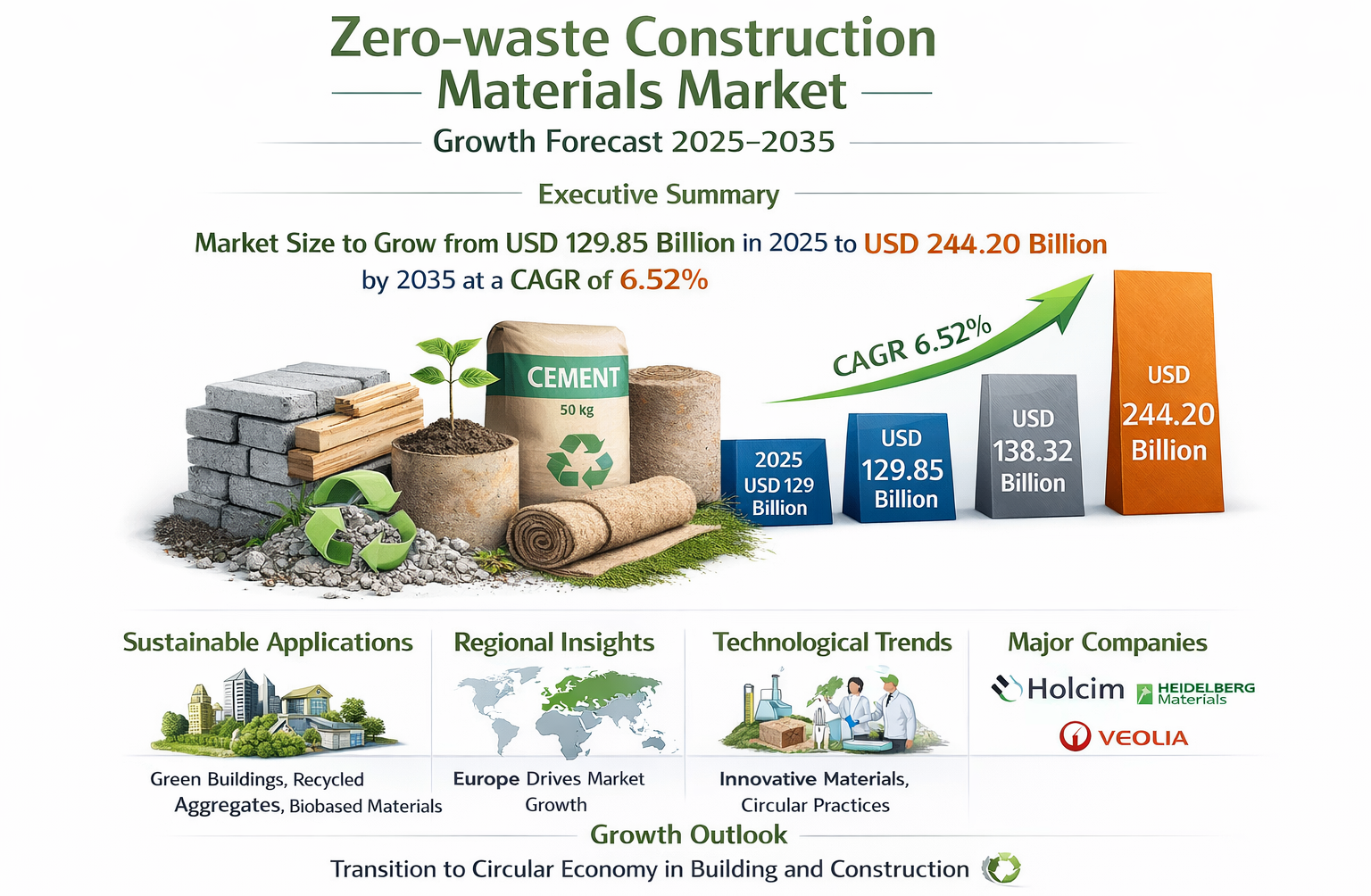
The global zero-waste construction materials market is poised for strong growth, with a market size estimated at USD 129.85 billion in 2025. This market is expected to grow steadily, reaching USD 138.32 billion in 2026 and surging to approximately USD 244.20 billion by 2035, expanding at a compound annual growth rate (CAGR) of 6.52% from 2026 to 2035. The zero-waste construction materials market is driven by the growing demand for sustainable building practices, environmental consciousness in construction projects, and government regulations promoting eco-friendly construction. Key industry drivers include the push for energy-efficient and waste-reducing materials, as well as the increasing adoption of circular economy principles in construction.
What Are the Primary Drivers for the Zero-Waste Construction Materials Market?
1. Rising Demand for Sustainable Building Practices
- Impact: As sustainability becomes a major focus in the construction industry, zero-waste construction materials are increasingly seen as a way to reduce the carbon footprint of buildings and improve energy efficiency.
- Drivers: Government mandates for sustainable building codes, growing environmental awareness among consumers and construction firms, and the desire to meet carbon reduction goals are all contributing to the growing adoption of zero-waste materials.
2. Government Regulations and Incentives
- Impact: Governments worldwide are implementing stricter environmental regulations and offering incentives for green construction. This includes policies targeting waste reduction, energy-efficient buildings, and sustainable material sourcing.
- Drivers: Increased government support for sustainable building projects, tax incentives, and environmental regulations are making zero-waste construction materials more attractive for developers and contractors.
3. Advances in Circular Economy
- Impact: The zero-waste construction materials market aligns with the principles of the circular economy, which focuses on reducing, reusing, and recycling materials to create a closed-loop system that minimizes waste.
- Drivers: Companies are adopting circular construction methods by incorporating recyclable, reusable, and upcycled materials into their projects, reducing the need for virgin materials and promoting the sustainable lifecycle of construction materials.
4. Increased Focus on Green Building Certifications
- Impact: Green building certifications, such as LEED (Leadership in Energy and Environmental Design), are becoming a significant factor in the construction industry. These certifications incentivize the use of sustainable materials, including zero-waste products.
- Drivers: As more developers seek to achieve green building certifications, the demand for zero-waste construction materials has risen, contributing to their widespread adoption in both residential and commercial projects.
Key Segments and Trends
1. By Application
- Residential Construction:
- Market Share: A key segment of the zero-waste materials market, residential construction projects are increasingly adopting sustainable materials to meet consumer demand for eco-friendly homes.
- Growth Drivers: The rise in eco-conscious consumers, coupled with government incentives for energy-efficient homes, is driving the adoption of zero-waste materials in residential buildings.
- Commercial Construction:
- Market Share: Commercial buildings, including offices, retail spaces, and industrial complexes, are seeing an increased use of sustainable materials to meet corporate sustainability goals.
- Growth Drivers: Businesses seeking to enhance their environmental credentials are opting for zero-waste materials in construction projects to align with sustainability objectives and improve their public image.
- Infrastructure Projects:
- Market Share: Infrastructure projects such as bridges, roads, and public utilities are also adopting zero-waste materials as part of broader sustainability initiatives.
- Growth Drivers: Government-funded infrastructure projects are often required to meet green building standards, contributing to the demand for zero-waste materials in public works.
2. By Type of Material
- Recycled Steel:
- Usage: Steel recycling in construction is gaining popularity as it reduces the need for new steel production and minimizes environmental impact.
- Trend: Recycled steel is increasingly used in structural applications, including beams, columns, and reinforcements in construction projects.
- Recycled Concrete:
- Usage: Recycled concrete is being utilized in road construction, pavements, and as aggregate for new concrete products, reducing the need for new raw materials.
- Trend: The use of recycled concrete aligns with sustainable construction practices, helping to reduce waste and lower the environmental impact of construction projects.
- Bamboo:
- Usage: Bamboo is being used as a renewable material for flooring, walls, and other architectural features, offering a sustainable and biodegradable alternative to traditional wood products.
- Trend: Bamboo’s growing popularity as a zero-waste material is a response to the rising demand for sustainable and eco-friendly building materials.
- Sustainable Insulation Materials:
- Usage: Insulation materials made from recycled or natural resources, such as cellulose or sheep’s wool, are increasingly used in zero-waste construction.
- Trend: The demand for energy-efficient homes and buildings is driving the adoption of sustainable insulation materials, which help reduce energy consumption and carbon emissions.
3. By Region
- Asia Pacific:
- Market Share (2025): 40%
- Growth Drivers: Rapid urbanization, growing industrialization, and increasing environmental regulations are driving the adoption of zero-waste construction materials in countries like China, India, and Japan.
- Forecast: The Asia Pacific region is expected to maintain strong growth, especially in residential and infrastructure projects, as the region moves towards more sustainable construction practices.
- North America:
- Growth Drivers: North America is witnessing a steady increase in the adoption of zero-waste materials, particularly in the U.S. and Canada, driven by demand for sustainable construction solutions and government incentives for green buildings.
- Forecast: The U.S. market will see significant growth in the residential and commercial construction sectors, with increasing adoption of zero-waste materials.
- Europe:
- Growth Drivers: Europe remains at the forefront of sustainability initiatives, with stringent environmental policies and a high demand for green buildings driving the use of zero-waste materials in construction projects.
- Forecast: The European market is expected to experience steady growth, particularly in countries such as Germany, the UK, and Sweden, where green building certifications are prevalent.
Emerging Technological Shifts
1. Advanced Recycling Technologies
- Impact: Advances in recycling technology are making it easier to repurpose construction waste into usable materials, reducing the need for new resources.
- Trend: Companies are investing in high-tech recycling facilities to process materials like concrete, metal, and plastic more efficiently.
2. 3D Printing in Construction
- Impact: 3D printing technology is enabling the use of zero-waste materials in the construction of buildings and structures, allowing for precise, waste-free construction.
- Trend: 3D printing is expected to revolutionize construction practices, particularly in small-scale projects and modular buildings, by reducing material waste and enhancing construction efficiency.
3. Sustainable Sourcing and Transparency
- Impact: The demand for transparency in sourcing materials is leading to the development of traceable supply chains for zero-waste materials.
- Trend: More construction companies are adopting digital platforms to track the origin and environmental impact of materials, ensuring they meet sustainability criteria.
Competitive Landscape
The zero-waste construction materials market is fragmented, with a growing number of companies embracing sustainable construction practices:
- Interface, Inc.: A leader in the production of eco-friendly flooring solutions made from recycled materials.
- BASF: Known for developing sustainable building materials and contributing to green construction projects worldwide.
- Saint-Gobain: A global manufacturer offering sustainable building materials and innovative solutions for reducing construction waste.
- Hempel: Focused on providing sustainable coatings and paints that align with zero-waste principles.
- Holcim: A key player in the development of green construction materials, including recycled concrete solutions.
Recent Strategic Moves:
- BASF: Partnered with several green building certification programs to promote the use of its sustainable construction materials.
- Saint-Gobain: Launched a new line of eco-friendly insulation materials, focusing on waste reduction and energy efficiency.
Data Presentation: Zero-Waste Construction Materials Market Overview
| Region | Market Share (2025) | CAGR (2026-2035) | 2025 Market Size (USD Billion) | 2035 Market Size (USD Billion) |
|---|---|---|---|---|
| Asia Pacific | 40% | High Growth | 51.94 | 97.43 |
| North America | 25% | Steady Growth | 32.46 | 61.10 |
| Europe | 22% | Moderate Growth | 28.57 | 53.45 |
| Rest of the World | 13% | Steady Growth | 17.88 | 32.22 |
Conclusion: Future Outlook for the Zero-Waste Construction Materials Market
The zero-waste construction materials market is poised for continued growth, driven by the increasing demand for sustainable and eco-friendly building practices across the globe. As governments continue to implement stringent regulations and incentives for green construction, and as technologies like recycling and 3D printing evolve, the market for zero-waste construction materials will expand significantly. Asia Pacific, North America, and Europe will remain the dominant regions, with the adoption of circular economy principles and sustainable practices continuing to gain momentum in the construction sector.






Leave a Reply