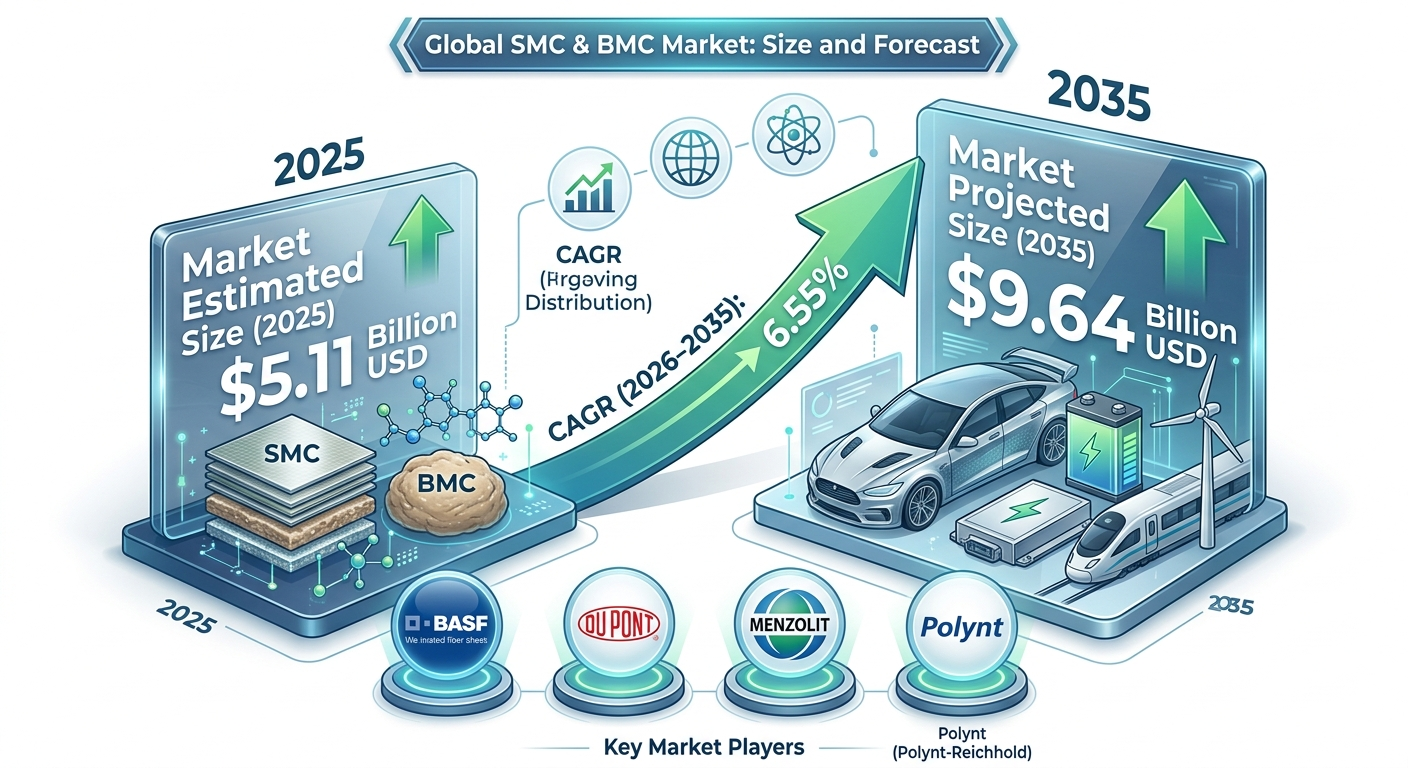
The global sheet molding compound (SMC) and bulk molding compound (BMC) market is entering a pivotal phase of high-performance evolution. Valued at USD 5.11 billion in 2025, the market is projected to reach approximately USD 7.82 billion by 2032, ultimately climbing to USD 9.64 billion by 2035. This expansion reflects a steady CAGR of 6.55% over the 2026–2035 period. Driven by the urgent need for lightweighting in automotive and aerospace sectors, the industry is transitioning toward high-grade, thermoset fiber-reinforced polymer composites that offer exceptional durability and corrosion resistance.
Market Overview & Importance
What is the market and why is it important? The SMC and BMC market encompasses high-performance thermoset composites, blending resins, mineral fillers, and glass or carbon reinforcements. These materials are foundational to modern industrial design, particularly where weight reduction and structural integrity are non-negotiable. Their importance is underscored by their role in the electrical, automotive, and construction sectors, where they replace heavy metals, improve fuel efficiency, and provide long-lasting infrastructure solutions in corrosive environments.
Market Dynamics: Drivers & Trends
What are the key factors driving the market? The primary driver is the global automotive shift toward Electric Vehicles (EVs). Lightweight composite components are essential for extending EV battery range, making SMC and BMC critical materials. Furthermore, rapid industrialization in the Asia Pacific region—which held 41% of the market share in 2025—is accelerating production demand.
What are the key market trends?
-
Technological Integration: The industry is moving toward “smart” manufacturing, incorporating automated composite processing (expected to grow at 8.60% CAGR) to enhance precision.
-
Sustainability Focus: Companies are pivoting toward green chemistry to align with new environmental regulations and satisfy consumer demand for eco-friendly materials.
-
Infrastructure Surge: The Middle East & Africa is emerging as a high-growth region, with a 7.80% CAGR driven by massive infrastructure expansion projects.
Market Segmentation & Strategic Insights
Which segments account for the largest market share?
-
Product Type: SMC dominated with 68% of the market in 2025, favored for its high-strength applications.
-
Fiber Type: Glass fiber remains the primary reinforcement at 71% share due to its automotive utility.
-
End-Use: The automotive segment continues to lead at 39% share, while the aerospace & defense segment is poised for the fastest growth (8.70% CAGR).
| Key Metric | 2025 Data | 2035 Projection | Growth (CAGR) |
| Market Revenue | USD 5.11 Billion | USD 9.64 Billion | 6.55% |
| Market Volume | 2.75 Million Tons | 4.81 Million Tons | 5.75% |
Recent Government Initiatives
Global legislative landscapes are shifting to promote sustainable manufacturing. Governments are increasingly implementing mandates that favor lightweight, recyclable materials to reduce the carbon footprint of transport networks. These policies often include incentives for R&D in green resin technologies and support for advanced manufacturing centers, which directly encourage the adoption of BMC and SMC solutions in public infrastructure and renewable energy components.
Competitive Landscape & Top Companies
The competitive landscape is defined by a shift toward direct procurement models, with direct sales capturing 44% of the market. Leading players are prioritizing innovation in fiber orientation and resin durability.
-
IDI Composites International: A global leader in BMC and SMC materials. (Estimated Market Cap: Private/Subsidiary focus). They provide custom-formulated thermoset molding compounds for complex structural parts.
-
Continental Structural Plastics (Teijin Group): Focused on lightweight automotive body panels. (Market Cap: ~$3B – $4B). Recent moves include expanding high-volume carbon fiber production for the EV market.
-
AOC: A major producer of resins for composite applications. (Market Cap: Private). They focus on sustainability, recently launching bio-based resin alternatives for the construction industry.
Future Outlook & Conclusion
What is the future of the market? The future of SMC and BMC lies in the convergence of material science and digital automation. As we approach 2035, the transition toward carbon fiber (8.90% CAGR) and automated processing will redefine cost-performance benchmarks. For the discerning analyst, the market’s trajectory is clear: it is moving away from generic material supply toward high-value, customized, and sustainable composite systems. Firms that integrate circular economy principles early will dominate the landscape of the next decade.
About Us
Towards Chemical and Materials is a leading global consulting firm specializing in providing comprehensive and strategic research solutions across the chemical and materials industries. With a highly skilled and experienced consultant team, we offer a wide range of services designed to empower businesses with valuable insights and actionable recommendations.
Our Trusted Data Partners
Precedence Research | Statifacts | Towards Packaging | Towards Healthcare | Towards Food and Beverages | Towards Chemical and Materials | Towards Consumer Goods | Nova One Advisor |
For Latest Update Follow Us: https://www.linkedin.com/company/towards-chem-and-materials/
USA: +1 804 441 9344
APAC: +61 485 981 310 or +91 87933 22019
Europe: +44 7383 092 044
Email: [email protected]


Leave a Reply