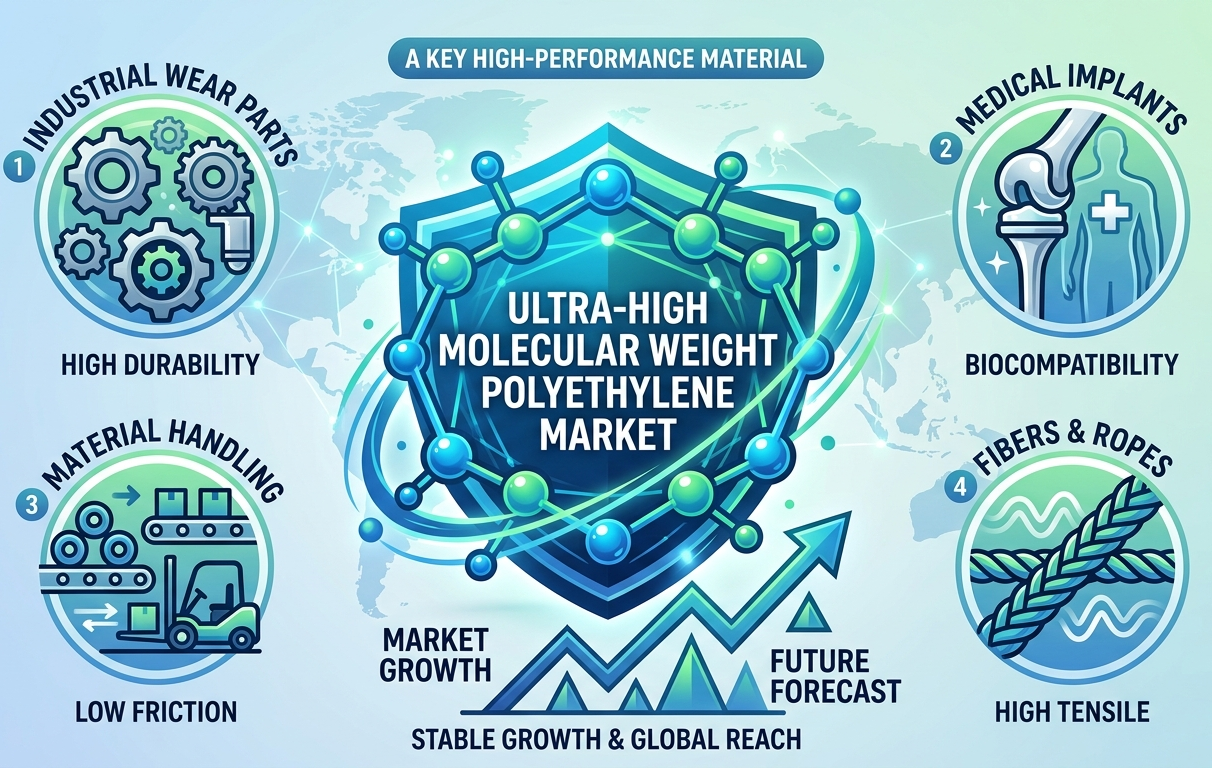
As a Senior Market Research Analyst with over 15 years in high-performance polymers, I have watched Ultra-High Molecular Weight Polyethylene (UHMWPE) evolve from a niche industrial plastic into a critical material for national security and human longevity. The global market was valued at USD 2.95 billion in 2025 and is projected to reach USD 7.34 billion by 2035, expanding at a robust CAGR of 9.55%. This growth is underpinned by an 8.65% volume CAGR, with consumption expected to reach 1.95 million tons by 2035. The convergence of aerospace demands and orthopedic innovation makes this one of the most resilient segments in the advanced materials sector.
Market Overview: The “Super Plastic” Advantage
What is the Ultra-High Molecular Weight Polyethylene Market? It is a specialized sector of the thermoplastic industry focused on polymer chains with molecular masses reaching up to 6 million Daltons. This “long-chain” architecture provides UHMWPE with an unparalleled impact strength and a friction coefficient comparable to Teflon, yet with significantly higher abrasion resistance. As of 2026, the market is characterized by a transition from virgin resins to Modified UHMWPE, which offers enhanced processability for complex geometries in defense and medical sectors.
What is the Current Market Growth?
The market is entering a high-growth phase, estimated at USD 3.23 billion for 2026. Growth is being propelled by the Asia Pacific region, which currently commands 43% of the market. The region’s 10.2% CAGR is driven by massive investments in military modernization and the expansion of healthcare infrastructure in emerging economies. Notably, the Fibers segment is outperforming other forms with a 10.4% CAGR, reflecting the urgent global need for lightweight ballistic materials.
What are the Key Market Trends?
-
Nanotechnology Integration: Incorporating carbon nanotubes into UHMWPE matrices to enhance thermal conductivity and creep resistance for aerospace components.
-
Orthopedic Longevity: The shift toward highly cross-linked UHMWPE in joint replacements to extend implant lifespans beyond 20 years.
-
Gel Spinning Breakthroughs: Innovations in gel spinning are producing fibers with ten times the strength of steel, revolutionizing maritime ropes and heavy-lifting slings.
-
Late Transition Metal Catalysts: New catalytic processes allow for better control over branching, enabling manufacturers to “tune” the resin for specific high-stress industrial applications.
-
Direct-to-Specialist B2B Platforms: While B2B sales dominate (64%), there is a 10.2% growth in specialty online procurement for small-scale precision engineering firms.
What are the Recent Government Initiatives?
Governmental policies are increasingly focusing on self-reliance in “strategic materials,” which includes UHMWPE for defense.
-
India’s “Atmanirbhar Bharat” in Defense: The Ministry of Defence has prioritized the domestic production of UHMWPE for bulletproof jackets and helmets to reduce import dependency.
-
EU Medical Device Regulation (MDR): New, stricter certification pathways for orthopedic materials are forcing a shift toward high-purity, Virgin-grade UHMWPE to ensure patient safety.
-
US Department of Defense (DoD) Modernization: Increased funding for the “Soldier Lethality” program is driving multi-year contracts for UHMWPE-based composite armor.
-
China’s 14th Five-Year Plan: Specifically mentions high-performance fibers as a key development area, providing tax incentives for UHMWPE manufacturing plants in industrial zones.
Market Dynamics: Why Is This Market Important?
UHMWPE is irreplaceable in environments where failure is not an option. From the inner workings of a human hip to the armor protecting a front-line soldier, its high energy absorption and biocompatibility make it a “life-saving” material. Furthermore, its role in the oil and gas sector as a pipeline liner prevents environmental disasters by offering superior chemical and abrasion resistance against corrosive slurries.





Leave a Reply