Executive Summary
The global silicone in personal care market is experiencing structural expansion, driven by a broad transition toward high-performance, functionally advanced beauty and wellness formulations. Valued at USD 3.85 billion in 2025, the market is predicted to rise from USD 4.12 billion in 2026 to approximately USD 7.54 billion by 2035. This projected trajectory represents a compound annual growth rate (CAGR) of 6.95% from 2026 to 2035. Based on this steady growth curve, the market value is estimated to reach approximately USD 6.16 billion by 2032. Simultaneously, total market volume is forecasted to scale from 621.11 thousand tons to 1,128.15 thousand tons over the same period, executing a volume CAGR of 6.15%.
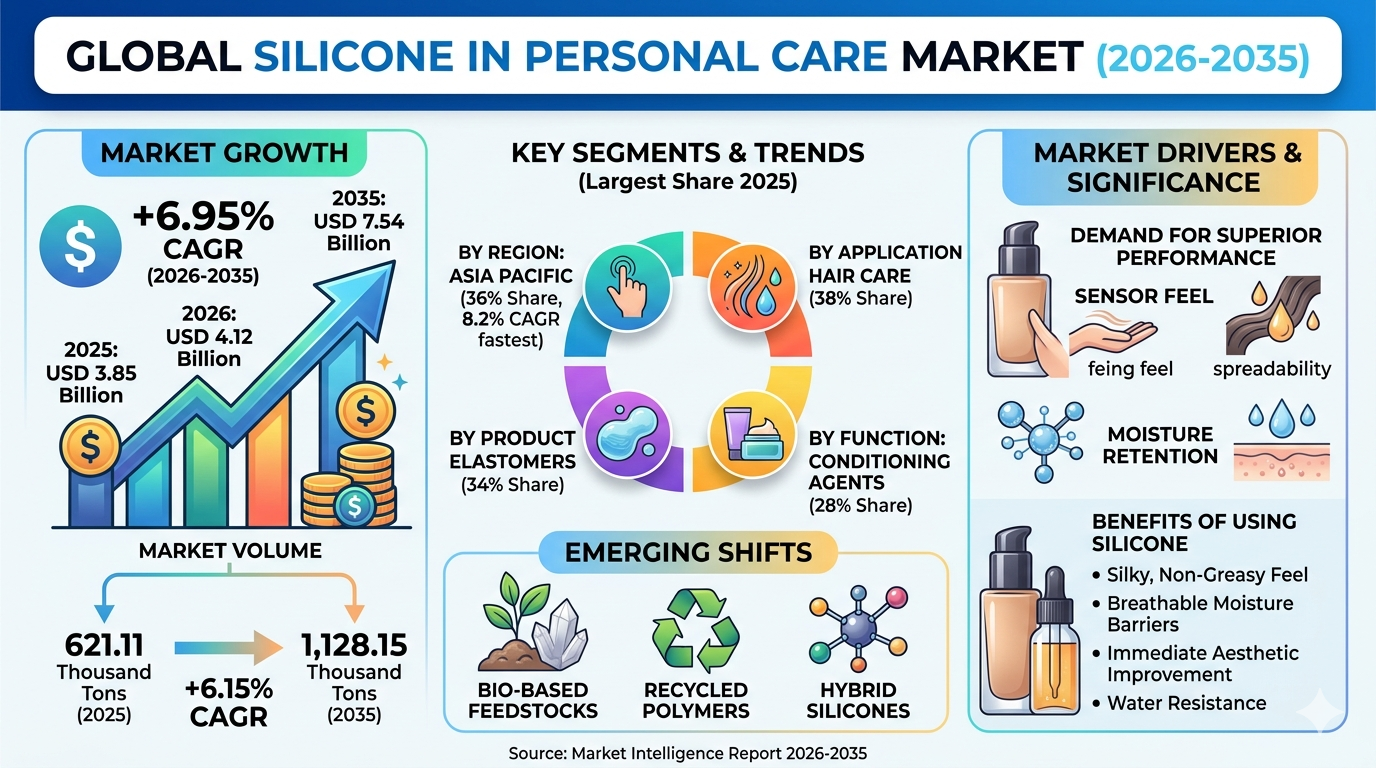
This sustained growth profile is powered by the urgent need for long-lasting performance parameters in skincare and hair care products. It is further amplified by significant demographic demand changes in rapidly urbanizing economies.
Market Overview
What is the significance of the silicone in personal care market?
The silicone in personal care market centers on the manufacturing, scaling, and compounding of specialized siloxane polymers engineered to elevate the performance of consumer cosmetics and skincare. Silicones serve as critical, multifunctioning ingredients that modify structural rheology. They act as superior sensory enhancers by eliminating grease, providing a silky texture, and delivering excellent spreadability, water resistance, and breathable moisture barriers across consumer formulations.
This technology is vital for cross-category personal care applications. It helps consumer brands build better, longer-lasting products that stand out in competitive cosmetic retail spaces.
Market Dynamics & Key Drivers
What are the key factors driving the market?
The primary catalyst driving this market is the consumer demand for high-performance beauty products that offer extended, resilient coverage and comfortable wear. Modern consumers expect premium attributes like water-resistant foundations, sweat-proof sunscreens, and heat-protective hair serums. These features depend heavily on the film-forming and spreadability characteristics of advanced silicones.
Additionally, the rising commercialization of hybrid “skincare-makeup” products is expanding the market. These formulations use specialized silicone structures to deliver active nourishing ingredients while instantly hiding cosmetic blemishes and skin imperfections.
Key Market Trends
What are the primary market trends?
The most significant trend reshaping the sector is the dual focus on high performance and environmental safety. While traditional volatile silicones face strict regulatory scrutiny, the market is moving quickly toward developing biodegradable silicones and eco-friendly alternatives.
Technologically, the industry is transitioning away from standard linear siloxanes and toward sophisticated hybrid silicone structures. These innovations combine organic components with traditional inorganic silicone bases. This design helps cosmetic chemists meet clean beauty standards without losing the silky texture and protective qualities that consumers expect.
Market Benefits & Product Importance
Why is this market important, and what are the benefits of using silicone?
Silicone chemistry is unique because it blends extreme chemical flexibility with strong biocompatibility. Unlike natural vegetable oils, which can oxidize quickly and leave a heavy, sticky residue, silicones are highly stable. They form an invisible, breathable mesh on skin and hair, locking in moisture while letting gases pass through naturally.
The primary benefit lies in their exceptional sensory texture. They significantly reduce the stickiness of thick skin lubricants, improve the smooth application of pigmented makeup, and provide deep hair conditioning without weighing down fine hair strands.
Recent Government Initiatives
What recent government initiatives are impacting the market?
Environmental and chemical regulatory agencies globally are introducing stricter rules for volatile organic compounds (VOCs) and cyclic siloxanes. The European Chemicals Agency (ECHA) and the U.S. Food and Drug Administration (FDA) continue to update safety assessments for specific cyclic silicones (like D4, D5, and D6) in wash-off and leave-on cosmetic products.
These shifting compliance standards are forcing chemical producers to redesign their manufacturing processes. They are investing heavily in strict purification steps and bio-based raw materials to meet regional safety and eco-toxicity certifications.
Market Segmentation Analysis
Which segment accounted for the largest market share?
An assessment of the market reveals distinct leadership profiles across all major analytical categories:
-
Regional Dominance: The Asia-Pacific region led the market with a 36% share in 2025 and is projected to grow the fastest at an 8.20% CAGR. North America followed, holding a 23% market share in 2025.
-
Product Type: Elastomers dominated the market with a 34% share in 2025. However, the resins segment is expected to grow the fastest, showing a 7.80% CAGR.
-
Functional Application: Conditioning agents held the largest share at 28% in 2025. Film formers are forecasted to see the fastest growth with a 7.90% CAGR.
-
End-Use Segment: Hair care led cosmetic applications with a 38% share in 2025, while color cosmetics is the fastest-growing segment at a 7.90% CAGR.
-
Consumer Demographics: The mass market segment held a dominant 52% share in 2025. The premium/luxury category is projected to grow the fastest at a 7.80% CAGR.
-
Distribution Channel: Offline retail dominated with a 63% share in 2025. The online e-commerce segment is expected to expand the fastest at an 8.30% CAGR.
Strategic Data Reference
The data table below summarizes the key metrics, growth parameters, and market shares across the global silicone in personal care landscape.




Leave a Reply