The global polyolefin sheets in industrial market is undergoing a structural expansion, functioning as a primary thermoplastic material pillar for high-performance engineering, modern logistics, and containment infrastructure. Valued at USD 8.95 billion in 2025, the market is estimated to reach USD 9.48 billion in 2026 and is projected to expand to USD 15.95 billion by 2035. This trajectory represents a compound annual growth rate (CAGR) of 5.85% over the forecast period from 2026 to 2035.
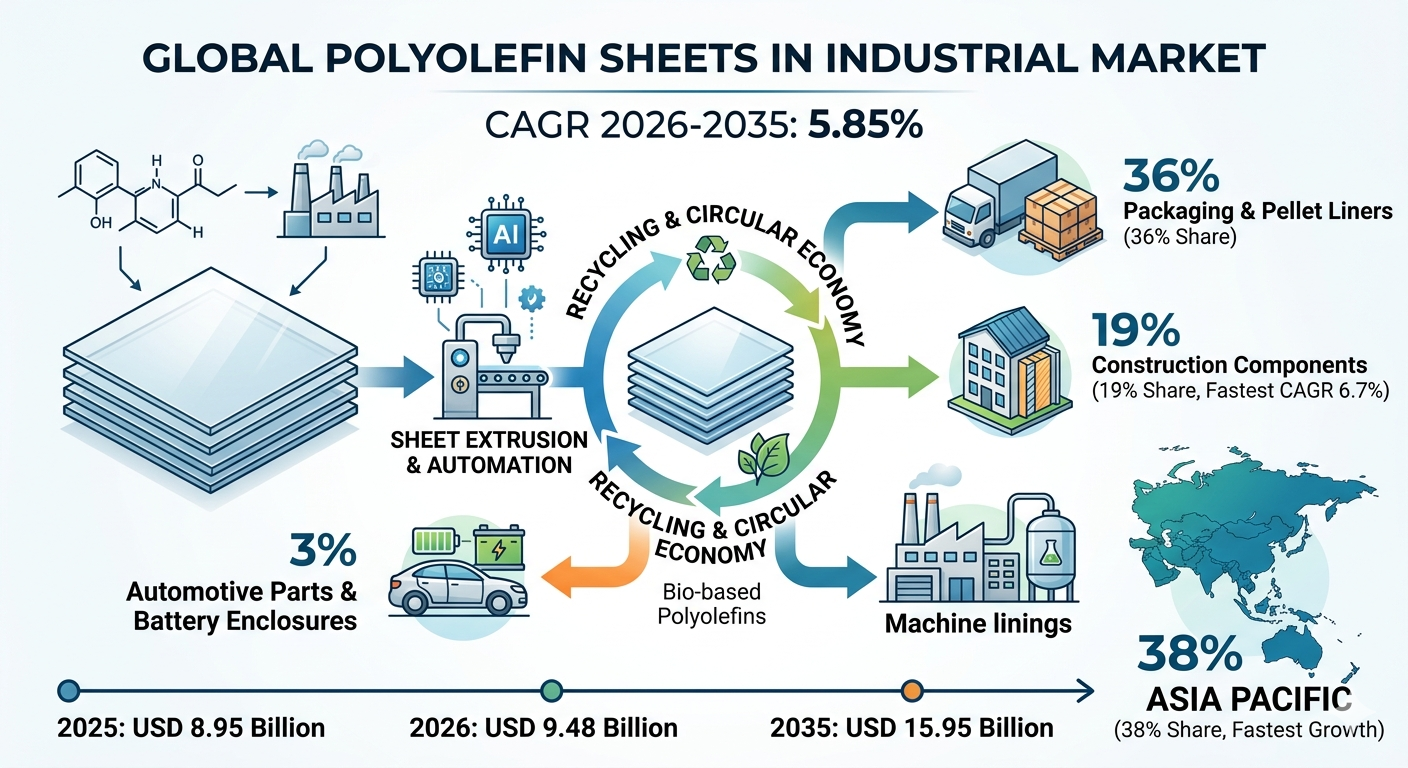
In terms of physical volume, demand is anticipated to climb from 2.11 million tons in 2025 to 3.59 million tons by 2035, registering a volume CAGR of 5.45%. Growth is heavily anchored in the Asia-Pacific region, driven by rapid urbanization, high-volume shipping requirements, and an industrial pivot toward automated, low-emission extrusion technologies.
Market Overview
Why Is the Polyolefin Sheets Market Important?
Polyolefin sheets, primarily consisting of high-density polyethylene (HDPE), polypropylene (PP), and advanced elastomer formulations, are indispensable to the global heavy industrial framework due to their remarkable chemical inertness, high strength-to-weight ratio, and absolute moisture impermeability. Without these specialized, extruded sheets, the modern logistics sector would lack puncture-resistant pallet liners, chemical processing plants would lack reliable anti-corrosive secondary containment vessels, and civil engineering would face massive structural moisture infiltration without durable sub-slab vapor barriers.
Furthermore, polyolefin sheets represent an eco-conscious material base that is fully compatible with established mechanical and chemical recycling streams, allowing heavy industries to drastically lower their landfill footprints.
What Is the Core Structure of the Polyolefin Sheets Market?
The industrial market for polyolefin sheets operates as a deeply integrated B2B value chain that transitions raw olefin monomers through high-pressure polymerization into high-output extrusion and sheet fabrication facilities. Standard polyethylene variations continue to capture the baseline of physical volume, while automated industrial manufacturing sectors demand specialized, thinner, high-tenacity co-extruded sheets to reduce material consumption while maintaining rigid safety standards.
Geographically, the market serves as a critical logistical link connecting raw shale-derived ethylene and propylene feedstocks with high-volume electronic mobility production lines, global e-commerce fulfillment hubs, and heavy mining infrastructure.
Market Dynamics
What Are the Key Factors Driving the Market?
-
Widespread Metal and Wood Substitution: Heavy industries are rapidly replacing heavy, corrosion-prone sheet metals and short-lived wood panels with advanced polyolefin sheets due to their exceptional strength-to-weight ratios and superior chemical stability.
-
Booming E-Commerce and Logistical Automation: The expansion of international supply chains has greatly escalated the demand for reusable packaging materials, moisture-proof warehouse wraps, and high-strength pallet liners.
-
Surging Demand for Electric Mobility Component Insulation: The rapid scaling of global electric vehicle (EV) manufacturing is driving high-volume demand for non-conductive, flame-retardant polypropylene sheets to construct lightweight battery enclosures.
What Are the Primary Restraints Limiting Polyolefin Sheets Adoption?
-
Raw Material Volatility: Polyolefin production remains structurally tied to upstream crude oil, natural gas, and naphtha cracking processes. Rapid price fluctuations in these commodities disrupt long-term supply contracts and create margin pressures for standard sheet extruders.
-
Capital Cost Barriers for Advanced Co-Extrusion Machinery: Transitioning factory operations to produce high-performance, ultra-thin, or multi-layer functionalized sheets requires massive capital expenditure on high-speed extrusion lines and automated thickness monitors.
What Are the Key Market Trends?
The structural evolution of this industry is highlighted by the rise of bio-based polyolefins derived from renewable feedstocks and the integration of artificial intelligence into automated extrusion plants. AI-driven predictive modeling is increasingly applied to simulate physical material performance before synthesis, allowing laboratories to optimize chemical formulations in a fraction of the time.
Concurrently, a massive trend toward digital asset visibility has introduced smart data-driven barrier sheets that embed RFID chips and conductive ink sensor circuits right into the polyolefin layer to monitor transit variables in real time.
Market Segments & Insights
Which Segment Accounted for the Largest Market Share?
The Polyethylene (PE) segment and the Packaging & Pellet Liners application segment dominated their respective fields, capturing 54% and 36% of the global revenue shares in 2025. This massive share is driven by polyethylene’s cost-effectiveness, deep compatibility with heavy-gauge extrusion lines, and its structural role as the preferred choice for industrial shipping barriers and moisture-proof protective liners.
2025 Market Share Breakdown
| Segment Category | Sub-Segment Name | 2025 Revenue Share (%) | Key Drivers & Performance Attributes |
| Product Type | Polyethylene (PE) | 54% | Superior chemical resistance, high cost-efficiency, and absolute recyclability. |
| Product Type | Polypropylene (PP) | 33% | Exceptional surface rigidity and heat tolerance; fastest product CAGR at 6.4%. |
| Product Type | Others (Elastomers/EVA) | 13% | Low-friction blends tailored for mining chutes and flexible industrial components. |
| Application | Packaging & Pellet Liners | 36% | Vital for puncture-resistant export containment and reusable pallet separation. |
| Application | Chemical Storage & Containment | 24% | Replaces steel and concrete via leakproof, hot-gas welded plastic joints. |
| Application | Construction Components | 19% | High-gauge vapor barriers; expanding at the fastest CAGR of 6.7%. |
| Application | Machine Linings | 14% | Self-lubricating panels used to maximize material flow in mining and agriculture. |
| Geographic Region | Asia Pacific | 38% | Leading regional manufacturing core; projected to grow at a 7.20% CAGR. |
What Is the Segment Growth Outlook?
The Polypropylene (PP) segment is projected to grow at the fastest product-based CAGR of 6.4% through 2035, driven by its structural toughness and excellent heat resistance inside automated automotive assemblies.
From an application perspective, the construction components segment is tracking the fastest expansion at a 6.7% CAGR. This rapid rise is accelerated by the widespread adoption of heavy-gauge HDPE protective walls and green-certified sub-slab membranes designed to safeguard foundational concrete from harmful soil chemistry.
Regional Insights
How Did Asia Pacific Dominate the Polyolefin Sheets Market?
The Asia Pacific region securely led the global marketplace with a dominant 38% revenue share in 2025 and is projected to expand at the fastest regional CAGR of 7.20% during the forecast window. Valued at USD 3.40 billion regionally in 2025 and marching toward USD 6.14 billion by 2035, its leading position is driven by large-scale infrastructure investments and high-volume sheet processing operations in China and India.
China remains a core engine for electric vehicle battery enclosure manufacturing, utilizing advanced polypropylene sheets on a massive scale. Meanwhile, India’s ongoing industrial modernization has drastically increased the use of heavy-duty sub-slab HDPE vapor barriers across modern real estate projects.
Western and Latin American Regional Dynamics
Europe held a significant 24% market share in 2025, with a projected 5.30% CAGR heavily focused on premium, ultra-thin sheet developments and industrial chemical recycling infrastructures. This enables German and Italian manufacturers to meet strict EU requirements regarding post-consumer plastic scrap reuse.
North America accounted for 22% of global revenue in 2025, driven by rapid shale-driven ethylene processing in the United States and strict vehicle lightweighting laws. Latin America (9% share) is maintaining a steady growth curve anchored by agricultural shipping needs in Brazil and heavy mining infrastructure lining projects throughout Argentina.
Benefits of Using Advanced Polyolefin Sheets
-
Outstanding Chemical and Structural Longevity: Industrial-grade polyolefin sheets exhibit extreme chemical resistance, completely resisting corrosion when exposed to harsh industrial acids and soil chemicals.
-
Substantial Vehicle Lightweighting Advantages: Replacing old metal panels with lightweight polypropylene sheets inside heavy transport networks and automotive designs significantly increases fuel efficiency and expands EV driving range.
-
Superior Environmental Barrier Performance: High-density polyethylene formulations show excellent puncture resistance and complete moisture proofing, serving as dependable barriers to stop hazardous chemical leaks.
-
Perfect Alignment with Circular Value Chains: Because polyolefins are highly recyclable through existing manufacturing loops, they allow factories to recover industrial scrap, minimizing waste and lowering their carbon footprint.
Competitive Landscape
Top Companies in the Polyolefin Sheets Market
Grafix Plastics (US)
-
About: A specialized American plastic sheet converter and distributor, focusing on precision finishing for diverse industrial and architectural sectors.
-
Products: High-clarity specialty polyethylene sheets, dimensional films, and custom-cut industrial barrier sheets.
-
Market Capitalization: Privately held company; estimated annual revenues exceed USD 25 million.
Mapal Plastics (IL)
-
About: A prominent international manufacturer specializing in high-quality extruded polypropylene sheets for agricultural, packaging, and industrial lining industries.
-
Products: Corrugated polypropylene boards, anti-static packing sheets, and weather-resistant agricultural liners.
-
Market Capitalization: Privately held corporation; key supplier to global e-commerce and automotive supply chains.
Trident Plastics, Inc. (US)
-
About: One of the largest independent industrial plastic distributors and sheet fabricators in North America, running advanced CNC machining facilities.
-
Products: Heavy-gauge HDPE sheets, UHMWPE wear-resistant linings, and custom thermoformed engineering components.
-
Market Capitalization: Private enterprise; estimated annual distribution value surpasses USD 60 million.
Ensinger, Inc. (DE)
-
About: A major global engineering plastic corporation that develops, manufactures, and distributes high-performance compounds and semi-finished shapes.
-
Products: Industrial-grade TECAFINE PE and PP extruded sheets, flame-retardant specialized sheets, and precision-machined guide rails.
-
Market Capitalization: Privately owned multinational conglomerate with global revenues exceeding EUR 600 million.
Duroplastic Technologies (ZA)
-
About: A leading supplier of composite materials and extruded thermoplastic sheets, serving industrial building markets across Africa.
-
Products: High-density protective wall panels, moisture-proof vapor barriers, and industrial packaging wraps.
-
Market Capitalization: Privately held entity; major developer of industrial infrastructure projects in sub-Saharan regions.
What Is the Status of Recent Strategic Developments?
The competitive framework showcases active manufacturing investments centered around cold durability, material toughness, and improved surface protection:
-
October 2025: Petrochemical leader LyondellBasell introduced Pro-fax EP410C, a highly durable polypropylene resin designed specifically for advanced extrusion and packaging sheets. This material delivers excellent cold-temperature impact strength and high melt strength, allowing manufacturers to produce tougher, thinner industrial shipping containers and protective liners.
-
February 2025: Intertape Polymer Group (IPG) expanded its commercial surface protection product line by introducing its new American® brand Plastic Sheeting. This high-performance product launch provides heavy industries with a cost-effective solution featuring superior tear resistance for demanding warehouse environments.
What Is the Regulatory Landscape Governing Polyolefin Sheets?
The industrial production, use, and disposal of polyolefin sheets are governed by strict international environmental and workplace safety frameworks:
-
European Union: The REACH Regulation, Packaging and Packaging Waste Regulation (PPWR), and the EU Green Claims Directive strictly monitor chemical catalyst safety during plastic extrusion. These directives mandate verified lifecycle assessments for pallet liners and push factories toward using certified post-consumer recycled content.
-
North America: The EPA TSCA and OSHA standards strictly limit VOC emissions during polymer processing. These regulations place clear limits on hazardous chemical risk profiles while setting formal guidelines for gathering post-industrial sheet scrap.
-
Asia-Pacific: National standardization boards, including India’s BIS Mandates and Japan’s MHLW Positive List System, enforce clear purity criteria. These standards eliminate hazardous heavy-metal migration out of high-density polyethylene sheets inside public infrastructure.
What Are the Recent Government Initiatives Supporting the Market?
Governments around the world are implementing strict policies targeting non-recyclable industrial plastics, which is driving a major pivot toward polyolefin sheets. In the European Union, the rollout of strict packaging waste targets has pressured major logistics companies to completely phase out single-use films in favor of reusable, heavy-gauge polyolefin pallet liners.
In the United States, federal infrastructure funding favors civil engineering projects that integrate certified HDPE sub-slab vapor barriers to ensure long-term concrete preservation. Concurrently, national green subsidies across Asia-Pacific are supporting plastic recycling plants that focus on reclaiming post-industrial polyolefin scraps, helping to lower carbon footprints across manufacturing regions.
What Is the Future of the Market?
The future of the polyolefin sheets in the industrial market will be shaped by the growth of bio-refining technologies and the widespread use of intelligent, automated extrusion systems. Over the next ten years, standard petroleum-derived polymer resins will increasingly be blended with or replaced by renewable bio-based polyolefins to meet strict carbon reduction milestones.
At the same time, artificial intelligence will shift from simply tracking material stability to controlling entire multi-layer co-extrusion factories autonomously, ensuring absolute uniformity in ultra-thin sheets. While standard polyethylene sheets will continue to see steady high-volume use in traditional warehousing settings, the industry’s economic value will increasingly shift toward smart, functionalized data sheets and specialized flame-retardant panels. This evolution will completely redefine modern industrial asset protection and global supply chain transparency through 2035.
About Us
Towards Chemical and Materials is a leading global consulting firm specializing in providing comprehensive and strategic research solutions across the chemical and materials industries. With a highly skilled and experienced consultant team, we offer a wide range of services designed to empower businesses with valuable insights and actionable recommendations.
Our Trusted Data Partners
Precedence Research | Statifacts | Towards Packaging | Towards Healthcare | Towards Food and Beverages | Towards Chemical and Materials | Towards Consumer Goods | Nova One Advisor |
For Latest Update Follow Us: https://www.linkedin.com/company/towards-chem-and-materials/
USA: +1 804 441 9344
APAC: +61 485 981 310 or +91 87933 22019
Europe: +44 7383 092 044
Email: [email protected]


Leave a Reply