| Market Attribute |
2025 Base Value |
2026 Estimate |
2035 Projection |
Forecast CAGR (2026–2035) |
| Market Value (USD) |
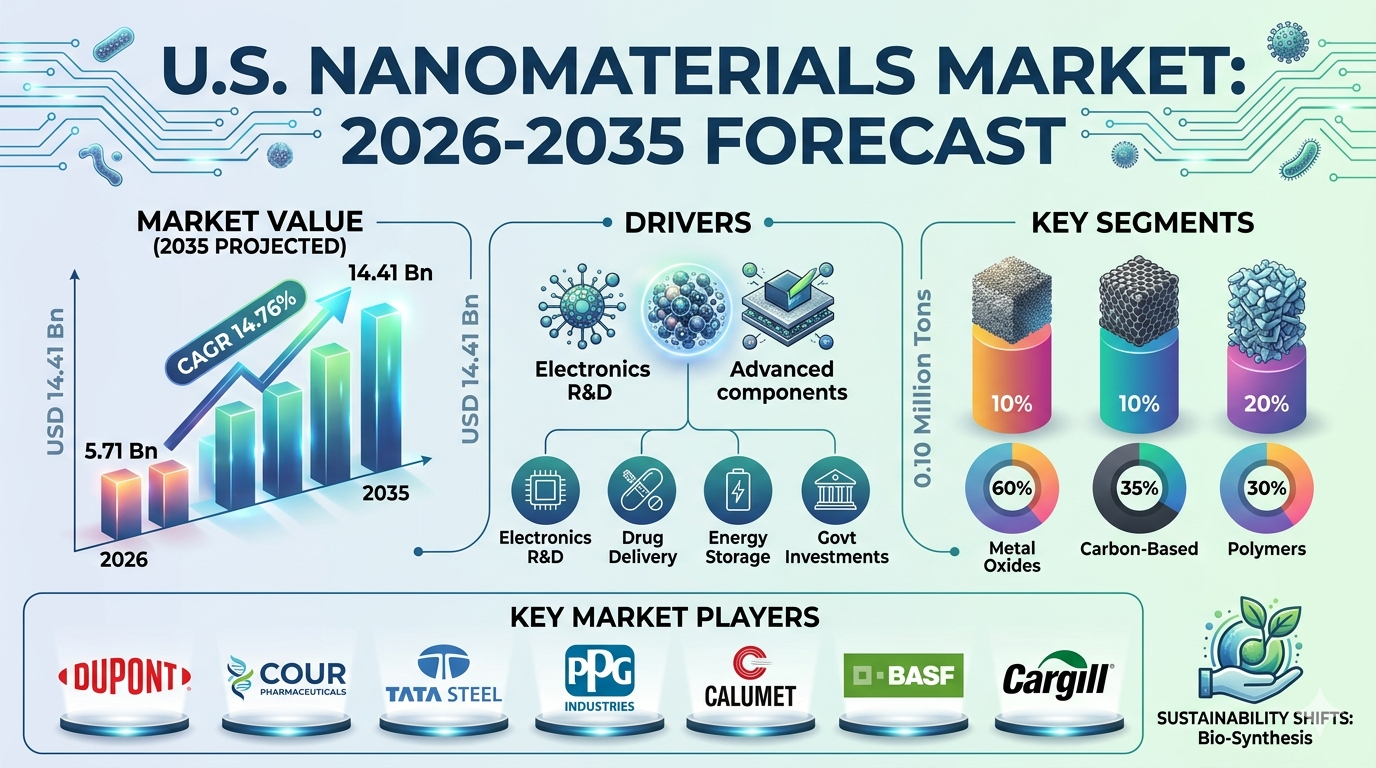
$4.98 Billion |
$5.71 Billion |
$14.41 Billion |
14.76% |
| Market Volume (Tons) |
0.03 Million |
0.032 Million* |
0.083 Million |
10.65% |
| Avg. Manufacturing Value |
$4.50 Billion |
— |
— |
— |
| Avg. Selling Value |
$9.45 Billion |
— |
— |
— |
Market Dynamics: Analyzing Drivers, Trends, and Benefits
What Are the Key Factors Driving the Market?
The expansion of the U.S. nanomaterials sector is driven by five distinct factors:
-
Government R&D Funding: Steady injections of capital from federal agencies through the National Nanotechnology Initiative (NNI) ensure that foundational research moves efficiently toward commercialization.
-
Targeted Biological Therapies: The medical sector’s transition toward personalized healthcare depends on nanoparticle-based drug delivery systems that can navigate biological barriers without harming healthy tissue.
-
High-Tech Electronic Componentry: The relentless push toward smaller, faster semiconductor architectures relies heavily on nanostructured logic gates, films, and interposers.
-
Advanced Energy Storage Requirements: Next-generation lithium-ion, solid-state, and hydrogen storage systems use nanomaterials to increase energy density and accelerate charge-discharge cycles.
-
Commercialization Scale-Up: Production methods are shifting from low-volume batch processing to continuous, highly automated synthesis lines, lowering unit costs and enabling broader commercial use.
What Is the Crucial Benefit of Using Nanomaterials?
From a materials science perspective, the primary benefit of using nanomaterials lies in the ability to achieve unprecedented performance gains without adding dead weight or excess bulk to a system. Due to their extreme surface-area-to-volume ratios and quantum confinement effects, adding even a fraction of a percent of carbon nanotubes or metal-oxide nanoparticles can drastically alter an end product’s electrical conductivity, thermal dissipation, mechanical tensile strength, and chemical barrier properties. This allows industrial manufacturers to build products that are simultaneously lighter, stronger, and more energy-efficient than those made with conventional polymers or alloys.
What Are the Key Market Trends and Sustainability Shifts?
The most significant trend reshaping the U.S. market is the push for sustainable synthesis. Historically, nanomaterial production relied on harsh chemical reduction agents, energy-intensive vapor deposition, and volatile organic solvents. Today, regulatory pressures and corporate environmental goals are driving a shift toward bio-based synthesis, green solvents, and renewable feedstocks.
This transition is highly visible in the biomedical and consumer spaces, where companies are adopting enzymatic or botanical synthesis pathways to avoid toxic residues. While physical manufacturing methods—such as top-down milling and laser ablation—held a dominant 34.66% market share in 2025 due to their reliability, the biological & green synthesis segment is projected to grow at the fastest CAGR through 2035.
What Are the Recent Government Initiatives Supporting the Market?
Federal and state governments across the U.S. are implementing targeted policies to secure domestic nanotechnology supply chains and ensure safety. Key regional growth areas like Texas, New York, and California are leveraging state-level high-tech grants alongside federal funding to construct open-access nanoscale fabrication cleanrooms.
Concurrently, the U.S. Environmental Protection Agency (EPA) and the Food and Drug Administration (FDA) are standardizing structural testing protocols. These updated frameworks clarify commercialization pathways, providing corporate investors and venture capital firms with the regulatory certainty needed to fund large-scale projects.
Material Type Analysis
The metal & metal oxide nanoparticles segment—including materials like nano-silica, titanium dioxide, and zinc oxide—held a dominant 33.64% value share in 2025. This strong position stems from widespread use in sunscreens, industrial coatings, and automotive catalysts.
However, carbon-based nanomaterials (such as graphene, multi-walled carbon nanotubes, and fullerenes) are projected to expand at the fastest CAGR over the forecast period. This rapid growth is driven by their excellent electrical conductivity and mechanical properties, making them ideal for reinforcing structural composites and EV battery anodes.
Product Form and End-Use Industry Breakdown
Dry nanopowders represented the primary commercial form in 2025, capturing approximately 41.58% of the market share due to their ease of bulk transportation and dry blending compatibility. Despite this, liquid-phase nanosuspensions & colloids are expected to register the fastest growth through 2035. This shift reflects a growing demand for stable, ready-to-use liquid mixtures that eliminate dust hazards during manufacturing and ensure uniform dispersion in liquid resins or pharmaceutical formulations.
In terms of consumption, the electronics sector led the market with a 29.84% share in 2025, driven by quantum-dot displays and semiconductor CMP (chemical mechanical planarization) slurries. Looking ahead, secondary application segments grouped under “Others”—such as functionalized smart textiles, UV-blocking cosmetics, and active food packaging films—are expected to achieve the fastest compound growth rates.
Competitive Landscape: Strategic Moves and Corporate Portfolios
The competitive landscape of the U.S. nanomaterials market is characterized by strategic capital deployment, deep patent portfolios, and focused R&D spending. Corporate investors and venture capital firms are steadily funneling money into the sector, drawn by its diverse applications in electronics, clean energy, and modern medicine.
Rather than engaging in traditional price competition, leading market players are focusing on surface-functionalized materials that offer higher performance margins and longer customer integration cycles. Strategic partnerships between chemical giants and niche biotech or electronics firms are becoming common as companies work to shorten the time it takes to bring advanced nanomaterials to market.
Key Market Players
1. DuPont de Nemours, Inc.
-
About: DuPont is an American multinational specialized materials producer formed via deep industrial heritage, known for its focus on high-margin, technology-driven applications in electronics, automotive, and water filtration.
-
Products: Portfolio includes specialized semiconductor wafer polishing products, copper/tungsten CMP slurries, dielectric nano-materials, and advanced optical films.
-
Market Capitalization: Approximately USD 34.50 Billion (Reflecting diversified specialty chemical industrial positioning).
-
Recent Strategic Move: DuPont has increased capital allocations for the R&D of its nano-based product range, focusing heavily on next-generation semiconductor fabrication lines and electronic packaging materials.
2. COUR Pharmaceuticals
-
About: COUR Pharmaceuticals is a clinical-stage American biotechnology company specializing in the development of first-in-class, antigen-specific immune tolerance therapies designed to reprogram the human immune system.
-
Products: Proprietary COUR Nanoparticles (CNPs) made from an FDA-approved, biodegradable polymer matrix encapsulating disease-specific antigens.
-
Market Capitalization: Private entity (Successfully closed a major USD 105 million Series A funding round to advance its clinical therapeutic pipeline).
-
Recent Strategic Move: Cour Pharmaceuticals is pioneering sustainable medicine by utilizing a bio-based process to produce specialized nanoparticles tailored to treat complex autoimmune conditions, recently entering into high-profile licensing agreements with Genentech.
3. Tata Steel (U.S. & International Operations)
-
About: Tata Steel is a global steel manufacturing giant that produces premium functionalized alloys and advanced carbon-coated metals for the automotive, construction, and packaging sectors.
-
Products: Nano-engineered high-strength steels, corrosion-resistant surface coatings, and carbon nanotube conductive composite additives.
-
Market Capitalization: Approximately USD 26.80 Billion.
-
Recent Strategic Move: Tata Steel is capitalizing on the January 2026 zero-tariff proposal on iron and steel products between the U.S., European Union, and India, leveraging this regulatory shift to expand its high-tech, nano-enhanced specialty alloy trade flows across international markets.
Future Outlook: A Forward-Looking Perspective
The future of the U.S. nanomaterials market will be defined by intelligent, multi-functional material architectures. We are moving past the era of simple, single-ingredient nanoparticles used merely as bulk additives. The next phase of market expansion will focus on smart nanomaterials capable of reacting dynamically to environmental stimuli, such as self-healing protective coatings, real-time diagnostic drug carriers, and adaptive energy storage matrices.
As green synthesis methods reach industrial scale and manufacturing costs fall, nanomaterials will integrate deeper into everyday commercial items. For materials analysts, industrial developers, and institutional investors, the U.S. market represents a highly dynamic ecosystem where advanced scientific research is rapidly translating into valuable commercial opportunities.
About Us
Towards Chemical and Materials is a leading global consulting firm specializing in providing comprehensive and strategic research solutions across the chemical and materials industries. With a highly skilled and experienced consultant team, we offer a wide range of services designed to empower businesses with valuable insights and actionable recommendations.
Our Trusted Data Partners
Precedence Research | Statifacts | Towards Packaging | Towards Healthcare | Towards Food and Beverages | Towards Chemical and Materials | Towards Consumer Goods | Nova One Advisor |
For Latest Update Follow Us: https://www.linkedin.com/company/towards-chem-and-materials/
USA: +1 804 441 9344
APAC: +61 485 981 310 or +91 87933 22019
Europe: +44 7383 092 044
Email: sales@towardschemandmaterials.com
Web: https://www.towardschemandmaterials.com/



Leave a Reply