Executive Summary
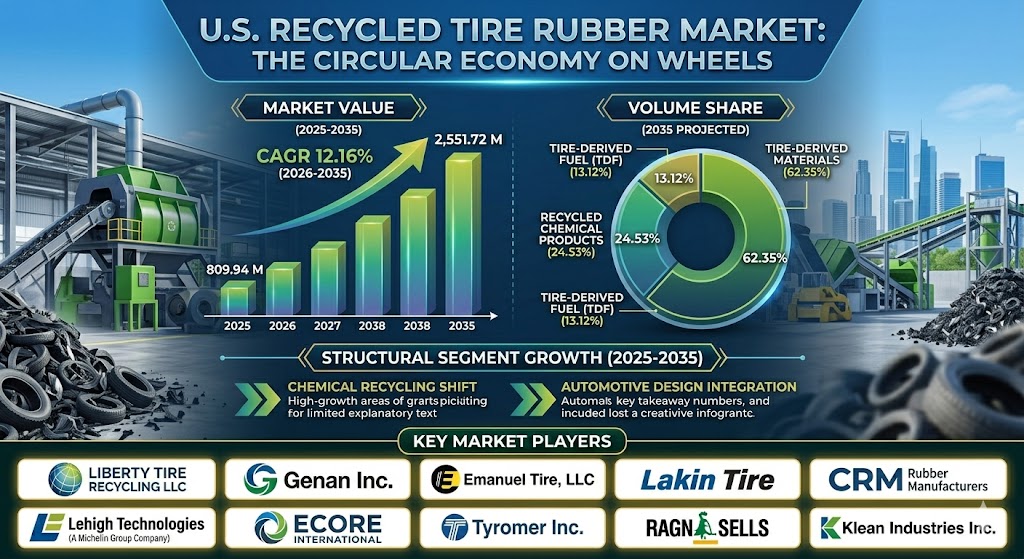
The U.S. recycled tire rubber market represents a high-velocity sustainability asset class. The domestic market value was valued at USD 809.94 million in 2025 and is projected to expand from USD 908.43 million in 2026 to a projected USD 2,551.72 million by 2035. This dynamic trajectory represents a compound annual growth rate (CAGR) of 12.16% over the 2026–2035 forecast window.
In terms of physical mass, processing volumes are expected to increase from 4.53 million tons in 2026 to 8.93 million tons by 2035, expanding at a volume CAGR of 7.84%. Looking ahead to intermediate milestones, the market is on track to reach an estimated valuation of USD 1.76 billion by 2032, driven by the commercialization of high-value chemical products and infrastructure spending.
Market Overview: What Defines the Recycled Tire Rubber Landscape?
Recycled tire rubber encompasses materials produced by collecting, processing, and modifying end-of-life passenger and commercial vehicle tires rather than sending them to landfills. By converting scrap tires into specific vulcanized states—ranging from coarse shreds and custom-sized granules to fine, micronized rubber powders and soft sheets—the sector has significantly enhanced its market readiness.
Modern recycled rubber functions as a direct substitute for virgin synthetic elastomers and fossil-derived polymers. It delivers notable value by lowering raw material production costs and significantly reducing environmental damage across downstream material supply chains.
Market Dynamics: What Are the Key Factors Driving the Market?
The Shift from Low-Value Waste Handling to High-Value Product Engineering
Historically, scrap tires were mostly down-cycled into low-value applications or used as primary fuel sources. Today, the regional market’s growth is driven by a structural shift toward high-value manufacturing inputs. Biorefineries and recovery plants are consistently upgrading processing standards to generate fine powders and chemically modified compounds suitable for demanding industrial goods and molded components.
Low Transport Costs via Near-City Biorefining Hubs
Because hauling bulk scrap tires over long distances undermines the economic viability of recycling, manufacturers are increasingly establishing decentralized processing facilities close to major metropolitan areas. These near-city locations insulate processing firms from freight volatility and secure a steady supply of local scrap material.
Regulatory Constraints on Carbon Footprints
With strict environmental oversight across North America, industrial buyers are seeking ways to hit corporate Scope 3 decarbonization targets. Recycled rubber compounds offer an ideal, low-carbon alternative that satisfies both regulatory mandates and corporate environmental guidelines.
Why Is This Market Important?
Tire rubber is a highly complex matrix of vulcanized natural rubber, synthetic polymers, carbon black, and anti-degradants. Standard environmental exposure does not break down these components easily.
Developing a robust recycling infrastructure is critical to prevent massive, high-risk stockpile fires and eliminate vector-borne disease breeding grounds in regional dumps. Economically, reintroducing these engineered polymers back into the manufacturing cycle reduces heavy reliance on virgin petrochemical synthesis and insulates downstream businesses from volatile crude oil prices.
Key Segments & Trends: Where Is Growth Materializing?
The operational architecture of the market is pivoting away from single-stream grinding toward highly flexible, multi-grade processing platforms, as summarized in this 200-word overview.
Breakdown of Structural Shifts and Product Trends
The industry is moving toward multi-output processing systems that utilize automated separation, custom bond-breaking techniques, and flexible production configurations. These setups enable plants to generate multiple distinct grades of recycled material from a single processing line. By matching processing intensity with the precise technical requirements of buyers, operators can optimize material recovery and boost margins.
A major trend is the rise of hybrid recycling configurations. Rather than depending solely on ambient grinding, modern plants combine mechanical shredding, chemical surface treatment, and thermal pyrolysis inside a single facility to maximize value extraction.
Product-wise, the tire-derived materials segment held 65% of the market share in 2025 because it is easier to handle, highly scalable, and cost-efficient. However, higher-value chemical products are growing rapidly as industrial buyers prioritize performance quality over basic volume.
Market Recent Government Initiatives: What Regulatory Scaffolding Exists?
The baseline operations of the domestic sector are governed by the U.S. Environmental Protection Agency (EPA) via Subtitle D of the Resource Conservation and Recovery Act (RCRA), which establishes strict state-level protocols for scrap tire management, collection, and landfill diversion.
Furthermore, state-level procurement mandates are requiring the use of rubber-modified asphalt (RMA) in public road projects. These policies are supported by research grants from the Federal Highway Administration, helping to establish a highly predictable and secure demand floor for crumb rubber across major infrastructure networks.
Deep-Dive Market Segmentation & Proportional Volume Projections
To provide clear, scannable insights for researchers and materials experts, the following table details the current and forecasted performance metrics of the market:
Insights by Process and Technology
-
Mechanical Recycling: This segment led the market with 70% of the volume share in 2025. Its dominance is supported by low capital requirements, reliable output consistency, and a well-established infrastructure for producing standard granulated crumb rubber.
-
Chemical and Thermal Recycling: This segment is projected to grow at a rapid CAGR over the forecast period. These technologies allow operators to break down rubber molecularly, producing high-value feedstocks that behave like virgin materials, lowering risks for buyers.
Insights by Application and Downstream Industry
-
Infrastructure & Construction: Commanded the largest revenue share at 54% in 2025. While large-scale civil projects routinely absorb high volumes of mixed-quality rubber, relying too heavily on construction can limit overall value growth. This is driving a shift toward higher-performance applications.
-
Automotive & Transportation: Expanding at a rapid CAGR. Automakers are shifting from basic regulatory compliance to integrating recycled elastomers directly during the initial design phase, turning recycled rubber into a functional component in modern vehicle platforms.
Competitive Landscape: Top Companies and Strategic Profiles
The competitive ecosystem features a mix of large regional collectors, automated grinding specialists, and advanced materials engineering corporations.
1. Liberty Tire Recycling LLC
-
About: Operating as the undisputed leader in North American scrap tire logistics and materials processing, Liberty processes over 215 million tires annually. The firm handles more than 4.5 billion pounds of rubber each year, transforming it into value-added industrial formulations.
-
Products: Advanced rubberized asphalt granules, sustainable commercial landscapes, agricultural mulch compounds, and high-BTU tire-derived fuel.
-
Market Capitalization: Private Company (Estimated enterprise asset valuation exceeds USD 1.2 billion; reinforced by its strategic acquisition of Lakin Tire in 2020).
2. Genan Inc. (U.S. Operations)
-
About: The North American division of Denmark’s Genan Holding A/S, this company operates one of the world’s largest automated tire recycling facilities in Houston, Texas. It is highly regarded for producing exceptionally clean, steel-free polymer fractions.
-
Products: High-purity cryogenic rubber granulates, micronized powders, and specialized pellets for technical molded goods.
-
Market Capitalization: Private Global Parent Entity (Group revenues reached EUR 64 million in 2025, with an operating profit of EUR 8.8 million, showing strong circular economic returns).
3. Lehigh Technologies, Inc. (A Michelin Group Company)
-
About: A fully owned, specialized technology subsidiary of tire titan Michelin, Lehigh is an industry leader in upgrading recycled materials from waste handling into advanced chemical synthesis.
-
Products: Proprietary Micronized Rubber Powder (MRP) formulations, including the PolyDyne™ and MicroDyne™ series, which can replace virgin chemistries in high-performance polymers.
-
Market Capitalization: Protected under the corporate umbrella of the Michelin Group (EPA: ML), which carries a multi-billion dollar valuation.
4. Quest Resource Management Group (QuestRMG)
-
About: A major environmental services provider that designs, executes, and tracks comprehensive landfill diversion and recycling programs for complex industrial waste streams across the country.
-
Products: National tire collection logistics, comprehensive tracking data for environmental compliance, and direct source management for scrap tire processing.
-
Market Capitalization: Publicly traded as Quest Resource Holding Corp (NASDAQ: QRHC) with a market capitalization of approximately USD 28.45 million.
What Is the Market’s Recent Progress?
The industry is moving quickly to expand its capacity and diversify downstream applications, as detailed in this 200-word overview.
Capacity Additions and Downstream Strategy
Strategic moves in the market show a strong focus on scaling production and targetting higher-value sectors. A major milestone occurred in November 2025, when industry leader Liberty Tire Recycling LLC announced targeted expansion plans for its facilities across Western Canada and Puerto Rico. This regional investment is explicitly designed to scale up the production of tire-derived fuel (TDF) and high-grade crumb rubber fractions, securing steady supply access for industrial buyers in those markets.
Concurrently, on the logistics and trade side, international demand remains steady. The United States exported roughly $154 million worth of used scrap tires in 2024, providing a reliable outlet for regional collection networks. This international flow, combined with rising domestic consumption in infrastructure projects, is helping to stabilize raw material pricing across North America, encouraging processors to invest in advanced multi-grade processing technologies.
Future of the Market: A Forward-Looking Perspective
The long-term trajectory of the U.S. recycled tire rubber market depends on its ability to advance chemical devulcanization. While traditional mechanical grinding will continue to provide stable baseline volumes for asphalt and turf infill, the real value expansion lies in molecular material engineering.
As technologies like continuous pyrolysis and chemical devulcanization mature, processors can successfully sever sulfur-carbon crosslinks without degrading the main polymer backbone. This breakthrough will allow recycled compounds to be reintroduced into new, high-performance passenger tire compounds at significantly higher blend ratios. Facilities that set up near-city collection hubs, deploy automated multi-grade separation lines, and maintain strict quality control standards will lead the next generation of the circular elastomer economy.
About Us
Towards Chemical and Materials is a leading global consulting firm specializing in providing comprehensive and strategic research solutions across the chemical and materials industries. With a highly skilled and experienced consultant team, we offer a wide range of services designed to empower businesses with valuable insights and actionable recommendations.
Our Trusted Data Partners
Precedence Research | Statifacts | Towards Packaging | Towards Healthcare | Towards Food and Beverages | Towards Chemical and Materials | Towards Consumer Goods | Nova One Advisor |
For Latest Update Follow Us: https://www.linkedin.com/company/towards-chem-and-materials/
USA: +1 804 441 9344
APAC: +61 485 981 310 or +91 87933 22019
Europe: +44 7383 092 044


Leave a Reply