The North American energy matrix is undergoing a rapid, technology-driven re-alignment. In an era hyper-focused on carbon intensity reduction, localized energy security, and bio-based raw materials, the domestic biofuel infrastructure has transformed from a regional policy initiative into a cornerstone of global macroeconomics.
As a Senior Market Research Analyst with over 15 years of experience tracking chemical and material value chains, this report breaks down the deep structural currents, economic drivers, and corporate strategies anchoring the modern United States ethanol sector.
Executive Summary
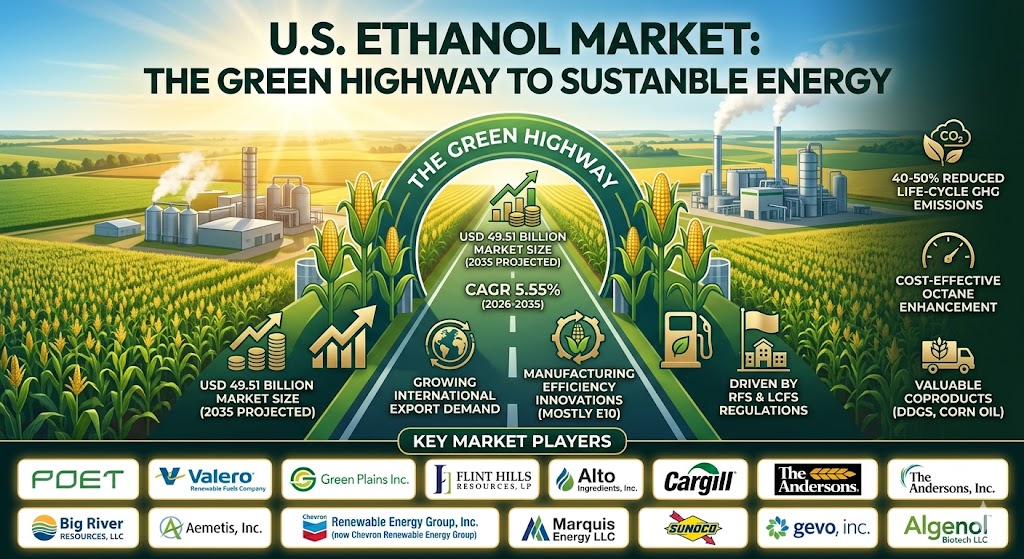
The U.S. ethanol market represents a highly mature yet dynamic infrastructure. The market size was valued at USD 28.85 billion in 2025 and is officially projected to step up from USD 30.45 billion in 2026 to an impressive USD 49.51 billion by 2035. This long-term trajectory expands at a steady, reliable CAGR of 5.55% over the 2026–2035 forecast window. Looking ahead at intermediate mid-decade milestones, the market is poised to reach a projected valuation of approximately USD 41.9 billion by 2032, sustained by massive global export networks and emerging high-value chemical co-product streams.
Market Overview: What is the Scope of the U.S. Ethanol Sector?
The domestic ethanol landscape encompasses the large-scale manufacturing, logistics, distribution, and blending of renewable ethyl alcohol derived predominantly from starch-based agricultural feedstocks. Structurally concentrated across the American Midwest corn belt, the market acts as the primary supplier of oxygenates for standard automotive transportation.
Today, ethanol is blended into more than 98% of all gasoline sold across the United States—primarily as E10 (a 10% ethanol, 90% gasoline mix)—to increase octane ratings, optimize combustion performance, and mitigate tailpipe greenhouse gas emissions.
Market Dynamics: What Are the Primary Drivers for This Market?
Escalating International Export Demands
As developing economies across Latin America, Asia-Pacific, and parts of Europe establish stricter domestic blending mandates to meet climate pledges, international markets increasingly look to the ultra-efficient production infrastructure of the United States. Growing international export demand stands out as the single most critical key factor driving overall market volume growth.
Manufacturing Efficiency Innovations
Modern biorefineries are no longer simple distillation facilities. The integration of advanced enzyme cocktails, high-yield yeast strains, and sophisticated waste-heat recovery systems allows modern producers to extract significantly more fuel per bushel of corn while simultaneously driving down operating expenditures.
Feedstock Availability and Supply Chain Stability
The agricultural footprint of the United States ensures a highly resilient, predictable supply of corn. This vast feedstock availability insulates domestic biorefineries from the crippling supply shocks that frequently disrupt international energy portfolios reliant on more volatile raw materials.
Why Is This Market Important?
Beyond acting as a highly cost-effective octane booster that lowers consumer prices at the fuel pump, the ethanol industry serves as an economic lifeline for rural communities, supporting hundreds of thousands of agricultural and industrial jobs. environmentally, it offers an immediate, scalable pathway to reduce the life-cycle carbon footprint of the massive internal combustion engine (ICE) fleet currently on the road, bypassing the decade-long timelines required for total vehicle-fleet electrification.
Key Segments & Trends: Where Is Growth Materializing?
The industrial architecture of the U.S. ethanol market is experiencing massive technological shifts, which are detailed below in a concise 200-word summary.
Breakdown of Trends & Shift Dynamics
While fuel blending for the domestic automotive transportation network continues to swallow the overwhelming majority of volume share, major structural realignments are occurring downstream. Geographically, production remains fiercely anchored in the Midwest, where localized access to grain minimizes transport overheads. However, distribution networks are shifting rapidly toward maritime ports to accommodate booming international export lanes.
Technologically, the industry is moving away from a singular focus on simple fuel volumes. The most critical emerging trend is the aggressive commercialization of the “Alcohol-to-Jet” (ATJ) pathway, positioning ethanol as a primary chemical precursor to feed the skyrocketing Sustainable Aviation Fuel (SAF) market. Furthermore, biorefineries are increasingly converting their traditional production facilities into high-margin “bioliqiud hubs” capable of producing ultra-pure, food-grade beverage alcohol, high-protein animal feed (Distillers Dried Grains with Solubles or DDGS), and industrial-grade solvents.
Market Recent Government Initiatives: What Regulatory Frameworks Dominate?
The regulatory landscape serves as the ultimate scaffolding for the biofuel economy. The primary legislative driver continues to be the federal Renewable Fuel Standard (RFS) program administered by the EPA, which enforces statutory annual volume mandates for renewable fuels blended into the domestic transportation pool.
At the state level, the proliferation of Low Carbon Fuel Standards (LCFS)—pioneered by California and rapidly adopted by other states—assigns explicit monetary values to the Carbon Intensity (CI) scores of fuels. Biorefineries that successfully lower their operational energy use are rewarded with highly lucrative compliance credits, fundamentally redefining market profitability.
What Are the Market’s Primary Benefits of Using Ethanol?
-
Substantial Environmental Footprint Reduction: On a life-cycle assessment basis, corn ethanol reduces greenhouse gas emissions by 40% to 50% compared to unblended petroleum.
-
Cost-Efficient Octane Enhancement: It provides an affordable source of high-octane performance, replacing highly toxic aromatic additives like benzene and toluene.
-
Valuable Coproduct Optimization: The production process yields secondary high-value streams, including corn oil for biodiesel and highly nutritious animal feed proteins.
Data Presentation: Market Breakdown and Strategic Highlights
To provide maximum clarity for market researchers, the following table models the key segments, growth centers, and volume orientations defining the modern U.S. infrastructure:
| Market Segmentation Criteria | Segment Type | Contextual Performance & Volume Share Orientation |
| Primary Fuel Blend | E10 (Standard Gasoline) | Dominates internal consumption; integrated into >98% of total U.S. gasoline. |
| Emerging Blend Class | E15 / E85 (Flex Fuel) | High-growth profile driven by expanding regulatory infrastructure allowances. |
| Core Feedstock Type | Starch-Based (Corn) | Represents the foundational volume footprint due to extensive domestic grain availability. |
| Primary Production Hub | U.S. Midwest Region | Geographic center for raw feedstock access and large-scale biorefining infrastructure. |
| High-Value Coproducts | DDGS & Corn Oil | Critical margin stabilizers driving circular revenue loops for modern producers. |
Competitive Landscape: Top Companies and Strategic Profiles
The competitive arena is dominated by agribusiness titans and highly specialized clean-energy operators executing sophisticated decarbonization plays.
1. POET, LLC
-
About: Positioned as the undisputed world’s largest producer of ethanol and bio-based products, POET stands as the foundational titan of the domestic biofuels market.
-
Products: Premium fuel-grade ethanol, Voila® corn oil, purified carbon dioxide, and high-protein animal feeds.
-
Market Capitalization: Private Company (Estimated multi-billion dollar asset valuation; operates an annual production capacity of approximately 3 billion gallons).
2. Valero Renewable Fuels Company, LLC
-
About: A wholly-owned subsidiary of refining powerhouse Valero Energy Corporation, this entity leverages classical midstream infrastructure expertise to run highly optimized biorefineries.
-
Products: Fuel-grade ethanol, distillers grains, and industrial-grade renewable corn oils.
-
Market Capitalization: Valero Energy Corporation (NYSE: VLO) trades publicly with a massive market cap of approximately USD 77.37 billion. It operates 12 advanced plants across the Midwest yielding ~1.7 billion gallons annually.
3. Green Plains Inc. (NASDAQ: GPRE)
-
About: A leading-edge agricultural technology innovator focused on transforming commercial corn processing into high-value sustainable ingredients.
-
Products: Low-carbon ethanol, ultra-high protein feed alternatives, and renewable corn oils.
-
Market Capitalization: Publicly traded with a market cap of approximately USD 1.04 billion. The firm controls a robust fleet of 17 biorefineries yielding ~1.2 billion gallons of annual capacity.
4. The Andersons, Inc. (NASDAQ: ANDE)
-
About: A diversified agribusiness powerhouse operating across commodity merchandising, crop nutrients, and large-scale renewable fuel production.
-
Products: High-quality fuel ethanol, co-product animal feeds, and extensive grain logistics services.
-
Market Capitalization: Publicly traded with a market capitalization of approximately USD 2.48 billion.
What is the Market’s Recent Development Activity?
The push for carbon lifecycle accounting has sparked intense collaborative innovation between the agribusiness sector and chemical manufacturers, as summarized in the following 200-word overview.
Key Industry Progress
The market has seen profound strategic pivots aimed at standardizing and monetizing low-carbon metrics. A major milestone occurred in February 2026 when chemical giant BASF launched Circalo™: Low Carbon Intensity Crops. This unified digital platform seamlessly bridges the operational gap between upstream farmers, field agronomists, and midstream ethanol producers. The tool enables real-time tracking, management, and verification of agricultural Carbon Intensity (CI) scores, giving producers the verified data required to capture premium pricing under modern LCFS frameworks.
Concurrently, looking at international maritime transportation vectors, December 2025 marked the official launch of the American Biofuels Maritime Initiative (ABMI). Jointly co-chaired by the American Biogas Council (ABC) and the Renewable Fuels Association (RFA), this high-level coalition was explicitly built to advance the integration of American-made renewable liquid fuels and biogas into the global deep-sea shipping sector. This strategic move successfully opens an entirely new, high-volume downstream demand channel for domestic biorefineries looking beyond traditional automotive infrastructure.
Future of the Market: A Forward-Looking Perspective
The long-term survival and prosperity of the U.S. ethanol market rely heavily on its ability to completely decouple its carbon footprint from fossil fuels. The era of focusing strictly on production volume is over; the future belongs entirely to Carbon Intensity (CI) optimization.
Over the coming decade, expect to see widespread capital allocation toward Carbon Capture, Utilization, and Storage (CCUS) pipelines across the Midwest. By capturing the highly pure $CO_2$ streams naturally generated during yeast fermentation and sequestering it deep underground, ethanol producers can drop their CI scores down close to zero or even achieve net-negative values.
Furthermore, as the global aviation community demands billions of gallons of sustainable fuels, ethanol-to-jet technology will solidify a permanent demand floor for the industry. Biorefineries that forge early alliances with tech providers, optimize their digital agricultural tracking, and secure direct export logistics will emerge as the dominant clean-tech leaders of the next generation.
About Us
Towards Chemical and Materials is a leading global consulting firm specializing in providing comprehensive and strategic research solutions across the chemical and materials industries. With a highly skilled and experienced consultant team, we offer a wide range of services designed to empower businesses with valuable insights and actionable recommendations.
Our Trusted Data Partners
Precedence Research | Statifacts | Towards Packaging | Towards Healthcare | Towards Food and Beverages | Towards Chemical and Materials | Towards Consumer Goods | Nova One Advisor |
For Latest Update Follow Us: https://www.linkedin.com/company/towards-chem-and-materials/
USA: +1 804 441 9344
APAC: +61 485 981 310 or +91 87933 22019
Europe: +44 7383 092 044




Leave a Reply