The U.S. polyolefin compounds market is entering a transformative era, driven by the convergence of advanced material engineering and a nationwide push for circularity. As industries from automotive to infrastructure demand higher performance with lower carbon footprints, polyolefin compounds—specifically tailored blends of polyethylene (PE) and polypropylene (PP)—have moved from commodity fillers to high-value strategic assets. This report analyzes the structural shifts, regulatory tailwinds, and technological breakthroughs defining the market through 2035.
Executive Summary
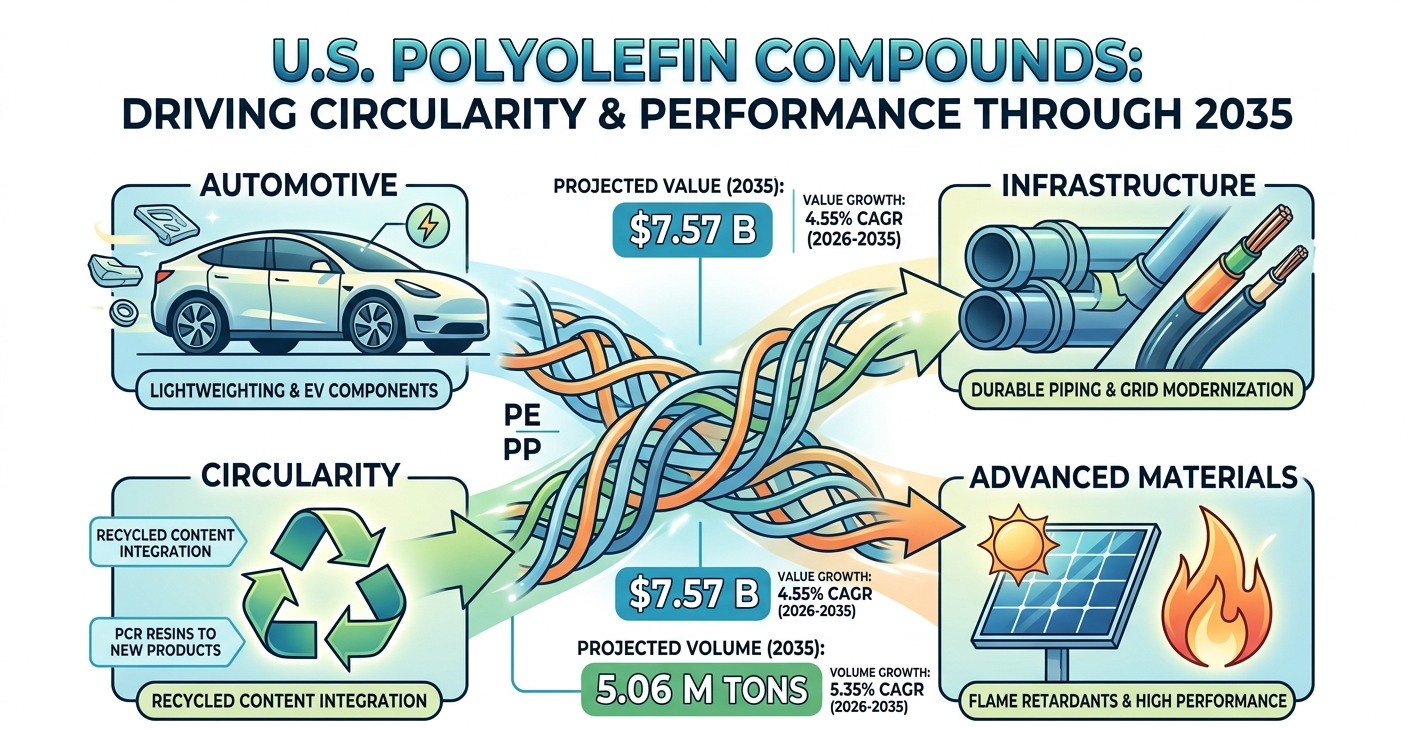
The U.S. polyolefin compounds market is positioned for steady expansion as manufacturers pivot toward high-performance thermoplastic polyolefins (TPO) and recycled content. Valued at USD 4.85 billion in 2025, the market is estimated to reach USD 5.07 billion in 2026. By 2035, the market is projected to reach USD 7.57 billion, representing a CAGR of 4.55% in value. In terms of volume, the market is expected to grow from 3.00 million tons in 2025 to 5.06 million tons by 2035, progressing at a CAGR of 5.35%. This volume-value delta highlights the industry’s focus on lightweighting and cost-efficiency over pure margin expansion.
Market Overview: Why Is the Polyolefin Compounds Market Important?
Polyolefin compounds are the unsung heroes of modern manufacturing. By incorporating functional fillers, glass fibers, and elastomeric modifiers into base resins, compounders create materials that bridge the gap between low-cost plastics and expensive engineering resins. Their importance stems from their incredible versatility; they offer the chemical resistance and moisture barrier of polyolefins while achieving the structural rigidity or flame retardancy required for demanding applications.
In the U.S. landscape, this market is critical for domestic supply chain resilience. As the automotive sector shifts toward Electric Vehicles (EVs), the need for lightweight, flame-retardant battery enclosures and interior components has surged. Similarly, in the wire and cable sector, specialized polyolefin compounds are essential for the modernization of the U.S. power grid. Without these advanced formulations, the transition to renewable energy and the evolution of durable consumer goods would be significantly hindered by material performance limitations and higher costs.
Market Dynamics: What Are the Primary Drivers for This Market?
The trajectory of the U.S. polyolefin compounds market is dictated by a three-pronged driver system: lightweighting, infrastructure investment, and the “circularity mandate.” In the automotive domain, reducing vehicle weight remains the most cost-effective way to extend EV range. This has led to a significant replacement of metal and heavier engineering plastics with reinforced polypropylene compounds. Simultaneously, the U.S. Bipartisan Infrastructure Law is fueling massive demand for high-density polyethylene (HDPE) compounds used in durable piping, telecommunication conduits, and protective coatings for aging assets.
Furthermore, the “circularity mandate” is no longer just a corporate social responsibility goal; it is a market-shaping force. Brand owners in the packaging and consumer goods sectors are demanding compounds that incorporate high percentages of post-consumer recycled (PCR) content without sacrificing mechanical integrity or aesthetic appeal. This is pushing compounders to innovate in compatibilization technology—developing additives that allow recycled PE and PP to blend seamlessly. This drive for sustainable performance is arguably the strongest catalyst for R&D investment in the current decade.
What Are the Key Market Trends and Segments?
The market is increasingly segmented by performance requirements rather than just base resin types. Thermoplastic Polyolefins (TPOs) continue to dominate the automotive exterior and interior segments due to their balance of impact resistance and stiffness. Halogen-Free Flame Retardant (HFFR) compounds are witnessing an uptick in the electronics and construction sectors, driven by stricter fire safety standards and a move away from toxic additives.
[Insert Data Table 1: U.S. Polyolefin Compounds Market Size and Volume Forecast, 2025–2035]
Technologically, the shift toward “Smart Compounding” is a major trend. This involves the use of twin-screw extrusion technologies that allow for precise control over the dispersion of nano-fillers and bio-based reinforcements (like cellulose or hemp fibers). Regionally, while manufacturing remains concentrated in the Gulf Coast and Midwest, there is a noticeable decentralization as “micro-compounding” facilities emerge closer to end-user hubs (like the Southeast automotive corridor) to minimize logistics costs and carbon footprints.
What Are the Primary Market Benefits of Using These Compounds?
-
Weight Reduction: Polyolefin compounds offer a lower density compared to metal or alternative polymers like PVC, making them ideal for mobility applications.
-
Cost-Effectiveness: They provide high-performance characteristics (UV resistance, impact strength) at a significantly lower price point than fluoropolymers or polyamides.
-
Chemical Stability: Inherently resistant to a wide range of chemicals, acids, and solvents, ensuring longevity in harsh industrial environments.
-
Recyclability: Unlike thermoset composites, polyolefin compounds are thermoplastic and can be reprocessed, aligning with modern environmental standards.
-
Design Freedom: Excellent flow properties in injection molding allow for complex, thin-walled part designs that reduce assembly time and material waste.
Market Recent Government Initiatives: How Is Regulation Shaping Growth?
Government policy is currently acting as a massive tailwind for the U.S. polyolefin compounds sector. The Inflation Reduction Act (IRA) provides significant incentives for domestic clean energy manufacturing, which indirectly boosts demand for specialized compounds used in solar panel components and wind turbine internal parts. Additionally, the Environmental Protection Agency (EPA) is tightening regulations around plastic waste, which has accelerated federal support for “advanced recycling” initiatives.
At the state level, mandates in California and Oregon regarding Minimum Recycled Content are forcing a shift in compounding strategies. Compounders are now receiving grants and tax breaks to upgrade facilities to handle “difficult” recycle streams. Furthermore, federal procurement guidelines under the “Buy Clean” initiative are prioritizing materials with lower embodied carbon, favoring polyolefin compounds over more energy-intensive material alternatives in public works projects.
Competitive Landscape: Top Companies and Strategic Movements
The U.S. competitive environment is characterized by large-scale resin producers moving downstream and specialized compounders moving toward niche high-performance grades.
1. LyondellBasell Industries N.V.
-
About: A global leader in the polyolefin industry, LyondellBasell is a dominant force in the U.S. TPO and specialty compounding market.
-
Products: Hostacom and Hifax (PP compounds), Circulen (recycled grades).
-
Market Cap: Approximately USD 31 billion.
-
Strategic Move: Recently expanded its “Circulen” portfolio in the U.S., focusing on high-quality recycled polyolefins to meet the demand from the automotive and consumer packaging industries.
2. Avient Corporation
-
About: Formerly PolyOne, Avient is a specialized provider of specialized polymer materials and services.
-
Products: Maxxam (PP/PE compounds), reSound (sustainable materials).
-
Market Cap: Approximately USD 4.5 billion.
-
Strategic Move: Focused on the “reSound R” product line, which incorporates recycled content, targeting the outdoor high-performance consumer goods market.
3. ExxonMobil Chemical
-
About: A powerhouse in the petrochemical sector, ExxonMobil is vertically integrated, producing both base resins and specialty elastomers.
-
Products: Exceed XP (PE-based performance polymers) and Vistamaxx (performance polymers for compounding).
-
Market Cap: Approximately USD 500 billion (ExxonMobil Corp).
-
Strategic Move: Investing heavily in “advanced recycling” facilities in Baytown, Texas, to provide chemically recycled feedstocks for ultra-high-purity compounds.
What Are the Recent Developments by Major Companies?
Innovation is currently focused on “High-Content PCR Compounds.” For instance, Dow recently launched a new grade of post-consumer recycled (PCR) resins designed specifically for collation shrink film, showing that compounding can maintain optical clarity even with recycled inputs. Washington Penn (a major private compounder) has been optimizing glass-fiber reinforced PP for under-the-hood EV components where heat resistance is paramount. Furthermore, there is a notable rise in “bio-hybrid” compounds, where traditional polyolefins are blended with bio-derived resins to lower the carbon footprint while maintaining existing processing infrastructure compatibility.
Conclusion: The Future of the Market
The U.S. polyolefin compounds market is evolving from a segment defined by “cost-per-pound” to one defined by “performance-per-carbon-gram.” Through 2035, the industry will likely see a consolidation of recycling technologies directly into the compounding process. As AI-driven formulation tools become standard, we expect the development of “hyper-specific” compounds that can be adjusted in real-time during production to account for variations in recycled feedstock quality. For stakeholders, the message is clear: the future belongs to those who can master the chemistry of circularity while delivering the mechanical properties of the future.
Inquiries: [email protected] | Explore our full suite of U.S. petrochemical and material research reports.
Contact Us https://www.towardschemandmaterials.com/contact-us
About Us
Towards Chem and Materials is a leading global consulting firm specializing in providing comprehensive and strategic research solutions across the chemical and materials industries. With a highly skilled and experienced consultant team, we offer a wide range of services designed to empower businesses with valuable insights and actionable recommendations.
Web: https://www.towardschemandmaterials.com/
For Latest Update Follow Us: https://www.linkedin.com/company/towards-chem-and-materials/?viewAsMember=true


Leave a Reply