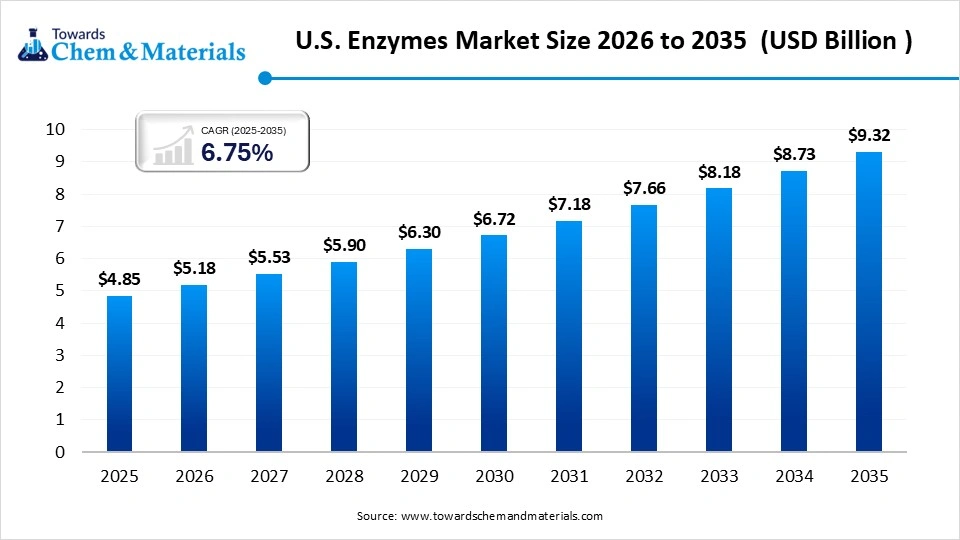
The U.S. enzymes market is executing a massive structural expansion as industries prioritize bioprocessing over traditional, carbon-heavy chemical synthesis. Initially valued at USD 4.85 billion in 2025, the market has expanded to an estimated USD 5.18 billion in 2026. Propelled by continuous innovations in genetic engineering and an urgent push for industrial sustainability, the market is projected to reach USD 9.32 billion by 2035. This trajectory represents a robust Compound Annual Growth Rate (CAGR) of 6.75% over the 2026–2035 forecast period, establishing biological catalysts as non-negotiable infrastructure across the pharmaceutical, food manufacturing, and clean energy sectors.
Market Overview: What is the U.S. Enzymes Market?
The U.S. enzymes market encompasses the commercial production, distribution, and functional deployment of biological catalysts derived from living organisms, including complex bacterial strains, fungi, and plant-based matrices. These specialized proteins drastically accelerate biochemical reactions without being consumed in the process. By reducing the activation energy required for industrial reactions, enzymes enable large-scale processing to occur at lower temperatures and ambient pressures, replacing aggressive chemical reagents and sharply lowering energy consumption.
Market Dynamics: What Are the Key Factors Driving the Market?
What are the primary drivers for this market?
-
Technological Shifts in Biofuel Generation: The ongoing push for cellulosic ethanol and sustainable aviation fuels (SAF) relies heavily on high-efficiency enzyme cocktails. These advanced biocatalysts rapidly hydrolyze rugged agricultural residues and wood biomass into fermentable sugars, driving down the per-gallon cost of green energy.
-
Accelerating Pharmaceutical Biocatalysis: Drug manufacturers are systematically swapping multi-step chemical synthesis tracks for single-pot enzymatic transformations. This methodology yields ultra-pure chiral molecules and critical active pharmaceutical ingredients (APIs) with minimal toxic waste.
-
Clean-Label Food & Beverage Innovations: Consumer demand for organic, gluten-free, and low-sugar alternatives requires targeted enzymology. Advanced enzymes optimize dough handling in baking, maximize extraction yields in juice processing, and create natural sugar alternatives seamlessly.
What Are the Key Market Trends?
The dominant trend reshaping the modern enzymes landscape is the commercialization of artificial intelligence (AI) and machine learning (ML) for directed evolution. Rather than screening millions of wild-type microbial strains, researchers use predictive algorithms to map out and synthesize custom-engineered enzymes. These designer proteins exhibit perfect structural stability under high thermal stress and extreme pH environments that would typically denature natural enzymes.
Simultaneously, the therapeutic enzyme segment is growing rapidly. Biomanufacturers are leveraging highly specialized animal and microbial enzymes to engineer targeted treatments for pancreatic insufficiencies, oncology protocols, and rare genetic lysosomal storage disorders.
Why Is the Market Important?
Enzymes serve as the bedrock of the modern bio-economy. As industrial regulatory bodies enforce stricter carbon accounting, conventional thermal chemistry is proving too costly and environmentally damaging. Enzymatic processing provides a reliable roadmap toward absolute circularity, ensuring that resource-heavy industries can maximize their raw-material conversions while scaling down their environmental footprint.
What Benefits Are Driving Corporate Adoption?
Industrial formulators deploy tailored enzyme systems to secure distinctive process and bottom-line advantages, such as:
-
Drastic Energy Reduction: Lowering processing temperatures from hundreds of degrees Celsius down to ambient levels, significantly trimming plant utility costs.
-
Absolute Molecular Specificity: Eliminating the formation of unwanted side-products or structural isomers, which dramatically reduces downstream purification and refinement expenses.
-
Excellent Biodegradability: Replacing persistent chemical catalysts with completely natural proteins that break down effortlessly in standard wastewater treatment systems.
Market Segmentation: Deep-Dive Analysis
Which segment accounted for the largest market share?
By type, industrial enzymes held the dominant market share in 2025 and continue to command massive volumes in 2026, primarily serving high-throughput segments like starch conversion, household detergents, and animal nutrition. However, the specialty enzymes segment is forecasted to expand at the fastest CAGR through 2035, driven by surging investments in diagnostics, molecular biology research, and specialized clinical therapies.
From a product standpoint, carbohydrases maintain the highest volume footprint due to their cross-industry utilization in corn wet milling and brewing. Meanwhile, the proteases segment is moving at the fastest growth rate, fueled by its critical role in advanced peptide synthesis, cheese maturation, and low-temperature laundry stain removal. Regionally, the U.S. remains a self-sustaining powerhouse due to concentrated bioprocessing infrastructure across the Midwest and dedicated biotech clusters in California and New England.
The baseline distribution across these essential segments highlights these dynamics:


Leave a Reply