Executive Summary
The U.S. Organic Peroxide Market was valued at USD 825.19 million in 2025 and is projected to grow to USD 1,412.22 million by 2035, registering a CAGR of 5.52% during the forecast period. Volume-wise, the market is expected to expand from 510.85 thousand tons in 2025 to 820.31 thousand tons by 2035, with a CAGR of 4.85%.
The market growth is driven by rising demand for polymerization initiators, curing agents, and crosslinking agents across polymer, rubber, composite, and reinforced plastic industries. Increasing industrialization, regulatory compliance for bleaching/oxidizing chemicals, and the growth of end-use sectors such as adhesives, coatings, and pharmaceuticals are further accelerating adoption. The market also benefits from technological advancements in organic peroxide stabilization, handling, and form factor innovations.
Market Overview
What is the U.S. Organic Peroxide Market?
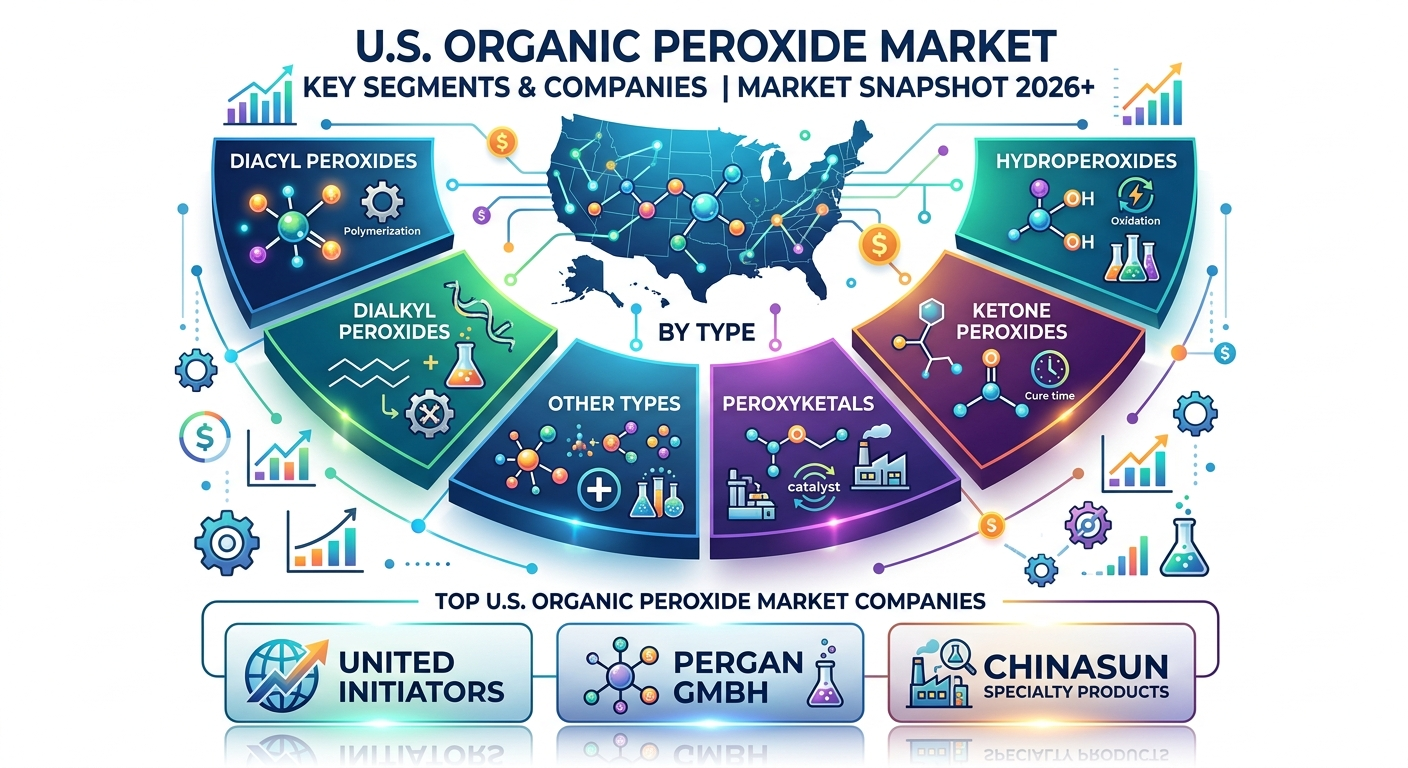
The U.S. Organic Peroxide Market includes chemical compounds such as diacyl peroxides, dialkyl peroxides, peroxyesters, hydroperoxides, ketone peroxides, and peroxyketals. These compounds serve as initiators, hardening agents, crosslinkers, and oxidizers in various chemical processes. Their application is essential in polymer and plastic manufacturing, rubber processing, composite materials, and industrial bleaching.
What is Market Growth?
The market is projected to grow at a CAGR of 5.52% in value and 4.85% in volume from 2026 to 2035. Growth is driven by increased production of polymers and industrial chemicals, rising demand for high-purity organic peroxides, and stricter compliance in end-use industries requiring consistent quality and performance.
Key Market Trends
- Increasing adoption of organic peroxides in high-performance polymers
- Growth in adhesives and sealants manufacturing
- Rising demand from paints, coatings, and textile industries
- Development of safer, stable liquid, solid, and gel/paste peroxide formulations
- Expansion of online distribution and direct procurement channels
Market Recent Government Initiatives
- U.S. Environmental Protection Agency (EPA) regulations enforcing safe handling and storage of oxidizing agents
- Chemical manufacturing safety standards promoting high-purity organic peroxide production
- Support for industrial chemical research through Department of Energy (DOE) initiatives
Market Benefits of Using Organic Peroxides
- Accelerates polymerization and curing reactions
- Enhances crosslinking efficiency and polymer stability
- Enables controlled bleaching and oxidation in industrial processes
- Provides versatile forms (powder, liquid, paste) for operational flexibility
- Reduces overall process time and energy consumption
- Improves product consistency and performance in manufacturing
Key Factors Driving the Market
- Growth in polymer, composite, and rubber production
- Rising industrial applications in coatings, adhesives, and sealants
- Regulatory compliance requirements for high-purity oxidizers
- Technological advances in peroxide stabilization and handling
- Expansion of specialty chemical manufacturing in the U.S.
Market Segmentation
By Type
- Diacyl Peroxides
- Dialkyl Peroxides
- Peroxyesters
- Hydroperoxides
- Ketone Peroxides
- Peroxyketals
- Other Types
By Function/Application
- Polymerization Initiators
- Curing/Hardening Agents
- Crosslinking Agents
- Bleaching/Oxidizing Agents
By Form
- Solid/Powder Peroxide
- Liquid Peroxide
- Paste/Gel Organic Peroxide
By Distribution Channel
- Direct Sales
- Distributors
- Online Retail/Procurement Portals
By End-Use Industry
- Polymer & Plastic
- Rubber Industry
- Composite & Reinforced Plastics
- Adhesives & Sealants
- Paints & Coatings
- Textile
- Pharmaceuticals
- Cosmetics & Personal Care
- Pulp & Paper
- Other End-use Industries
Top Companies in the U.S. Organic Peroxide Market
Arkema
About:
Global specialty chemical company providing high-performance organic peroxides for polymerization and curing applications.
Products:
Diacyl peroxides, peroxyesters, hydroperoxides.
Market Cap:
Approximately USD 13 billion.
United Initiators
About:
Leading manufacturer of industrial peroxides and curing agents with global supply network.
Products:
Solid and liquid organic peroxides, curing and crosslinking agents.
Market Cap:
Private Company.
NOF Corporation
About:
Specialized in high-purity organic peroxides for polymers and composites.
Products:
Hydroperoxides, ketone peroxides, peroxyketals.
Market Cap:
Mid-cap multinational corporation.
Pergan GmbH
About:
Provider of customized peroxide formulations for industrial and polymer applications.
Products:
Diacyl peroxides, solid and liquid peroxides.
Market Cap:
Private company.
Arkema Specialty Chemicals Division
About:
Focuses on high-performance peroxides for industrial curing and polymerization.
Products:
Liquid peroxides, powder peroxides, functionalized oxidizers.
Market Cap:
Integrated into Arkema’s global portfolio.
Competitive Landscape
The U.S. Organic Peroxide Market is highly competitive with global chemical manufacturers, specialty peroxide producers, and industrial suppliers vying for market share. Leading companies are focusing on high-purity product innovation, safer handling and storage solutions, and expanded distribution channels. Strategic partnerships with polymer and composite manufacturers are enabling closer integration with industrial processes. Companies are also investing in research and development for novel peroxide chemistries to serve emerging applications in adhesives, coatings, and high-performance materials. Market competition intensifies as demand for specialized, safe, and high-efficiency peroxides increases across U.S. industries.
Market Recent Developments by Major Companies
- In 2025, Arkema introduced advanced diacyl peroxides for high-efficiency polymer curing.
- Companies are expanding liquid and gel peroxide capacities to meet industrial scale requirements.
- Investments in safer packaging and storage technologies are ongoing.
- Integration with online procurement platforms has improved accessibility and logistics efficiency for industrial buyers.
Future of the Market
The U.S. Organic Peroxide Market is poised for strong growth, driven by rising polymer, composite, and rubber production, increasing demand for adhesives, coatings, and high-purity oxidizers. Technological advancements in peroxide stabilization, safer handling, and flexible form factors will continue to enhance market attractiveness. The adoption of specialty peroxides across emerging end-use sectors, combined with regulatory support and R&D investment, will ensure steady expansion through 2035.
Conclusion
The U.S. Organic Peroxide Market is a vital segment of industrial chemical manufacturing, providing essential solutions for polymerization, curing, crosslinking, and bleaching processes. Continued innovations, sustainable chemical development, and strategic industry partnerships are expected to shape a competitive, high-growth market over the next decade.


Leave a Reply