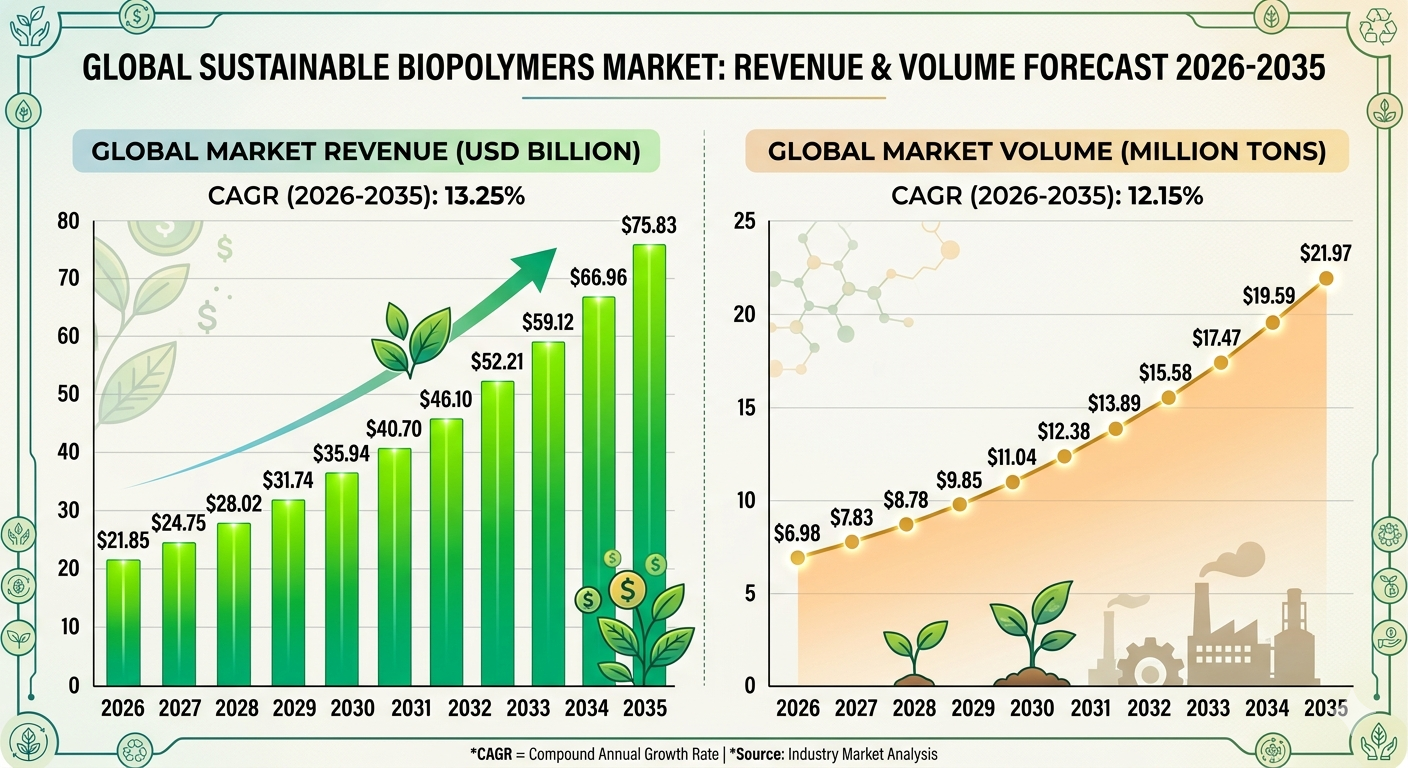
The Sustainable Biopolymers Market is entering a high-growth phase, projected to expand from USD 21.85 billion in 2025 to USD 75.83 billion by 2035, registering a CAGR of 13.25%. Market volume is expected to rise from 6.98 million tons to 21.97 million tons, reflecting a 12.15% CAGR. This surge is driven by regulatory pressure on plastics, corporate sustainability commitments, and rapid innovation in bio-based materials. The market outlook toward 2032 already signals strong double-digit expansion, supported by packaging, automotive, and biomedical applications.
What is Market Overview?
The sustainable biopolymers market encompasses biodegradable and bio-based polymers derived from renewable sources such as corn starch, sugarcane, and cellulose. These materials are increasingly replacing conventional plastics due to their lower carbon footprint and recyclability. Industries including packaging, agriculture, and healthcare are adopting biopolymers to meet sustainability goals and comply with evolving environmental regulations.
What is Market Growth?
The market demonstrates robust expansion fueled by increasing global plastic bans and ESG-driven investments. Growth is particularly strong in Europe and Asia-Pacific, where regulatory frameworks and manufacturing capabilities are aligned. Rising consumer awareness and corporate commitments to circular economy models are accelerating adoption across industries.
What are Key Market Trends?
- Shift toward biodegradable packaging solutions
- Increased use in electric vehicles and lightweight components
- Advancements in PLA and PHA technologies
- Integration with 3D printing materials
- Rising demand for compostable consumer goods
What are Market Dynamics?
The market is shaped by a combination of regulatory push and technological pull. While high production costs remain a challenge, economies of scale and innovation are gradually improving cost competitiveness. Supply chain development for raw materials is also stabilizing, enabling consistent production.
What Are the Key Factors Driving the Market?
Key drivers include stringent environmental regulations, growing demand for sustainable packaging, and corporate sustainability targets. Additionally, advancements in polymer engineering and increasing investments in green chemistry are accelerating commercialization.
Competitive Landscape: Top Companies
The market is characterized by a mix of chemical giants and specialized biotech firms. Recent strategic moves include joint ventures to secure feedstock and the acquisition of small-scale PHA startups by major players to diversify portfolios.
1. NatureWorks LLC
-
About: A world leader in renewable materials, jointly owned by Cargill and PTT Global Chemical.
-
Products: Ingeo™ Polylactic Acid (PLA).
-
Market Cap: Private (Significant subsidiary value estimated in billions).
2. BASF SE
-
About: The world’s largest chemical producer, heavily investing in the “ChemCycling” and bio-based divisions.
-
Products: ecovio® (compostable polymers) and ecoflex®.
-
Market Cap: ~USD 45–55 Billion (Fluctuating).
3. TotalEnergies Corbion
-
About: A 50/50 joint venture between TotalEnergies and Corbion, focused exclusively on PLA.
-
Products: Luminy® PLA resins.
-
Market Cap: Joint Venture (Parent Corbion Cap: ~USD 1.5 Billion).
4. Danimer Scientific
-
About: A pioneer in PHA technology and marine-degradable solutions.
-
Products: Nodax® PHA.
-
Market Cap: ~USD 100–150 Million (Emerging Growth).
Which segment accounted for the largest Market share?
The Starch-Based Polymers segment currently holds the largest volume share (approx. 35%) due to its low cost and widespread use in compostable bags and loose-fill packaging. However, in terms of revenue growth, PLA (Polylactic Acid) and PHA are rapidly closing the gap. PLA is favored for its transparency and rigidity in food-service applications, while PHA is gaining ground in high-value medical and marine-safe packaging segments.
Future of the Market
Looking ahead, the market will shift from “biodegradable” to “functional.” We expect the 2030s to be dominated by Smart Biopolymers that can respond to environmental stimuli, such as color-changing food packaging that indicates spoilage. The integration of 3D printing with biopolymer filaments will also revolutionize localized manufacturing, allowing companies to print sustainable parts on-demand, further reducing the carbon footprint associated with global logistics.
About Us
Towards Chemical and Materials is a leading global consulting firm specializing in providing comprehensive and strategic research solutions across the chemical and materials industries. With a highly skilled and experienced consultant team, we offer a wide range of services designed to empower businesses with valuable insights and actionable recommendations.
Our Trusted Data Partners
Precedence Research | Statifacts | Towards Packaging | Towards Healthcare | Towards Food and Beverages | Towards Chemical and Materials | Towards Consumer Goods | Nova One Advisor |
For Latest Update Follow Us: https://www.linkedin.com/company/towards-chem-and-materials/
USA: +1 804 441 9344
APAC: +61 485 981 310 or +91 87933 22019
Europe: +44 7383 092 044
Email: [email protected]


Leave a Reply