Executive Summary
The global surface treatment chemicals market is undergoing significant technical advancements. Driven by the strict requirement for advanced substrate protection, superior molecular bonding, and strict alignment with green chemistry principles, the market is poised for robust expansion. The global surface treatment chemicals market size was valued at USD 16.85 billion in 2025. It is expected to reach USD 17.95 billion in 2026 and is further projected to expand to USD 31.78 billion by 2035. This trajectory represents a compound annual growth rate (CAGR) of 6.55% during the forecast period from 2026 to 2035.
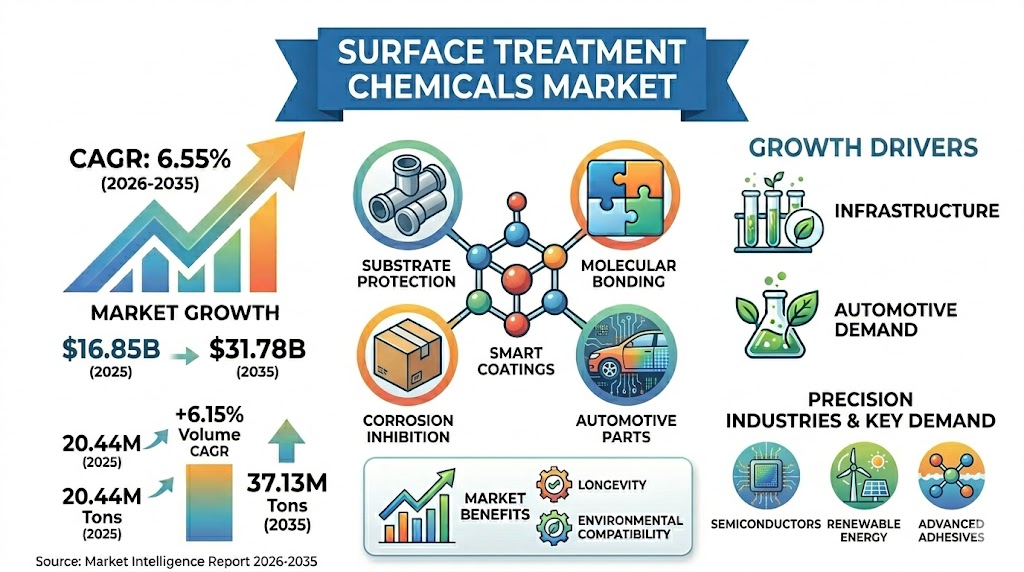
Through mathematical calculation of this structural growth trajectory, the market value is estimated to reach approximately USD 26.24 billion by the year 2032. Concurrently, the physical demand volume is projected to grow from 20.44 million tons in 2025 to 37.13 million tons by 2035, moving at a volume CAGR of 6.15%. The close alignment between value and volume growth highlights steady commodity pricing, supported by an anticipated average pricing compound annual growth rate of 2.19%.
Market Overview
What is the surface treatment chemicals market?
The surface treatment chemicals market involves the specialized chemicals, engineering processes, and industrial formulations applied to change the physical, chemical, or aesthetic properties of a substrate surface. These formulations alter interfacial engineering properties, improving paint adhesion, surface energy, molecular bonding, electrical conductivity, and long-term corrosion resistance.
The primary industrial chemicals include industrial cleaners, conversion coatings, plating formulations, and pickling agents. They are applied across multiple substrate variants such as metals, plastics, and advanced composites. These chemicals serve as a vital manufacturing step before subsequent painting, powder coating, electroplating, or adhesive bonding.
Market Dynamics & Key Drivers
What are the key factors driving the market?
The adoption of specialized surface treatment chemicals is driven by the growing demand in high-precision, automated industries. Industries like semiconductor fabrication, renewable energy equipment (such as photovoltaic panels and wind turbine structures), and advanced structural adhesives require precise surface energy optimization and strict corrosion inhibition.
Modern industrial infrastructure relies heavily on automated manufacturing lines. This transition requires integrating smart coatings and precise nanofabrication techniques to protect expensive tooling from wear and environmental degradation. Additionally, the shift away from legacy heavy metals toward eco-friendly, high-performance chemistries is pushing industrial plants to upgrade their chemical treatment lines.
Key Market Trends
What are the primary market trends?
The key trend reshaping this market is the fast acceleration of green chemistry and eco-friendly formulations, driven by a commitment to a circular economy. Chemical manufacturers are allocating significant R&D spending to phase out toxic hexavalent chromium formulations, replacing them with chromium-free, zirconium-based conversion coatings and bio-based industrial cleaners.
Technologically, the integration of nanostructured chemical pre-treatments is gaining traction. These thin-film coatings require less energy to apply, reduce sludge generation, and provide superior cross-linking capabilities for topcoats. This helps industrial plants lower their waste disposal costs while improving overall corrosion resistance.
Market Benefits & Product Importance
Why is this market important, and what are the benefits of using surface treatment chemicals?
Surface treatment chemicals are essential for extending the operational lifespan and safety of industrial and consumer assets. By engineering the substrate surface at a molecular level, these chemicals create an effective barrier against oxidation, moisture ingress, and chemical attacks.
The primary benefit lies in the economic savings achieved through reduced component failure and minimized maintenance downtime. For example, treating a metal or plastic substrate optimizes its surface energy and cross-linking density. This ensures that downstream paints and adhesives bond permanently, preventing premature peeling, blistering, or delamination under harsh outdoor conditions.
Recent Government Initiatives
What recent government initiatives are impacting the market?
Global environmental regulations are driving changes in the chemical compositions used by surface finishing plants. Strict regulatory frameworks, such as the European Union’s REACH guidelines and toxic substance directives from the US EPA, continue to enforce bans on hexavalent chromium and hazardous volatile organic compounds (VOCs).
Consequently, regional environmental ministries are offering tax incentives and green manufacturing grants to production plants that transition to water-borne, trivalent chromium, or chromium-free pre-treatment systems. Additionally, government funding for domestic semiconductor fabs and clean energy infrastructure mandates using certified eco-friendly chemical supply chains.
Market Segmentation Analysis
Which segment accounted for the largest market share?
A review of the market reveals specific leadership patterns across different segments. In regional terms, the Asia-Pacific area dominated the market, capturing a 38% share in 2025. It is also projected to grow at the fastest rate, with a CAGR of 6.80%. By chemical type, industrial cleaners led the segment with a 28% market share in 2025. Meanwhile, plating chemicals are expected to grow at the fastest CAGR of 6.40%.
Regarding substrates, metals held the dominant position with a 72% share in 2025, while plastics are projected to grow the fastest at a 6.20% CAGR. In application categories, the automotive sector led with a 29% share in 2025. However, the electronics segment is forecasted to see the fastest growth, moving at a 6.50% CAGR. Finally, the coating process segment led with a 27% market share in 2025 and is projected to expand at a 6.20% CAGR.
Strategic Data Reference
The table below organizes the benchmark market data and growth rates across different segments, providing a clear reference for production planning.


Leave a Reply