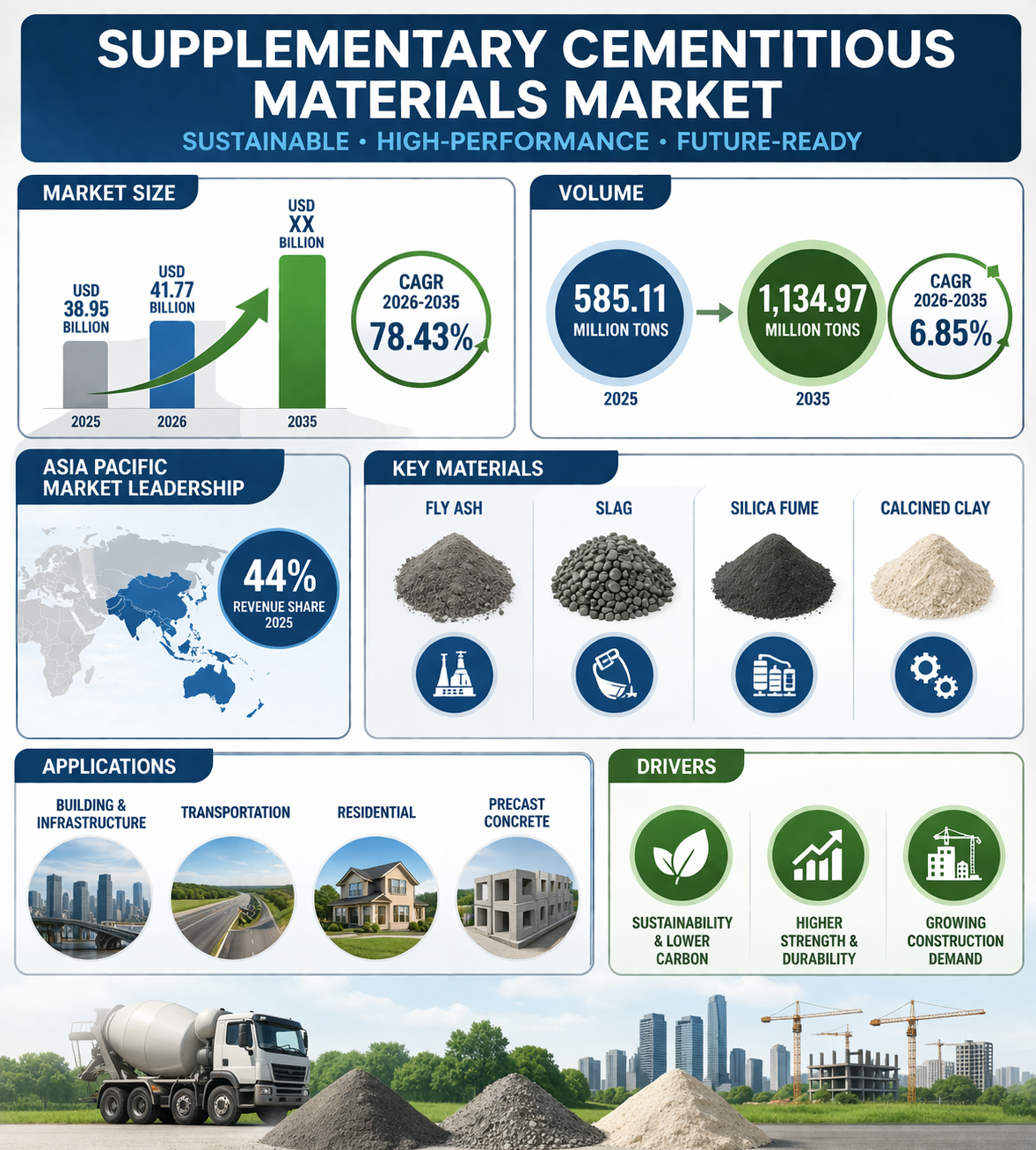
The global supplementary cementitious materials (SCM) market, valued at USD 38.95 billion in 2025, is poised for steady growth over the next decade. By 2035, the market is expected to reach substantial growth, with a projected market size of USD 78.43 billion. This growth represents a Compound Annual Growth Rate (CAGR) of 6.85% from 2026 to 2035. In terms of volume, the market is projected to increase from 585.11 million tons in 2025 to 1,134.97 million tons by 2035, reflecting the rising demand for sustainable construction materials.
Asia Pacific leads the global SCM market with the largest revenue share of 44% in 2025, driven by the rapid expansion of infrastructure development and increasing construction activities in emerging economies such as China and India. The shift towards sustainable and environmentally friendly construction materials, coupled with regulatory support and growing infrastructure investments, is driving the market’s expansion.
What Are Supplementary Cementitious Materials (SCM)?
Supplementary Cementitious Materials (SCMs) are materials that, when combined with cement, enhance the properties of concrete, such as strength, durability, and resistance to environmental stresses. These materials include fly ash, slag, silica fume, and natural pozzolans. SCMs are essential for reducing the carbon footprint of cement production, which is a significant contributor to global CO2 emissions.
SCMs are gaining traction in the construction industry due to their environmental benefits, including reducing the amount of Portland cement required, which in turn reduces greenhouse gas emissions and energy consumption during cement production.
Key Drivers for Growth in the SCM Market
- Sustainability and Eco-Friendly Construction:
- The global push for greener building materials is driving the adoption of SCMs. These materials reduce the environmental impact of concrete, offering a more sustainable alternative to conventional cement.
- Governments and environmental agencies worldwide are setting stricter regulations to limit the carbon footprint of construction, further boosting the demand for SCMs.
- Growing Infrastructure Development:
- Rapid urbanization and population growth in developing economies, particularly in Asia Pacific, are increasing demand for concrete and its derivatives, including SCMs, for infrastructure projects.
- Infrastructure projects such as roads, bridges, and buildings, especially in regions like China and India, are pivotal drivers for SCM usage.
- Government Regulations and Incentives:
- Governments are increasingly incentivizing the use of SCMs through policy measures that encourage sustainable construction practices. For example, many countries offer tax breaks or credits for using sustainable materials.
- The adoption of green building certification systems, such as LEED (Leadership in Energy and Environmental Design), is further contributing to the demand for SCMs.
- Rising Concrete Demand in Residential and Commercial Construction:
- The construction industry’s reliance on concrete for residential, commercial, and industrial buildings directly influences the growth of the SCM market. SCMs improve the strength and durability of concrete, making them a preferred choice for builders and contractors.
Key Segments & Trends in the SCM Market
By Type of SCM:
- Fly Ash:
- Fly ash is one of the most widely used SCMs, produced as a byproduct of coal combustion in power plants. It enhances the workability, durability, and long-term strength of concrete while reducing the need for cement.
- Key trends: Fly ash is increasingly being used in high-performance concrete applications, particularly in large-scale infrastructure projects.
- Ground Granulated Blast Furnace Slag (GGBFS):
- Slag is a byproduct of steel manufacturing and is used in concrete to improve its resistance to chemical attacks, such as sulfate and chloride penetration.
- Key trends: The use of slag is growing due to its ability to enhance the durability and sustainability of concrete, particularly in regions with aggressive environments like coastal areas.
- Silica Fume:
- Silica fume, a byproduct of silicon metal or ferrosilicon alloy production, is used to improve the strength and permeability of concrete. It is often employed in high-strength, high-performance concrete.
- Key trends: Silica fume is increasingly used in specialized applications where superior strength and durability are required, such as in bridges and tunnels.
- Natural Pozzolans:
- These include volcanic ash and calcined clays, which are naturally occurring materials that possess cementitious properties when combined with lime. Natural pozzolans are gaining popularity as a sustainable alternative to traditional SCMs.
- Key trends: The increasing demand for low-carbon concrete has led to a resurgence in the use of natural pozzolans, especially in regions where these materials are locally available.
By Application:
- Construction:
- The largest application segment, as SCMs are widely used in concrete production for residential, commercial, and industrial buildings. The adoption of SCMs is particularly significant in large-scale infrastructure projects such as highways and bridges.
- Road Construction:
- SCMs are increasingly used in road construction for creating durable, long-lasting pavements and reducing the environmental impact of road projects.
- Precast Concrete:
- Precast concrete products, including beams, blocks, and panels, are incorporating SCMs to achieve higher strength and durability while reducing the environmental impact of production.
- Ready-Mix Concrete:
- Ready-mix concrete manufacturers are increasingly incorporating SCMs into their products to meet sustainability goals and enhance the performance of the concrete.
By Region:
- Asia Pacific:
- The largest and fastest-growing region for SCMs, driven by rapid infrastructure development in emerging economies like China, India, and Southeast Asia. The region accounts for over 44% of the global market share.
- Key trends: The increasing demand for low-carbon concrete in infrastructure projects and the growing emphasis on sustainability in construction practices are driving the adoption of SCMs.
- North America:
- North America is expected to see steady growth in the SCM market, with strong demand for sustainable building materials in the U.S. and Canada, especially for green building projects.
- Key trends: Increasing regulatory support for sustainable construction and growing adoption of green building standards are driving market growth.
- Europe:
- Europe is a significant market for SCMs, driven by stringent environmental regulations and the need for sustainable building materials.
- Key trends: The shift towards reducing the carbon footprint of concrete and government-led initiatives encouraging the use of SCMs are contributing to market growth.
Competitive Landscape
The global supplementary cementitious materials market is highly fragmented, with both large multinationals and local players dominating the industry. Some of the key players in the market include:
- LafargeHolcim:
- A leading supplier of cement and concrete, LafargeHolcim has a strong portfolio of SCMs, including fly ash, slag, and natural pozzolans. The company is focusing on enhancing the sustainability of its products and expanding its global SCM supply chain.
- Cemex:
- Cemex is another major player offering a wide range of SCMs for the construction industry. The company is investing in R&D to develop more sustainable solutions and reduce the environmental impact of cement production.
- HeidelbergCement:
- A global player in the building materials sector, HeidelbergCement is increasingly incorporating SCMs like slag and fly ash into its product offerings to meet the demand for environmentally friendly construction materials.
- BASF:
- BASF offers a range of chemical solutions for the construction industry, including high-performance additives for SCMs to enhance the performance and sustainability of concrete.
These companies are actively investing in expanding their SCM product portfolios and exploring new applications for these materials in order to capitalize on the growing demand for sustainable construction.
Conclusion: Future Outlook
The supplementary cementitious materials market is on a strong growth trajectory, driven by increasing demand for sustainable construction materials and rising infrastructure investments across the globe. The use of SCMs will continue to grow as the construction industry works towards reducing its carbon footprint and improving the performance and durability of concrete.
By 2035, the market is expected to reach USD 78.43 billion, with substantial opportunities in Asia Pacific, Europe, and North America. The development of new, more sustainable SCM options and regulatory support for green construction practices will play a pivotal role in shaping the future of the market.
| Year | Market Size (USD Billion) | Market Volume (Million Tons) |
|---|---|---|
| 2025 | 38.95 | 585.11 |
| 2026 | 41.77 | 625.00 |
| 2027 | 45.00 | 675.00 |
| 2028 | 50.00 | 725.00 |
| 2029 | 55.00 | 800.00 |
| 2030 | 60.00 | 900.00 |
| 2031 | 65.00 | 1,000.00 |
| 2032 | 70.00 | 1,050.00 |
| 2033 | 75.00 | 1,100.00 |
| 2034 | 78.00 | 1,125.00 |
| 2035 | 78.43 | 1,134.97 |
This report provides a comprehensive overview of the global SCM market, highlighting key drivers, segments, and emerging trends.
Contact Us https://www.towardschemandmaterials.com/contact-us
About Us
Towards Chem and Materials is a leading global consulting firm specializing in providing comprehensive and strategic research solutions across the chemical and materials industries. With a highly skilled and experienced consultant team, we offer a wide range of services designed to empower businesses with valuable insights and actionable recommendations.
Email: [email protected]
Web: https://www.towardschemandmaterials.com/
For Latest Update Follow Us: https://www.linkedin.com/company/towards-chem-and-materials/?viewAsMember=true


Leave a Reply