Executive Summary
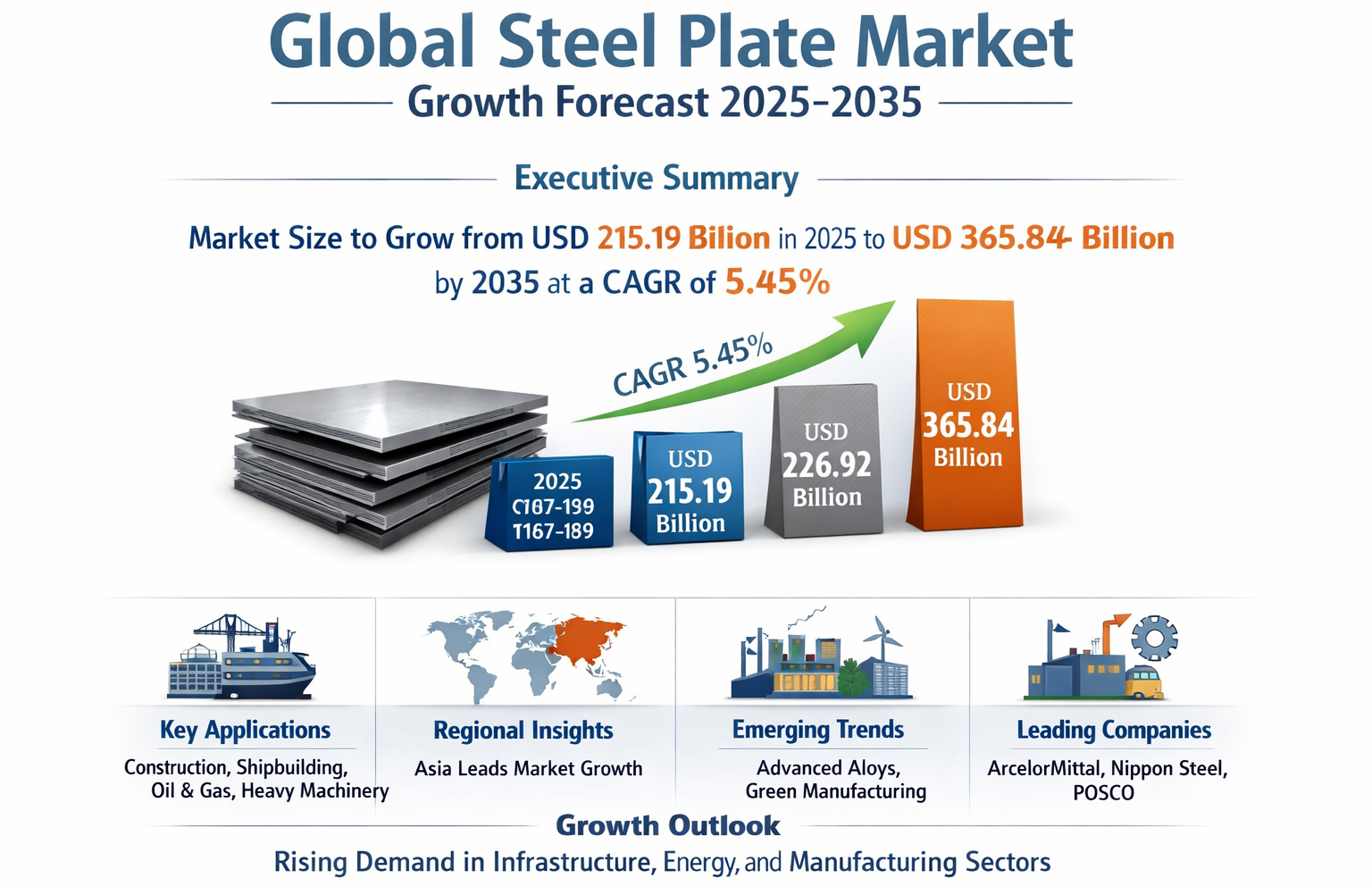
The global steel plate market is on a steady growth path, with a projected market size of USD 215.19 billion in 2025. The market is expected to grow significantly, reaching USD 226.92 billion in 2026 and expanding to USD 365.84 billion by 2035, with a robust compound annual growth rate (CAGR) of 5.45% from 2026 to 2035. This growth is driven by increasing demand across key industries such as construction, automotive, energy, and infrastructure, as well as innovations in steel manufacturing processes. The market is expected to be shaped by evolving trends in steel production, sustainability efforts, and regional demand dynamics.
What Are the Primary Drivers for the Steel Plate Market?
1. Rising Demand in Construction and Infrastructure
- Impact: The construction and infrastructure sectors are major consumers of steel plates due to their strength, versatility, and ability to withstand high stress.
- Drivers: Rapid urbanization, infrastructure development in emerging economies, and increased demand for residential and commercial buildings are major contributors to steel plate consumption.
2. Automotive Industry Growth
- Impact: Steel plates are widely used in the automotive sector, particularly in the manufacturing of car bodies, frames, and structural components.
- Drivers: The growth of the automotive industry, especially in emerging markets, along with the shift towards lightweight materials to enhance fuel efficiency, is driving demand for high-performance steel plates.
3. Energy Sector and Renewable Energy Initiatives
- Impact: Steel plates are integral to the construction of energy infrastructure, such as wind turbines, pipelines, and power plants.
- Drivers: The global push toward renewable energy and the increasing need for energy-efficient infrastructure are driving growth in the energy sector’s demand for steel plates.
4. Technological Advancements in Steel Manufacturing
- Impact: Innovations in steel manufacturing, such as the development of high-strength steel plates and advanced coatings, have led to enhanced durability, efficiency, and applications.
- Drivers: Improved production technologies, such as electric arc furnaces and automated rolling mills, are boosting steel plate quality and reducing production costs.
Key Segments and Trends
1. By Application
- Construction and Infrastructure:
- Market Share: Significant contributor to the steel plate market, driven by global infrastructure and urbanization projects.
- Growth Drivers: The expansion of cities, industrial zones, and the need for sustainable buildings and structures.
- Automotive:
- Market Share: A crucial segment for the automotive industry’s lightweight and strong steel plate requirements.
- Growth Drivers: Increasing demand for automobiles, especially in emerging economies, and the industry’s shift towards fuel-efficient and eco-friendly vehicles.
- Energy:
- Market Share: Steel plates are essential in power generation, including nuclear, wind, and solar energy plants.
- Growth Drivers: Growing investments in renewable energy infrastructure and energy diversification initiatives.
- Shipbuilding:
- Market Share: Steel plates are used extensively in shipbuilding due to their ability to withstand harsh marine environments.
- Growth Drivers: The global demand for shipping and offshore oil and gas exploration activities.
2. By Type of Steel Plate
- Carbon Steel Plates:
- Usage: Widely used in structural applications due to their strength and durability, carbon steel plates are crucial for industries such as construction and automotive.
- Alloy Steel Plates:
- Usage: These plates offer enhanced resistance to heat, pressure, and corrosion, making them ideal for the energy and shipbuilding sectors.
- Stainless Steel Plates:
- Usage: Used for their resistance to corrosion and aesthetic appeal in industries such as automotive, construction, and heavy machinery.
3. By Region
- Asia Pacific:
- Market Share (2025): 60%
- Growth Drivers: The Asia Pacific region, led by China, India, and Japan, dominates the global steel plate market due to rapid industrialization, infrastructure development, and automotive production.
- Forecast: Continued growth driven by ongoing urbanization, infrastructure expansion, and automotive demand in the region.
- North America:
- Growth Drivers: North America is expected to see steady growth, particularly driven by the U.S. and Canada, which are major players in the energy, automotive, and construction sectors.
- Forecast: The demand for high-performance steel plates in renewable energy, automotive, and infrastructure projects will fuel market growth.
- Europe:
- Growth Drivers: Europe’s focus on sustainability and renewable energy infrastructure is boosting demand for steel plates in construction and energy sectors.
- Forecast: The European market is expected to grow as countries move toward carbon-neutral and energy-efficient buildings and infrastructure.
- Latin America and Middle East & Africa:
- Growth Drivers: These regions will see increasing demand for steel plates due to energy projects, infrastructure development, and the automotive industry.
- Forecast: The market will grow, particularly in energy and construction, driven by government policies and private sector investments in renewable energy.
Emerging Technological Shifts
1. Advanced Steel Production Technologies
- Impact: New manufacturing techniques, such as direct reduced iron (DRI) and advanced rolling processes, are improving the efficiency and quality of steel plates.
- Trend: Companies are focusing on improving production efficiency while reducing energy consumption and emissions.
2. Sustainability and Recycling
- Impact: The steel industry is embracing sustainability through recycling and reducing the carbon footprint of production processes.
- Trend: The adoption of electric arc furnaces and the increased use of recycled steel in plate production are contributing to a greener steel industry.
3. Smart Manufacturing and Automation
- Impact: Automation in steel plate production enhances precision, speed, and consistency, allowing manufacturers to meet rising demand while reducing costs.
- Trend: The integration of AI, IoT, and robotics is revolutionizing the steel plate manufacturing process, enhancing production speed and reducing human error.
Competitive Landscape
The steel plate market is highly competitive, with several global players dominating production and distribution:
- ArcelorMittal: A leading player in the steel industry, offering a wide range of steel plates for construction, automotive, and energy applications.
- POSCO: A major producer of steel plates, with a strong presence in Asia and Europe, specializing in high-strength and alloy steel plates.
- Nippon Steel Corporation: Known for its advanced steel manufacturing technologies and large-scale production capabilities, serving industries such as automotive and energy.
- Baosteel: One of the largest producers of steel plates in China, offering a variety of products used in construction, energy, and shipbuilding.
- Tata Steel: A significant player in the global steel market, producing high-quality steel plates for a wide range of industrial applications.
Recent Strategic Moves:
- ArcelorMittal: Announced an expansion in its production of high-strength steel plates for the automotive industry to meet growing demand.
- POSCO: Invested in a new, state-of-the-art facility in the U.S. to cater to the automotive and energy sectors.
- Tata Steel: Focused on sustainability initiatives by increasing the use of recycled steel in its production processes.
Data Presentation: Steel Plate Market Overview
| Region | Market Share (2025) | CAGR (2026-2035) | 2025 Market Size (USD Billion) | 2035 Market Size (USD Billion) |
|---|---|---|---|---|
| Asia Pacific | 60% | Strong Growth | 129.11 | 219.50 |
| North America | 15% | Steady Growth | 32.28 | 53.77 |
| Europe | 14% | Moderate Growth | 30.13 | 51.57 |
| Rest of the World | 11% | Moderate Growth | 23.67 | 41.00 |
Conclusion: Future Outlook for the Steel Plate Market
The steel plate market is expected to grow steadily over the next decade, driven by key sectors such as construction, automotive, energy, and shipbuilding. Technological advancements in steel production, sustainability efforts, and increasing demand from emerging markets will shape the market’s future. The Asia Pacific region will continue to dominate, while North America and Europe will see steady growth due to strong demand from automotive, energy, and infrastructure sectors. With innovation in manufacturing processes and a growing focus on sustainability, the steel plate market is set for a dynamic and competitive future.


Leave a Reply