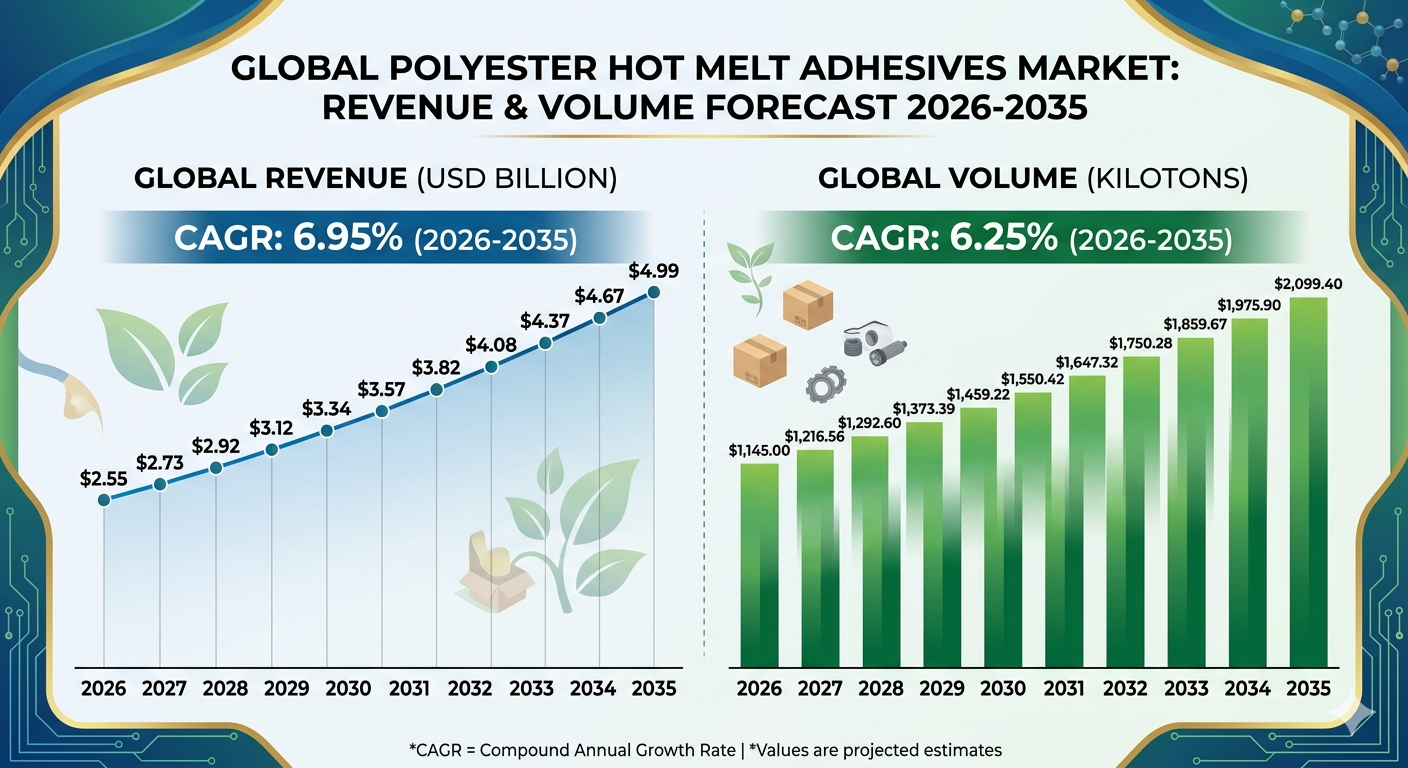
The global Polyester Hot Melt Adhesives (PHMA) Market is entering a period of steady industrial integration as sectors move away from solvent-based systems. Valued at USD 2.55 billion in 2025, the market is anticipated to rise to USD 2.73 billion in 2026 and reach a projected valuation of USD 4.99 billion by 2035. This represents a steady CAGR of 6.95%. By 2032, the market is expected to reach an estimated value of approximately USD 4.07 billion, driven by the dual imperatives of high-speed industrial automation and stringent environmental safety standards.
Market Overview: What is the Significance of the PHMA Market?
The polyester hot melt adhesives market is a critical pillar of the modern specialty chemicals sector, providing high-performance, thermoplastic bonding solutions often referred to as PET-based or copolyester adhesives. These materials are prized for their ability to provide strong, flexible bonds across disparate substrates such as textiles, plastics, and metals. As a Senior Analyst, I observe that the market’s significance lies in its “fast-setting” nature, which is essential for high-throughput manufacturing lines in packaging and automotive assembly. Unlike traditional adhesives, PHMAs are 100% solid systems, eliminating the need for drying time and reducing the overall carbon footprint of the production line.
What is the Projected Market Growth?
Growth in this sector is remarkably consistent across both value and volume metrics. The market revenue is scaling at a 6.95% CAGR, while the volume is projected to grow from 1,145 kilotons in 2025 to 2,099.4 kilotons by 2035. This volume expansion is supported by a 6.25% CAGR, reflecting the increasing adoption of PHMAs in emerging economies where industrial manufacturing is rapidly modernizing.
What are the Key Market Trends?
-
E-commerce Packaging Surge: The explosion of home delivery services is driving demand for durable, tamper-evident sealing solutions in the food and beverage sectors.
-
Automotive Lightweighting: Adhesives are increasingly replacing heavy mechanical fasteners to reduce vehicle mass and improve fuel efficiency.
-
Bio-based Innovation: Substantial R&D investment is flowing into bio-sourced polyester resins to reduce dependence on fossil-fuel feedstocks.
-
Rise of Reactive PHMAs: A shift toward reactive grades that offer superior heat and chemical resistance compared to traditional linear types.
-
Online Distribution Channels: The digital procurement of industrial adhesives is the fastest-growing sales segment, scaling at a 7.9% CAGR.
What are the Recent Government Initiatives?
Governments worldwide are implementing regulations that act as strong tailwinds for the PHMA market. In the European Union, the REACH (Registration, Evaluation, Authorisation and Restriction of Chemicals) framework continues to tighten restrictions on Volatile Organic Compounds (VOCs), effectively mandating a shift from solvent-based adhesives to 100% solid hot melts. Similarly, in Asia-Pacific, national “Green Manufacturing” policies in China and India provide tax incentives for companies adopting solvent-free bonding technologies to improve workplace safety and air quality. In North America, the EPA’s focus on reducing hazardous air pollutants in automotive manufacturing has led to the widespread adoption of polyester hot melts for interior trim and upholstery bonding. These initiatives are not merely regulatory hurdles but are essential drivers that ensure the long-term viability of eco-friendly adhesive solutions.
What are the Benefits of Using Polyester Hot Melt Adhesives?
The primary advantage of PHMAs is their superior adhesion to synthetic fibers and plastics, making them indispensable for the textile and automotive industries. They offer excellent wash and dry-clean resistance, which is a critical requirement for apparel bonding. Furthermore, these adhesives provide high thermal stability and a long shelf life, reducing waste in the supply chain. From a process efficiency standpoint, their rapid set time allows for near-instantaneous bonding, which is vital for the high-speed machinery used in the modern packaging industry.
What Are the Key Factors Driving the Market?
The market is primarily driven by the Automotive Lightweighting Trend, where PHMAs are used for emblem attachment, door panels, and upholstery to replace heavier components. Additionally, the Packaging and E-commerce industries are driving volume as they require reliable sealing for global shipping. The Sustainability Focus remains a core driver, as corporate ESG commitments force manufacturers to look for low-VOC and bio-based alternatives to traditional bonding agents.
Why is this Market Important?
This market is important because it acts as the “industrial glue” for the circular economy. By providing high-performance bonds that are also thermoplastic, PHMAs facilitate easier recycling of components at the end of their life compared to thermoset adhesives. It is a critical enabler for the automotive, packaging, and textile industries to reach their sustainability and efficiency goals simultaneously.
Key Segments & Regional Insights
The market is geographically and technologically diverse, with Asia-Pacific maintaining a dominant 42% share in 2025. This region’s dominance is expected to continue, growing at a 7.8% CAGR due to the massive textile and electronics manufacturing hubs in China, Vietnam, and India. Europe follows with a 24% share, driven by high environmental standards and advanced automotive manufacturing.
-
By Type: Linear polyesters led with a 38% share in 2025, but Reactive PHMAs are the growth leaders at 7.8% CAGR.
-
By Form: Granules/Pellets are the standard (46% share), while Films are the fastest-growing form at 7.2% CAGR.
-
By Application: Packaging is the largest segment (32% share), but the Automotive segment is accelerating at 7.5% CAGR.
Competitive Landscape: Top Companies
The competitive environment is characterized by large chemical conglomerates focusing on “green” resin development and specialized performance additives. Strategic moves currently focus on acquisitions that bolster bio-based portfolios.
1. Henkel AG & Co. KGaA
-
About: A global leader in adhesive technologies, headquartered in Germany.
-
Products: Technomelt® high-performance polyester hot melts for automotive and electronics.
-
Market Cap: ~USD 30–35 Billion.
2. H.B. Fuller Company
-
About: A major American player focused exclusively on adhesive manufacturing.
-
Products: Advantra® and specialized polyester solutions for packaging.
-
Market Cap: ~USD 4–5 Billion.
3. Arkema (Bostik)
-
About: A French specialty chemicals giant; its Bostik division is a pioneer in hot melt tech.
-
Products: Vitel® copolyester resins for high-performance bonding.
-
Market Cap: ~USD 7–8 Billion.
4. Jowat SE
-
About: A German-based specialist in industrial adhesives with a strong global presence.
-
Products: Jowat-Toptherm® polyester hot melts.
-
Market Cap: Private (Significant market presence).
Data Presentation & Trade Insights
The following table structure is recommended for clarifying the pricing and volume trajectory for stakeholders:
-
Average Manufacturing Price (2025): USD 2.66/kg
-
Average Selling Price (2025): USD 3.86/kg
-
Pricing CAGR (2025–2035): 3.45%
-
Dominant Distribution Channel: Direct Sales (48% share)
-
Growth Leader (Sales): Online Sales (7.9% CAGR)
Recent Developments: Leading manufacturers have recently launched low-application temperature PHMAs, which significantly reduce energy consumption in the packaging industry. Furthermore, the development of copolyester adhesive films (growing at 7.2%) is allowing for ultra-thin bonding in the wearables and electronics sectors.
Which segment accounted for the largest Market share?
In 2025, the Asia-Pacific region (42%), Linear Polyester types (38%), and Packaging applications (32%) held the largest market shares. The Direct Sales channel also remained the primary route to market with a 48% share.
Future of the Market & Conclusion
The future of the Polyester Hot Melt Adhesives market lies in functional integration. We are moving toward “Smart Adhesives” that can offer conductivity for electronic textiles or reversible bonding to facilitate easier recycling of automotive parts. By 2035, the industry will likely be dominated by Bio-based Reactive systems that offer the strength of structural adhesives with the sustainability of renewable feedstocks. As the global manufacturing sector continues its transition toward automation and eco-efficiency, PHMAs will remain an indispensable tool for engineers and designers worldwide.
About Us
Towards Chemical and Materials is a leading global consulting firm specializing in providing comprehensive and strategic research solutions across the chemical and materials industries. With a highly skilled and experienced consultant team, we offer a wide range of services designed to empower businesses with valuable insights and actionable recommendations.
Our Trusted Data Partners
Precedence Research | Statifacts | Towards Packaging | Towards Healthcare | Towards Food and Beverages | Towards Chemical and Materials | Towards Consumer Goods | Nova One Advisor |
For Latest Update Follow Us: https://www.linkedin.com/company/towards-chem-and-materials/
USA: +1 804 441 9344
APAC: +61 485 981 310 or +91 87933 22019
Europe: +44 7383 092 044
Email: [email protected]


Leave a Reply