Market Overview
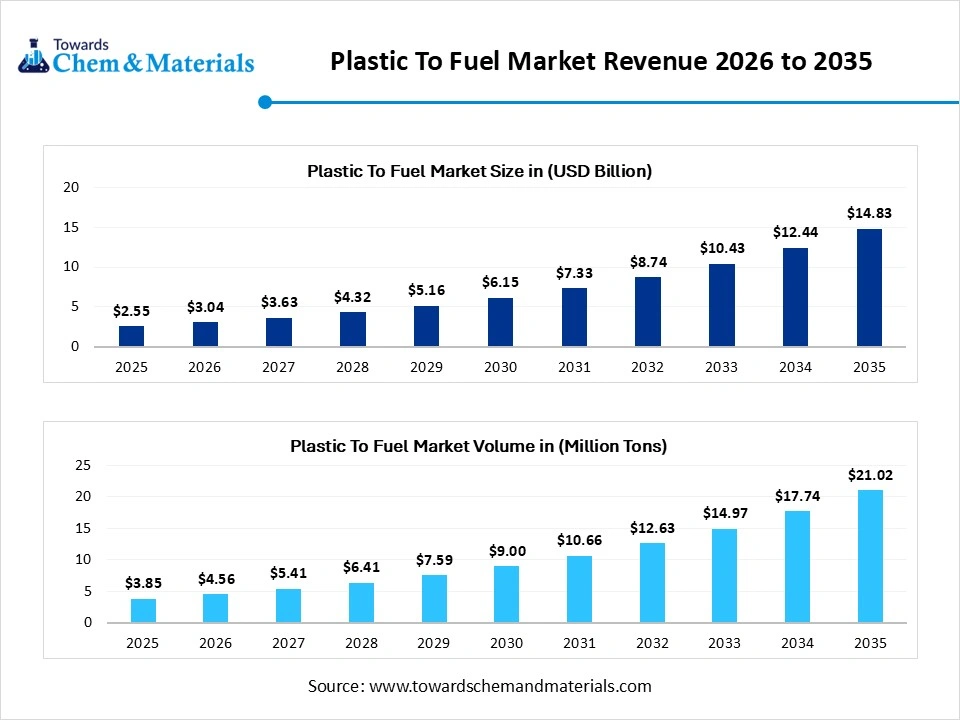
The global Plastic to Fuel (PTF) market is experiencing remarkable growth, driven by rising demand for sustainable waste management solutions and clean energy alternatives. Valued at USD 2.55 billion in 2025, the market is expected to reach an impressive USD 14.83 billion by 2035, marking a substantial compound annual growth rate (CAGR) of 19.25% from 2026 to 2035. The increasing volume of plastic waste being converted into fuel, which is forecast to rise from 3.85 million tons in 2025 to 21.02 million tons by 2035, further emphasizes the market’s promising growth trajectory. This growth is driven by a shift towards sustainable waste-to-energy technologies and the growing demand for alternative energy sources, as environmental concerns around plastic waste intensify globally.
What is Market Growth?
The Plastic to Fuel market is experiencing rapid growth, fueled by the increasing recognition of the importance of waste-to-energy solutions. The market is forecast to grow at a CAGR of 19.25% between 2026 and 2035, expanding its size from USD 2.55 billion in 2025 to USD 14.83 billion by 2035. As more companies and countries adopt plastic-to-fuel technologies, the demand for such solutions will continue to rise, driven by the need to tackle plastic waste, produce alternative energy, and meet global sustainability targets.
In terms of volume, the market is projected to grow significantly from 3.85 million tons in 2025 to 21.02 million tons by 2035, reflecting a CAGR of 18.5%. This indicates that plastic-to-fuel technology will not only become more widespread but will also significantly contribute to reducing global plastic waste and generating cleaner energy.
Market Size and Volume Forecast
- Market Estimated Size (2025): USD 2.55 Billion | CAGR (2026–2035): 19.25%
- Market Projected Size (2035): USD 14.83 Billion
- Market Volume (2025): 3.85 Million Tons (MT) | Volume CAGR (2026–2035): 18.5%
- Market Projected Volume (2035): 21.02 Million Tons (MT)
- Market Pricing (2025):
- Average Manufacturing Price: USD 519/ton
- Average Selling Price: USD 768/ton
- Pricing CAGR (2025–2035): 5.7%
Key Takeaways
- By region, Asia Pacific dominated the market in 2025, with 32% share, and is expected to be the fastest-growing in the market, with a CAGR of 21.10% in the forecast period.
- By region, Europe is notably growing with 26% market share in 2025.
- By technology, the pyrolysis segment dominated the market with 62% share in 2025.
- By technology type, the depolymerization segment held 14% market share in 2025 and is expected to be the fastest-growing in the market, with a CAGR of 20.3% in the forecast period.
- By feedstock type, the polyethylene segment dominated the market with 33% share in 2025.
- By feedstock type, the mixed plastic waste segment held 24% market share in 2025 and is expected to be the fastest-growing in the market, with a CAGR of 20.5% in the forecast period.
- By fuel type, the diesel segment dominated the market with 41% share in 2025.
- By fuel type, the gasoline segment held 22% market share in 2025 and is expected to be the fastest-growing in the market, with a CAGR of 19.4% in the forecast period.
- By end-use industry, the transportation segment dominated the market with 38% share in 2025.
- By end-use industry, the residential & commercial heating segment held 17% market share in 2025 and is expected to be the fastest-growing in the market, with a CAGR of 19.6%.
Key Market Trends
- Sustainability and Circular Economy: The transition towards a circular economy is one of the major drivers of the Plastic to Fuel market. By converting plastic waste into usable fuel, industries are reducing plastic pollution while addressing energy needs. This trend is gaining momentum, as it aligns with global efforts to reduce landfill waste and curb environmental pollution.
- Technological Advancements: Innovations in plastic-to-fuel technologies, such as pyrolysis and gasification, are enhancing the efficiency of plastic waste conversion. These technologies are becoming more cost-effective and environmentally friendly, attracting investments from both public and private sectors.
- Government Regulations and Initiatives: As governments worldwide push for more sustainable energy practices, regulations are being implemented that support the adoption of waste-to-energy technologies. Incentives for companies that incorporate eco-friendly practices, such as waste plastic recycling and conversion into fuel, are expected to fuel market growth.
- Increased Demand for Renewable Energy: The global push for renewable energy sources has increased the attractiveness of alternative fuels produced from plastic waste. The Plastic to Fuel market benefits from this trend, as it provides a renewable energy source that helps reduce reliance on fossil fuels.
Market Recent Government Initiatives
Governments across the globe have implemented various policies to encourage the growth of the Plastic to Fuel market. These initiatives often focus on supporting sustainable energy practices and reducing plastic pollution:
- Environmental Regulations: Countries are introducing stricter environmental laws that require companies to adopt sustainable waste management solutions, including plastic waste recycling and conversion into fuel.
- Subsidies and Incentives: Many governments are offering subsidies and tax incentives to companies that invest in plastic-to-fuel technologies, thereby encouraging investment in research and development.
- Partnerships for Waste Management: Governments are collaborating with private companies to establish large-scale plastic recycling plants, which convert waste plastic into valuable fuel. This collaboration ensures that plastic-to-fuel technologies are effectively integrated into the global waste management systems.
Market Benefits of Using Plastic to Fuel
The Plastic to Fuel market offers several notable benefits:
- Waste Reduction: One of the most significant benefits is the ability to reduce plastic waste, which is a growing environmental concern. By converting plastic waste into fuel, the market helps to mitigate the impact of plastic pollution on oceans, landfills, and wildlife.
- Energy Generation: Converting plastic into fuel provides a valuable alternative energy source, which is vital in reducing reliance on fossil fuels. This fuel can be used in a wide range of industries, including transportation, electricity generation, and heating.
- Sustainability: Plastic to fuel technology contributes to a more sustainable future by addressing the dual challenges of plastic waste and energy production. It supports the transition towards a circular economy, where waste is recycled and reused rather than discarded.
- Economic Benefits: By turning waste into a valuable commodity, the market opens up new economic opportunities. Companies involved in the plastic-to-fuel industry benefit from cost-effective waste management, while governments can reduce the financial burden of managing plastic waste.
Key Factors Driving The Market
Several key factors are contributing to the growth of the Plastic to Fuel market:
- Plastic Waste Crisis: The global accumulation of plastic waste, which is not easily biodegradable, creates a major environmental issue. The need for effective waste management solutions has driven the adoption of plastic-to-fuel technology.
- Energy Demand: The growing global demand for alternative energy sources is another driving factor. Plastic to fuel provides a renewable energy source that helps reduce dependence on traditional fossil fuels.
- Technological Innovation: Advances in pyrolysis and gasification technologies are making plastic-to-fuel conversion more efficient and cost-effective. These innovations are key to the widespread adoption of this technology.
- Government Support: Policies that promote recycling, waste-to-energy projects, and clean energy have further accelerated market growth. Subsidies and incentives from various governments are making it more attractive for companies to invest in plastic-to-fuel projects.
Future of the Market
The future of the Plastic to Fuel market looks incredibly promising. As the world increasingly shifts towards sustainability, plastic-to-fuel technologies will continue to evolve and play a crucial role in both waste management and energy generation. The integration of more efficient conversion technologies will reduce the cost of production, making plastic-to-fuel solutions more accessible worldwide.
Additionally, as governments strengthen environmental regulations and push for cleaner energy sources, the market is expected to see a surge in demand for plastic-to-fuel technologies. By 2035, plastic-to-fuel technology will likely become an essential part of global waste management and energy production systems.
Why Is This Market Important?
The Plastic to Fuel market is important for several reasons. It provides a solution to the ever-growing problem of plastic waste, one of the most persistent and harmful pollutants on the planet. By turning waste into valuable fuel, this market contributes to both environmental sustainability and energy security. Moreover, the market offers an innovative way to bridge the gap between waste management and renewable energy production, helping to create a more sustainable, circular economy.
Key Companies to Mention
Some of the leading players in the Plastic to Fuel market include:
- Plastic Energy: Known for its innovative technology that converts waste plastics into synthetic oils and other valuable fuels.
- Agilyx: Specializes in advanced recycling solutions and converting waste plastics into high-value fuels and chemicals.
- Redox Energy: Focuses on developing cost-effective, scalable solutions for plastic-to-fuel technologies.
- Carbios: A pioneer in biotechnology, Carbios focuses on the enzymatic recycling of plastic waste and its conversion into usable fuels.
- Bioforcenergy: A key player in promoting sustainable waste management practices, Bioforcenergy specializes in converting plastic waste into liquid fuels.
Which Segment Accounted for the Largest Market Share?
The largest market share in the Plastic to Fuel market is accounted for by the pyrolysis segment. Pyrolysis is the most common technology used for converting plastic waste into fuel. It involves heating the plastic in the absence of oxygen to break it down into smaller molecules, which are then converted into valuable products like synthetic oil, diesel, and gasoline. This method is favored due to its efficiency, scalability, and relatively low cost of implementation.
Contact Us https://www.towardschemandmaterials.com/contact-us
About Us
Towards Chem and Materials is a leading global consulting firm specializing in providing comprehensive and strategic research solutions across the chemical and materials industries. With a highly skilled and experienced consultant team, we offer a wide range of services designed to empower businesses with valuable insights and actionable recommendations.
Email: [email protected]
Web: https://www.towardschemandmaterials.com/
For Latest Update Follow Us: https://www.linkedin.com/company/towards-chem-and-materials/?viewAsMember=true


Leave a Reply