Market Overview
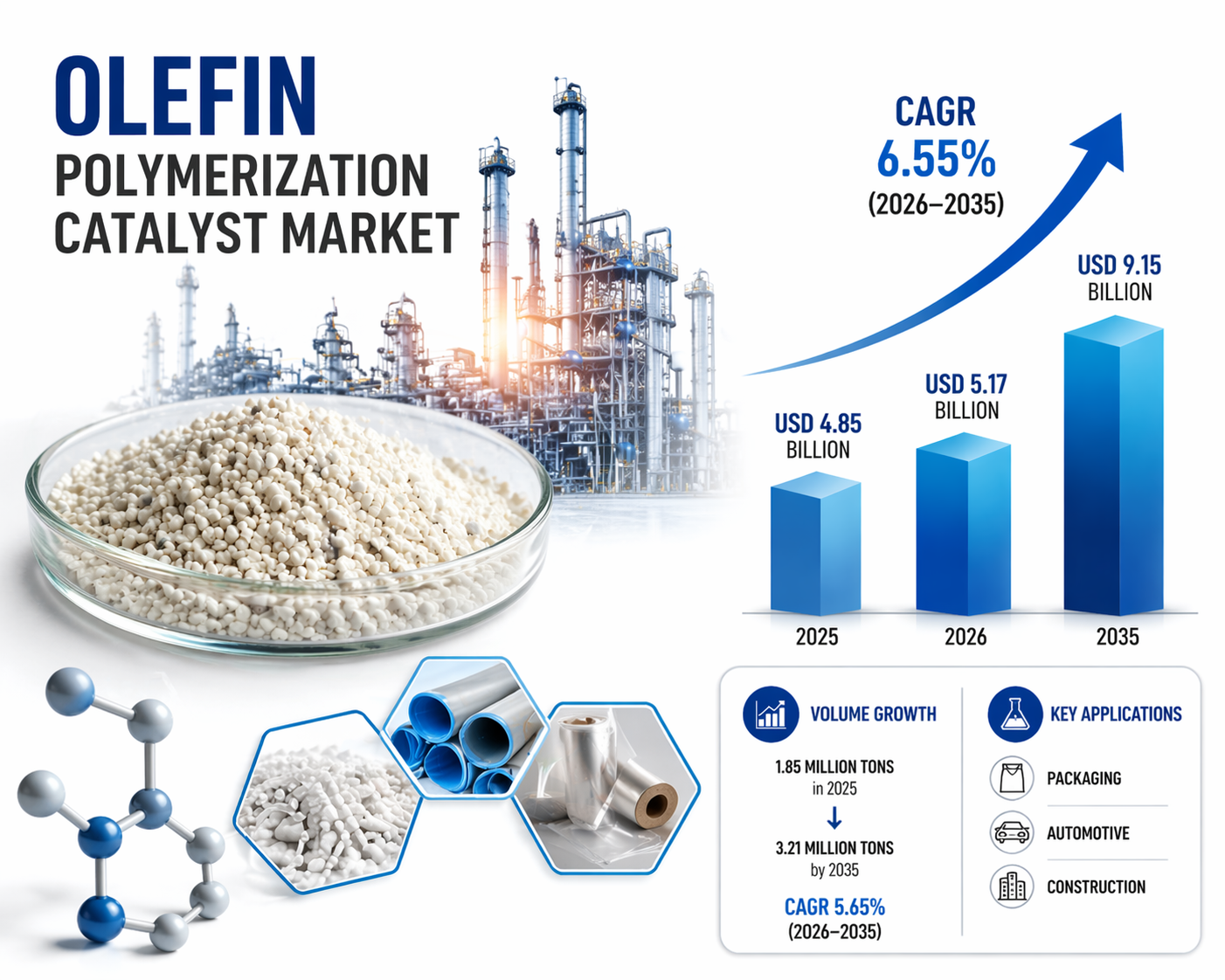
The Olefin Polymerization Catalyst market is set for significant growth in the coming years. Valued at USD 4.85 billion in 2025, the market is projected to reach USD 9.15 billion by 2035, growing at a compound annual growth rate (CAGR) of 6.55% from 2026 to 2035. Olefin polymerization catalysts play a pivotal role in the production of various olefin-based polymers, which are integral to a broad spectrum of industries such as automotive, packaging, and construction. Their ability to enhance the efficiency of polymerization reactions makes them indispensable in the manufacturing of products ranging from plastics to fibers.
What is Market Growth?
The global Olefin Polymerization Catalyst market is poised to expand at a steady pace. From 2025 to 2035, the market is expected to grow at a CAGR of 6.55% in terms of value, reaching USD 9.15 billion by 2035. In terms of volume, the market is projected to grow from 1.85 million tons in 2025 to 3.21 million tons by 2035, at a CAGR of 5.65%. This consistent growth is driven by the increasing demand for high-performance materials in key industries like packaging, automotive, and construction.
Key Takeaways
- By region, Asia Pacific dominated the market with a share of 48% in 2025 and is expected to sustain its position while growing with a CAGR of 7.00% in the forecast period.
By region, North America held the market share of 19% in 2025. - By catalyst type, the Ziegler-Natta Catalysts segment dominated the market with 52% share in 2025.
- By catalyst type, the metallocene catalysts segment held 28% market share in 2025 and is expected to have the fastest growth with a CAGR of 7.40% in the forecast period.
- By polymer type, the polyethylene (PE) segment dominated the market with 49% share in 2025.
- By polymer type, the polypropylene (PP) segment held 38% market share in 2025 and is expected to have the fastest growth with a CAGR of 6.1% in the forecast period.
- By application, the packaging segment dominated the market with 44% share in 2025 and is expected to have the fastest growth with a CAGR of 6.80% in the forecast period.
- By end-use industry, the plastics & polymers segment dominated the market with 46% share in 2025.
- By end-use industry, the electrical & electronics segment held 11% market share in 2025 and is expected to have the fastest growth with a CAGR of 6.60% in the forecast period.
- By distribution channel, the direct sales segment dominated the market with 47% share in 2025.
- By distribution channel, the contract supply agreements segment held 22% market share in 2025 and is expected to have the fastest growth with a CAGR of 6.50% in the forecast period.
Market Size and Volume Forecast
- Market Estimated Size (2026): USD 5.17 Billion | CAGR (2026–2035): 6.55%
- Market Projected Size (2035): USD 5.17 Billion
- Market Volume (2025): 1.85 Million Tons (MT) | Volume CAGR (2026–2035): 5.65%
- Market Projected Volume (2035): 3.21 Million Tons (MT)
- Market Pricing (2025):
- Average Manufacturing Price: USD 2,860/ton
- Average Selling Price: USD 3,780/ton
- Pricing CAGR (2025–2035): 4.25%
What Are the Key Market Trends?
- Increasing Demand for High-Performance Polymers: With industries focusing on lightweight, durable, and sustainable materials, there is a growing demand for olefin polymers in automotive and packaging applications. This trend is boosting the need for efficient polymerization catalysts that can facilitate the production of advanced materials.
- Technological Advancements in Catalyst Design: The development of new, more efficient catalysts is a key trend in the market. Innovations such as single-site catalysts and Ziegler-Natta catalysts are being introduced to enhance the speed and selectivity of polymerization reactions, resulting in higher-quality polymers.
- Shift Toward Sustainable Manufacturing: As the demand for eco-friendly materials increases, there is a shift toward catalysts that can enable the production of bio-based and recyclable polymers. This trend is gaining traction in industries like packaging, where sustainability is a growing concern.
- Adoption of Automation and AI in Catalyst Production: The increasing use of automation and artificial intelligence (AI) in catalyst production is driving efficiency and cost-effectiveness in the market. These technologies allow manufacturers to optimize the production process, resulting in better yield and lower operational costs.
What are Recent Government Initiatives in the Market?
Governments worldwide are prioritizing sustainability and eco-friendly manufacturing practices, which directly impact the olefin polymerization catalyst market. Initiatives aimed at reducing carbon emissions, such as green chemistry programs and regulations promoting the use of recyclable materials, are driving the demand for more sustainable catalysts. Governments are also encouraging research and development in materials science, funding projects that focus on improving catalyst efficiency and reducing their environmental footprint.
What Are the Market Benefits of Using Olefin Polymerization Catalysts?
- Enhanced Polymer Quality: Olefin polymerization catalysts are essential in producing high-quality polymers with desirable properties such as better strength, flexibility, and heat resistance. These characteristics are vital for industries such as automotive, packaging, and construction.
- Increased Production Efficiency: By using advanced catalysts, manufacturers can increase the efficiency of the polymerization process, reducing energy consumption and improving yield. This leads to significant cost savings in production.
- Sustainability: With growing environmental concerns, the use of olefin polymerization catalysts that facilitate the production of recyclable and bio-based polymers is becoming more critical. These catalysts help reduce waste and contribute to a more sustainable manufacturing process.
- Cost Reduction: The development of highly efficient catalysts reduces the need for excess raw materials, helping manufacturers lower production costs. Furthermore, the use of catalysts allows for faster production cycles, which can increase overall output.
What Are the Key Factors Driving the Market?
- Growing Demand for Olefin Polymers: The demand for olefin polymers, especially polyethylene and polypropylene, continues to rise due to their widespread use in packaging, automotive parts, and textiles. This, in turn, is driving the need for effective polymerization catalysts.
- Technological Advancements in Catalyst Design: The continuous innovation in catalyst technology, including the development of more efficient and selective catalysts, is a significant driver for the market. These advancements help manufacturers meet the increasing demand for high-quality and specialized polymers.
- Sustainability and Eco-Friendly Solutions: The growing focus on sustainable manufacturing practices, driven by both government regulations and consumer demand for environmentally friendly products, is pushing for the use of catalysts that enable the production of recyclable and bio-based polymers.
- Rising Demand from Emerging Economies: The expansion of industries like automotive, packaging, and textiles in emerging economies is contributing to the demand for olefin polymerization catalysts. As these industries grow, so does the need for efficient catalysts to produce the polymers required for various applications.
What is the Future of the Olefin Polymerization Catalyst Market?
The future of the Olefin Polymerization Catalyst market looks promising. With an estimated market size of USD 5.17 billion in 2026, the market is expected to continue its upward trajectory, reaching USD 9.15 billion by 2035. This growth will be driven by technological innovations, the increasing demand for high-performance polymers, and a shift toward more sustainable manufacturing practices. The market will likely witness the development of new catalysts that offer higher efficiency, selectivity, and eco-friendliness, enabling the production of polymers that meet the evolving needs of industries such as automotive, packaging, and construction.
Why is the Olefin Polymerization Catalyst Market Important?
The Olefin Polymerization Catalyst market is essential because these catalysts are crucial to the production of a wide range of polymers that form the backbone of numerous industries. From packaging materials to automotive components, the demand for high-quality olefin polymers continues to rise, making the role of catalysts indispensable. Moreover, the market’s growth is aligned with global trends toward sustainability and efficiency, as catalysts help reduce waste and energy consumption in polymer production. As industries evolve and demand for advanced materials increases, the olefin polymerization catalyst market will play a central role in shaping the future of manufacturing.
Key Companies in the Olefin Polymerization Catalyst Market
Several major companies are leading the way in the development and production of olefin polymerization catalysts. These include:
- BASF SE
- Clariant AG
- LyondellBasell Industries N.V.
- ExxonMobil Chemical Company
- Chevron Phillips Chemical Company
- Haldor Topsoe
- The Dow Chemical Company
These companies are not only contributing to the growth of the olefin polymerization catalyst market but are also heavily involved in research and development to create more efficient and sustainable catalysts.
Which Segment Accounted for the Largest Market Share?
The polyethylene and polypropylene segments account for the largest share of the Olefin Polymerization Catalyst market. These two polymers are the most widely produced olefins due to their extensive use in packaging, automotive components, textiles, and consumer goods. The demand for these polymers continues to rise, especially in the packaging industry, where polyethylene and polypropylene are used in everything from food packaging to household items. As a result, the catalysts used to produce these materials dominate the market.
The automotive and construction sectors are also growing rapidly, and with them, the demand for specific polymers designed for durability and performance. These trends further reinforce the dominance of polyethylene and polypropylene in the olefin polymerization catalyst market.
About Us
Towards Chemical and Materials is a leading global consulting firm specializing in providing comprehensive and strategic research solutions across the chemical and materials industries. With a highly skilled and experienced consultant team, we offer a wide range of services designed to empower businesses with valuable insights and actionable recommendations.
Our Trusted Data Partners
Precedence Research | Statifacts | Towards Packaging | Towards Healthcare | Towards Food and Beverages | Towards Chemical and Materials | Towards Consumer Goods | Nova One Advisor |
For Latest Update Follow Us: https://www.linkedin.com/company/towards-chem-and-materials/
USA: +1 804 441 9344
APAC: +61 485 981 310 or +91 87933 22019
Europe: +44 7383 092 044
Email: [email protected]


Leave a Reply