Executive Summary
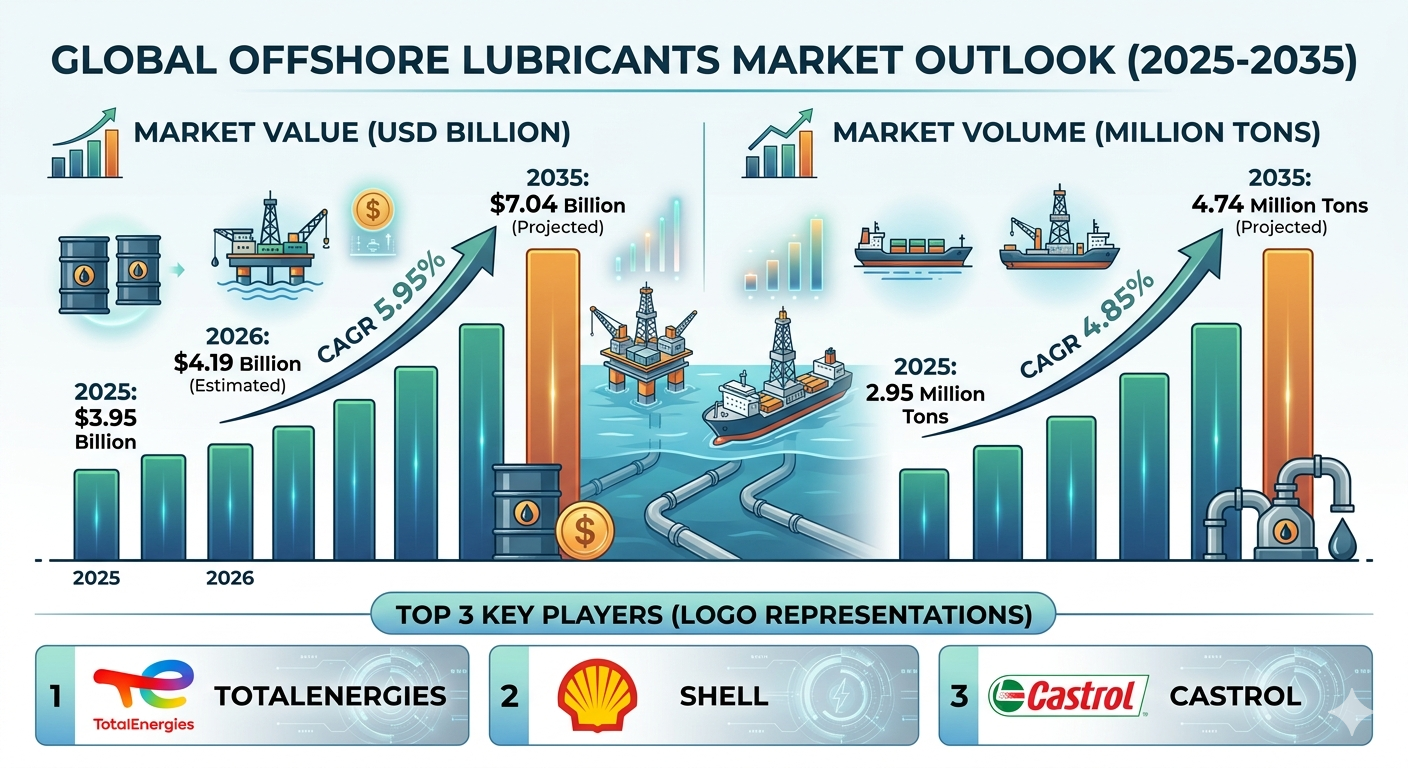
The critical role of high-performance fluids in hostile marine environments has positioned the global offshore lubricants market as an indispensable segment within the industrial chemical sector. Valued at USD 3.95 billion in 2025, the market has expanded steadily to an estimated USD 4.19 billion in 2026. Projections indicate it is on track to reach USD 7.04 billion by 2035, exhibiting a revenue Compound Annual Growth Rate (CAGR) of 5.95% over the forecast period from 2026 to 2035.
In terms of product volume, the market is poised to grow from 2.95 million tons in 2025 to 4.74 million tons by 2035, displaying a volumetric CAGR of 4.85%. By interpolating this trajectory, the market is expected to achieve a valuation of approximately USD 5.86 billion by 2032. This growth is heavily driven by deepwater oil exploration breakthroughs and massive capital investments in offshore wind installations across maritime territories.
Market Overview
What is the Offshore Lubricants Market?
The offshore lubricants market comprises highly specialized specialty formulations—such as engine oils, hydraulic fluids, gear oils, and heavy-duty greases—engineered explicitly for marine machinery operating under severe ambient conditions. Unlike onshore industrial fluids, offshore lubricants are subjected to continuous salt spray, extreme atmospheric pressures, high moisture, and volatile thermal gradients. They protect critical mechanics in drilling vessels, production platforms, supply ships, and offshore wind turbines, preventing premature equipment failure where maintenance down-time incurs catastrophic financial losses.
Why is the Offshore Lubricants Market Important?
Offshore operations exist at the intersection of extreme mechanical strain and zero-tolerance environmental regulation. These specialized lubricants are vital because they guarantee operational continuity for multi-billion-dollar installations. Without them, critical subsea mechanisms would succumb rapidly to galvanic corrosion, micro-pitting, and thermal breakdown. Furthermore, the modern market dictates a shift toward Environmentally Acceptable Lubricants (EALs) that offer high biodegradability and minimal aquatic toxicity, ensuring operators meet strict international maritime safety and ecological compliance frameworks.
Market Dynamics & Analytical Insights
What Are the Key Factors Driving the Market?
The expansion of the global offshore lubricants sector is propelled by distinct structural drivers:
-
Frontier Deepwater Subsea Developments: As shallow-water hydrocarbon fields mature, exploration and production (E&P) activities are pushing into deepwater and ultra-deepwater fields, demanding high-performance synthetic lubricants capable of withstand high-pressure, high-temperature (HPHT) reservoirs.
-
The Decarbonization Wave and Offshore Wind Capacity: Global climate policies have accelerated the buildout of mega-scale offshore wind farms. Subsea wind infrastructure demands massive quantities of specialized lubricants for main gearboxes, yaw bearings, and specialized installation vessel equipment.
-
Regulatory Compliance Constraints: Strict environment protection mandates, such as the US EPA Vessel General Permit (VGP) and international OSPAR conventions, act as catalysts for high-margin, bio-based synthetic formulations over low-cost traditional mineral oils.
What are the Primary Challenges Hampering Market Growth?
Despite favorable growth curves, the industry faces severe structural headwinds:
-
Geopolitical and Macro-Volatility: Fluctuations in crude oil prices directly destabilize capital expenditure budgets for offshore oil fields, creating a highly cyclical demand environment.
-
High Premium Costs of Bio-Formulations: Advanced synthetic and bio-based lubricants can cost up to 3 to 4 times more than mineral-based fluids, causing procurement resistance among cost-conscious shallow-water independent operators.
-
Extreme Logistics Complexity: Supplying thousands of tons of heavy fluid assets to remote marine locations requires specialized supply chains, certified bunkering networks, and rigid storage compliance.
What is the Value Proposition: Benefits of Using Advanced Offshore Lubricants?
Investing in premium-tier and synthetic offshore lubricants yields tangible operational efficiencies:
-
Extended Drain Intervals: High-performance synthetics possess superior oxidative stability, reducing fluid degradation and expanding the time required between maintenance cycles—critical for unmanned remote offshore structures.
-
Superior Corrosion Resistance: Specialized additives create a molecular barrier against saltwater ingress, curbing pitting and oxidation damage in critical load-bearing assemblies.
-
Optimal Thermal and Shear Stability: Advanced lubricants maintain consistent viscosity at freezing subsea temperatures as well as inside high-friction engine cores, protecting assets from mechanical wear.
Market Segments & Emerging Trends
Which Segment Accounted for the Largest Market Share?
The drilling operations segment claimed the largest application share at 32% in 2025, mirroring intense upstream E&P activities in global frontier basins. On a base-oil basis, mineral oils maintained a dominant market foothold of 48% due to well-established, legacy supply agreements. Regionally, Asia-Pacific captured the largest market share with 31% in 2025, concrete evidence of the region’s status as a powerhouse for maritime manufacturing and rapid infrastructure deployment.
What are the Key Market Trends & Fastest-Growing Segments?
The industry is undergoing a clear technological pivot toward sustainability and heavy-duty resilience. The fastest-growing sub-sectors highlighted in deep market modeling indicate that:
-
Offshore Wind Operations: Leading growth by end-use industry with a projected CAGR of 8.5%, fueled by long-drain synthetic demands for remote wind turbine drivetrains.
-
Renewable Offshore Applications: Anticipated to expand at the fastest application CAGR of 8.3% as global decarbonization mandates build out massive green energy marine grids.
-
Ultra-Deepwater Deep Exploration: Expected to grow at a 7.4% CAGR by water depth as technological breakthroughs expand the limits of subsea drilling.
-
Synthetic Base Oils: Advancing at a 7.2% CAGR, fast outpacing standard mineral base alternatives due to extreme performance mandates in subsea environments.
Policy & Governance: What are Recent Government Initiatives?
Regulatory frameworks heavily shape product design and demand in the global offshore lubricants sector:
-
The US EPA Vessel General Permit (VGP) Extensions: Mandates that all vessels greater than 79 feet operating within 3 nautical miles of the US coastline must utilize Environmentally Acceptable Lubricants (EALs) in all oil-to-sea interfaces.
-
The European OSPAR Convention Harmonized Mandatory Control Scheme: Restricts the chemical discharge of offshore exploration fluids in the North-East Atlantic, pushing operators to phase out non-biodegradable mineral base oils.
-
Asia-Pacific Renewable Energy Subsidies: Aggressive feed-in tariffs and maritime spatial allocations by the governments of China, South Korea, and India have drastically lowered structural barriers for offshore wind farms, directly elevating regional synthetic fluid procurement.
Competitive Landscape: Top Companies in the Market
ExxonMobil Corporation
-
About: Headquartered in Spring, Texas, ExxonMobil is a global energy giant and one of the largest refiners and marketers of petroleum-based products and specialized chemical additives worldwide.
-
Products: Mobilgard series marine engine oils, Mobil SHC Aware environment-friendly bio-synthetic lubricants, and Mobilith SHC specialized greases.
-
Market Cap: USD 642.14 billion (May 2026).
Chevron Corporation
-
About: Based in San Ramon, California, Chevron is a vertically integrated multinational energy corporation with extensive downstream chemical manufacturing capacities across global distribution hubs.
-
Products: Taro series high-performance cylinder lubricants, Clarity synthetic hydraulic fluids, and Meropa synthetic gear oils.
-
Market Cap: USD 381.26 billion (May 2026).
TotalEnergies SE (S.A.)
-
About: Operating out of Courbevoie, France, TotalEnergies is a major European multi-energy provider heavily transitioning into renewable infrastructure while maintaining top-tier marine lubricant market share.
-
Products: Aurelia and Talusia marine diesel engine oils, Biohydran biodegradable hydraulic fluids, and Carter specialized industrial gear systems.
-
Market Cap: USD 203.47 billion (May 2026).
BP Plc (Castrol Marine)
-
About: Headquartered in London, United Kingdom, BP manages its specialized marine and offshore lubricant portfolios primarily through its world-renowned premium sub-brand, Castrol.
-
Products: Castrol Cyltech cylinder oils, Castrol BioStat environmental stern-tube lubricants, and Alpha synthetic industrial gear fluids.
-
Market Cap: USD 114.23 billion (May 2026).
Shell Plc
-
About: Based in London, UK, Shell is the world’s leading global supplier of finished lubricants, maintaining complex value chain networks across more than 100 countries.
-
Products: Shell Alexia marine engine oils, Shell Naturelle bio-lubricants, and Shell Gadus specialty extreme-pressure industrial greases.
-
Market Cap: USD 261.10 billion (May 2026).
Idemitsu Kosan Co., Ltd.
-
About: Headquartered in Tokyo, Japan, Idemitsu is a premier energy and chemical corporation, specializing in synthetic oil formulations for precise heavy-industry and manufacturing applications.
-
Products: Daphne Marine series engine oils, specialized subsea hydraulic oils, and high-performance industrial turbine lubricants.
-
Market Cap: Approximately USD 6.50 billion (May 2026).
Gulf Oil International
-
About: Part of the Hinduja Group, Gulf Oil is a globally recognized commercial fluid manufacturer with an extensive marine bunkering presence spanning critical ports worldwide.
-
Products: Gulf Sea power-plant and marine main engine lubricants, Gulf Fluid specialized subsea control lines, and multi-purpose marine greases.
-
Market Cap: Privately/Conglomerate Held (Gulf Oil Lubricants India listed entity valued at ~USD 650 million).
Aegean Marine Petroleum (Frontera)
-
About: Following major corporate restructuring and asset acquisition by international energy logistics groups, the entity focuses primarily on global marine bunker supply networks and physical physical fuel/lubricant delivery.
-
Products: Specialized marine fuel blending products, mid-tier commercial fleet diesel engine oils, and generic marine greases.
-
Market Cap: Restructured / Privately Managed Asset Base.
Fuchs SE
-
About: Based in Mannheim, Germany, Fuchs is the world’s largest independent lubricant manufacturer, highly regarded for rapid R&D and tailor-made specialty chemical solutions.
-
Products: Titan marine engine oils, Renolin high-performance hydraulic fluids, and Plantogel ecologically sound, biodegradable marine greases.
-
Market Cap: Approximately USD 5.20 billion (May 2026).
What are the Strategic Moves? Market Recent Developments by Major Companies
The strategic alignment within this sector reveals a rapid consolidation around sustainable chemistries and deepwater technological capabilities:
-
ExxonMobil (Late 2025): Expanded its Mobil SHC Aware eco-friendly line to integrate next-generation bio-synthetic formulations designed to exceed stricter Vessel General Permit mandates while maintaining extreme-pressure structural integrity.
-
Shell (Early 2026): Entered long-term strategic supply partnerships with prominent European offshore wind farm developers, ensuring direct delivery of extended-drain synthetic fluids to massive multi-megawatt turbine architectures.
-
TotalEnergies (2025): Rolled out upgraded variants of its bio-degradable fluid line, targeted directly at deepwater exploration rigs operating in ecologically sensitive frontier basins.
Future of the Market & Conclusion
The future of the global offshore lubricants market is defined by a dual-axis operational challenge: supporting deepwater hydrocarbon E&P while accelerating the offshore wind transition. Over the next decade, traditional mineral oils will slowly cede market dominance to highly engineered, bio-based synthetic formulas. Companies that invest in direct OEM collaboration and formulate products with extended drain cycles will successfully capture the highly lucrative offshore wind market. As energy extraction moves into deeper, harsher marine environments, advanced offshore lubricants will remain critical to global energy infrastructure.
About Us
Towards Chemical and Materials is a leading global consulting firm specializing in providing comprehensive and strategic research solutions across the chemical and materials industries. With a highly skilled and experienced consultant team, we offer a wide range of services designed to empower businesses with valuable insights and actionable recommendations.
Our Trusted Data Partners
Precedence Research | Statifacts | Towards Packaging | Towards Healthcare | Towards Food and Beverages | Towards Chemical and Materials | Towards Consumer Goods | Nova One Advisor |
For Latest Update Follow Us: https://www.linkedin.com/company/towards-chem-and-materials/
USA: +1 804 441 9344
APAC: +61 485 981 310 or +91 87933 22019
Europe: +44 7383 092 044
Email: [email protected]


Leave a Reply