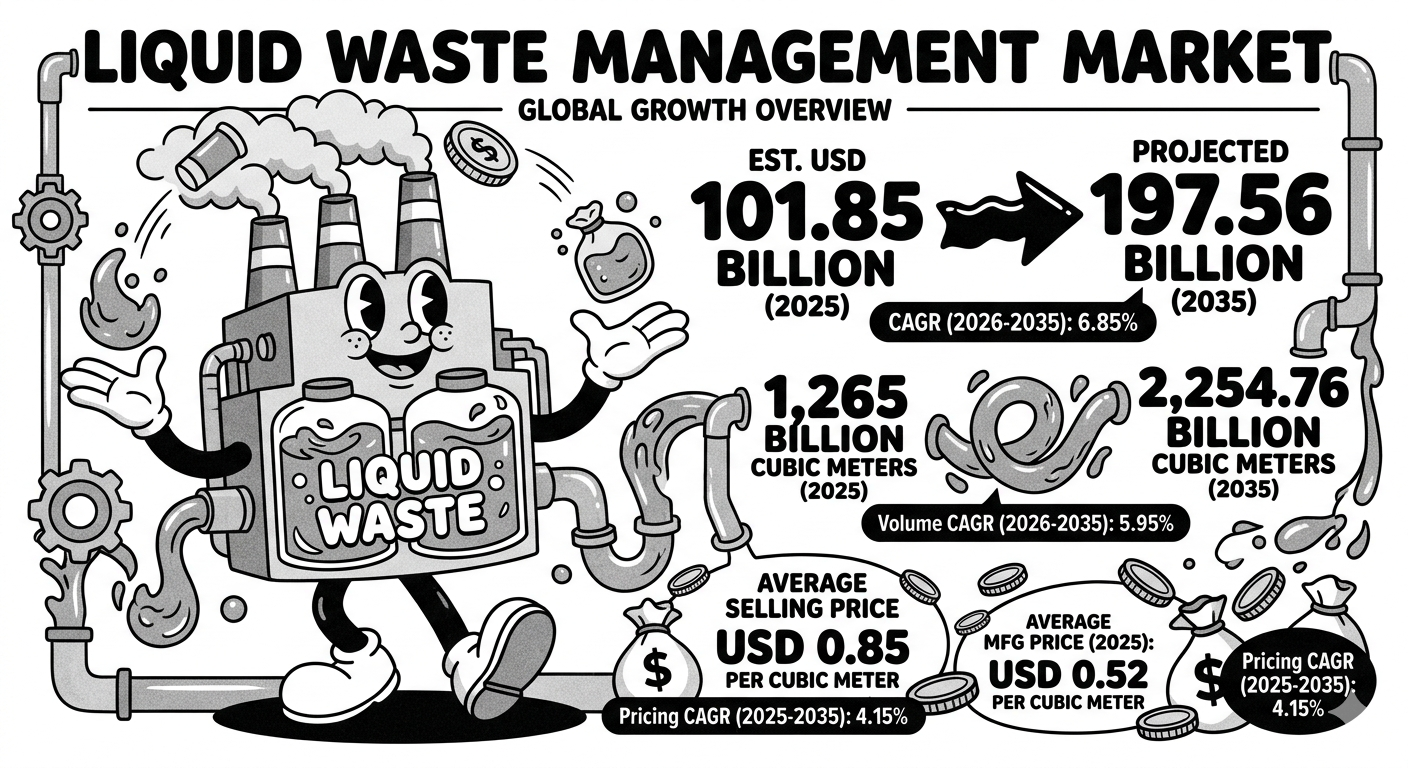
The global liquid waste management market is undergoing a transformative shift from simple disposal to sophisticated resource recovery. The market size was estimated at USD 101.85 billion in 2025 and is projected to reach approximately USD 197.56 billion by 2035, exhibiting a robust Compound Annual Growth Rate (CAGR) of 6.85% from 2026 to 2035. While specific 2032 projections are part of this growth trajectory, the industry is fundamentally driven by the urgent need for water circularity and stringent environmental compliance.
Market Overview
What is the Market Overview and Why is it Important?
Liquid waste management involves the systematic collection, treatment, and disposal of effluents from industrial, municipal, and commercial sources. It is a global priority sector because it directly impacts public health, environmental integrity, and water security. As freshwater costs rise and environmental regulations tighten, industries are moving away from linear “disposal” mindsets toward circular “resource recovery” models. This industry is essential for preventing toxic seepage into aquifers and ensuring that high-volume industrial runoff does not degrade local ecosystems.
What is Market Growth?
The industry is experiencing steady growth, with volumes expected to increase from 1,265.00 billion cubic meters in 2025 to 2,254.76 billion cubic meters by 2035. This growth is fueled by rapid urbanization, expanding industrial bases, and the global adoption of “Zero Liquid Discharge” (ZLD) mandates.
Market Dynamics & Driving Factors
What Are the Key Factors Driving the Market?
-
Rising Freshwater Costs: As clean water becomes scarcer, industries are incentivized to recycle and reuse wastewater rather than repeatedly purchasing fresh supplies.
-
Stricter Regulatory Mandates: Global agencies are enforcing more rigorous discharge standards for pollutants like microplastics, PFAS, and heavy metals, forcing investment in advanced filtration infrastructure.
-
Corporate Sustainability Goals: Companies are proactively managing liquid waste to avoid reputational damage, legal liabilities, and the rising operational costs associated with inefficient waste handling.
What Are the Market Benefits of Using Advanced Management?
-
Resource Recovery: Modern plants extract valuable salts, nutrients, and biogas from waste streams, turning potential disposal burdens into revenue-generating secondary materials.
-
Operational Efficiency: Automated, AI-driven treatment systems reduce manpower requirements while optimizing chemical usage and energy consumption.
-
Brand Resilience: Implementing sustainable wastewater practices helps firms align with environmental standards, thereby improving their market positioning and investor appeal.
Key Segments & Trends
The market is characterized by a strong move toward Intelligent Treatment Plants that utilize machine learning and smart sensors to adjust treatment processes in real-time based on fluctuating waste conditions.
-
Waste Type Insights: The industrial liquid waste segment dominated in 2025 with a 52% market share, due to the high volume of complex, toxic effluents produced by the chemical, pharmaceutical, and manufacturing sectors.
-
Treatment Methods: While biological treatment held the largest share (28%) in 2025 due to its cost-effectiveness, the Advanced Treatment segment (22% share) is expected to be the fastest-growing (7.60% CAGR) as pollution types become more complex, requiring membrane filtration and UV/Ozone stages.
-
Regional Dominance: The Asia Pacific region holds the largest market share (30% in 2025) and remains the fastest-growing hub, driven by massive population growth and government-led industrial infrastructure projects in China and beyond.
Competitive Landscape & Recent Developments
The competitive landscape is defined by large-scale environmental services providers integrating IoT and circular economy principles. These companies are shifting from traditional transport-and-dispose models to high-tech purification and resource reclamation services. A key recent development is the February 2026 launch by Sumitomo Electric of a compact membrane treatment system capable of reducing industrial waste disposal by 90%, highlighting the industry’s trend toward space-saving, high-efficiency technology.
Top Companies Profiled
-
Veolia Environnement S.A. (Market Cap: Significant Global Presence): A French leader specializing in ecological transformation, Veolia excels in reclaiming resources from industrial fluids and converting hazardous sludge into renewable energy.
-
Suez S.A.: Focused on revolutionary water recovery, Suez uses advanced digital monitoring to protect global aqueous resources and turn effluents into valuable secondary materials.
-
Waste Management, Inc. (WM): The North American leader in environmental services, WM operates extensive collection networks, focusing on the safe containment and stabilization of industrial liquids.
Market Recent Government Initiatives
Governments are prioritizing water security through various legislative frameworks:
-
United States (EPA): The Resource Conservation and Recovery Act (RCRA) remains the cornerstone for tracking hazardous liquids from generation to final destruction, with a focus on preventing subsurface aquifer leakage.
-
European Commission: Through the Waste Framework Directive, the EU enforces the “Polluter Pays Principle” and promotes the “Waste Hierarchy,” prioritizing recovery over simple disposal.
-
China (MEE): The country is aggressively scaling Zero Liquid Discharge (ZLD) technologies and integrating real-time digital monitoring for factory outflows to control industrial water pollution.
Future Perspective
The future of liquid waste management lies in the transition from waste treatment as a cost center to waste management as a value-generation system. As AI, machine learning, and advanced membrane filtration become standard, the “invisible” wastewater industry will move to the center of the global green economy. Firms that invest in adaptive, resource-recovering infrastructure today will hold a competitive advantage in the 2035 landscape, where clean water availability will be the defining constraint of industrial and urban growth.
About Us
Towards Chemical and Materials is a leading global consulting firm specializing in providing comprehensive and strategic research solutions across the chemical and materials industries. With a highly skilled and experienced consultant team, we offer a wide range of services designed to empower businesses with valuable insights and actionable recommendations.
Our Trusted Data Partners
Precedence Research | Statifacts | Towards Packaging | Towards Healthcare | Towards Food and Beverages | Towards Chemical and Materials | Towards Consumer Goods | Nova One Advisor |
For Latest Update Follow Us: https://www.linkedin.com/company/towards-chem-and-materials/
USA: +1 804 441 9344
APAC: +61 485 981 310 or +91 87933 22019
Europe: +44 7383 092 044
Email: [email protected]


Leave a Reply