Executive Summary
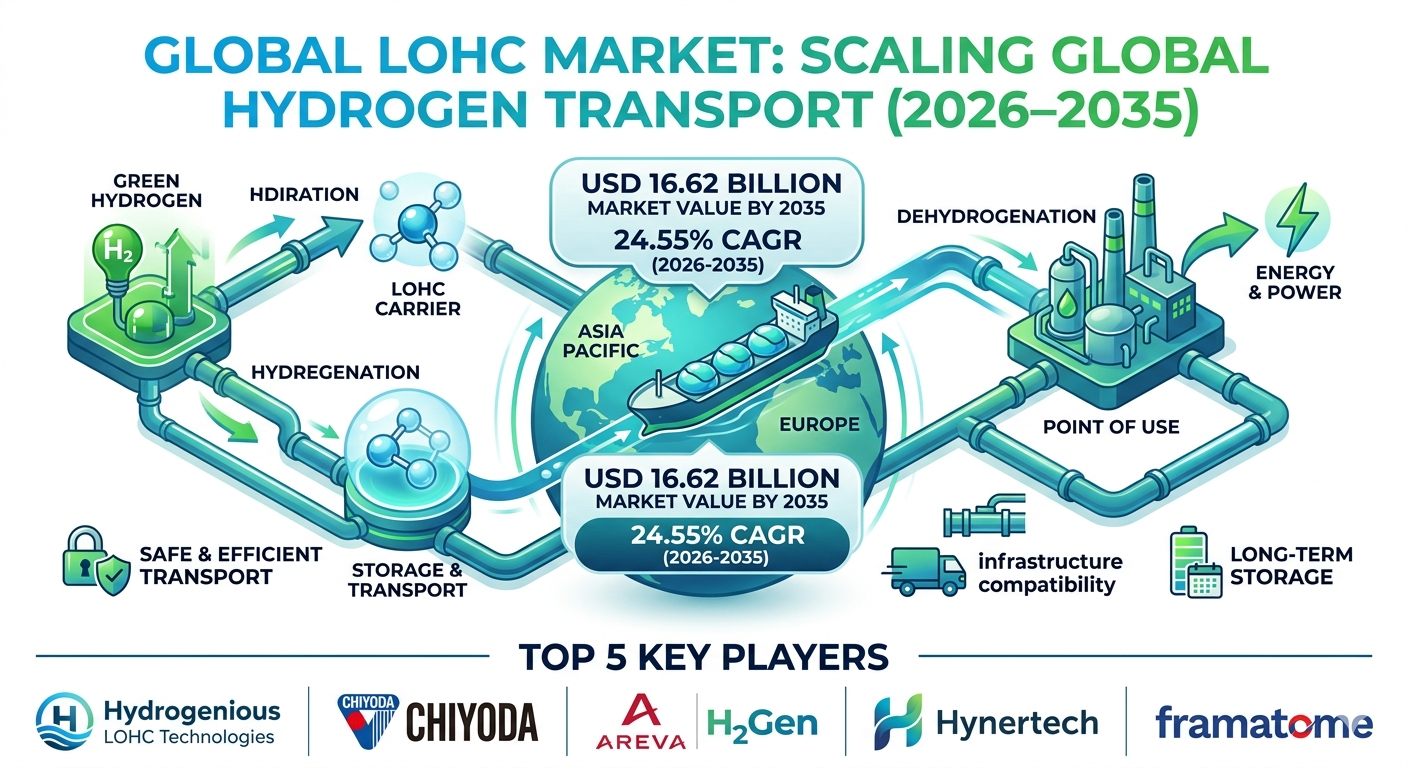
The global Liquid Organic Hydrogen Carrier (LOHC) market is emerging as the definitive solution for the safe, long-distance transport of green hydrogen. Valued at USD 1.85 billion in 2025, the market is set for transformative expansion, projected to reach USD 16.62 billion by 2035 at a stellar CAGR of 24.55%. As global economies race to decarbonize, LOHC technology provides the crucial link—allowing hydrogen to be stored and shipped at ambient conditions using existing liquid fuel infrastructure. This capability effectively solves the logistical hurdles of high-pressure or cryogenic hydrogen storage, positioning LOHC as the backbone of the future international hydrogen trade.
Market Overview
The LOHC market is defined by its ability to chemically bind hydrogen to liquid organic carriers, which are then released at the point of use via dehydrogenation. Unlike traditional storage methods, LOHC media remains stable at ambient temperature and pressure, drastically reducing capital expenditure and safety risks for industrial-scale energy storage. This market is fundamentally shifting the energy landscape by enabling cross-border hydrogen movement, bridging regions with abundant renewable energy potential with high-demand industrial hubs.
What is Driving Market Growth?
The primary driver for the LOHC market is the urgent necessity for efficient, scalable hydrogen infrastructure. Industries are increasingly adopting LOHC because it utilizes existing oil and gas logistics—pipelines, tankers, and storage tanks—thereby minimizing the “stranded asset” risk associated with new infrastructure investments. Furthermore, as the world transitions to renewable energy, LOHC serves as an ideal seasonal storage medium, allowing surplus electricity generated from wind and solar to be captured as hydrogen and stored for months without degradation.
Key Market Trends
Market dynamics are currently dominated by the rapid adoption of dibenzyl toluene-based LOHC formulations, which are prized for their superior thermal stability during long-distance shipping. Another critical trend is the optimization of the dehydrogenation process, which captured 54% of the market in 2025. Innovation is shifting toward high-performance catalysts that can lower the temperatures required for hydrogen release, significantly improving the net energy efficiency of the entire system.
Market Recent Government Initiatives
Global government initiatives are acting as a catalyst for LOHC commercialization, with aggressive decarbonization mandates driving public funding into hydrogen infrastructure. Many nations are incorporating LOHC projects into their national hydrogen strategies, specifically funding pilot projects that test international shipping routes from regions like Australia or the Middle East to demand centers in Europe and East Asia. These subsidies are critical for de-risking early-stage technology deployments and accelerating the standardization of safety regulations for hydrogen-laden liquid carriers.
Benefits of Using LOHC
The most significant benefit of LOHC technology is its compatibility with ambient conditions, which eliminates the need for expensive high-pressure tanks or cryogenic cooling. This makes LOHC an incredibly versatile medium for storing large volumes of energy, ensuring supply chain resilience for industries reliant on stable power. By enabling the reuse of existing liquid fuel infrastructure, LOHC significantly reduces the “time-to-market” for hydrogen energy projects, providing a cost-effective alternative to building bespoke infrastructure from scratch.
Which Segment Accounted for the Largest Market Share?
In 2025, the hydrogen transport application dominated the market, accounting for 42% of the share, underscoring its pivotal role in global hydrogen trade. By form, pure LOHC compounds led with a 49% share due to their established simplicity in current systems. Geographically, Asia Pacific commanded the largest regional share at 36%, driven by massive hydrogen deployment initiatives in China, Japan, and South Korea.
| Metric | 2025 (Base) | 2035 (Projected) |
| Global Market Size | USD 1.85 Billion | USD 16.62 Billion |
| Market Volume | 621.11 Thousand Tons | 4,536.98 Thousand Tons |
| CAGR (2026-2035) | – | 24.55% |
Competitive Landscape
The competitive landscape is characterized by strategic alliances aimed at proving the viability of large-scale hydrogen shipping. Major market players are moving beyond R&D into commercial-scale pilot programs that leverage direct supply contracts with energy majors. Strategic partnerships are the fastest-growing distribution channel, with a 26.1% CAGR, as firms collaborate to synchronize LOHC production with hydrogen supply and end-use industrial applications. The recent developments focus on increasing the “cycle efficiency” of the hydrogenation/dehydrogenation loop to ensure that the process remains cost-competitive with other storage technologies.
Top Companies Profiled
-
Hydrogenious LOHC Technologies: The pioneer of LOHC technology; focuses on high-capacity hydrogen storage systems.
-
Chiyoda Corporation: Renowned for its SPERA Hydrogen® system, which uses toluene-based LOHC for large-scale transport.
-
LOHC-based R&D Firms & Specialty Chemical Producers: Various global players are focusing on custom catalyst development and proprietary carrier blends.
(Note: Market caps for private specialized players vary; investors should monitor specific project announcements and strategic funding rounds for real-time valuation updates.)
The Future and Importance of the Market
LOHC technology is essential for a truly global hydrogen economy. Its ability to store and transport hydrogen without the massive technical constraints of traditional methods ensures its role in the future energy grid. As we look toward 2035, the market will mature through increased standardization and the deployment of massive international trade corridors. Companies that lead in carrier efficiency and dehydrogenation innovation today will define the energy standards of tomorrow. The future belongs to those who can make the movement of green hydrogen as simple and reliable as the transport of traditional fuels.
About Us
Towards Chemical and Materials is a leading global consulting firm specializing in providing comprehensive and strategic research solutions across the chemical and materials industries. With a highly skilled and experienced consultant team, we offer a wide range of services designed to empower businesses with valuable insights and actionable recommendations.
Our Trusted Data Partners
Precedence Research | Statifacts | Towards Packaging | Towards Healthcare | Towards Food and Beverages | Towards Chemical and Materials | Towards Consumer Goods | Nova One Advisor |
For Latest Update Follow Us: https://www.linkedin.com/company/towards-chem-and-materials/
USA: +1 804 441 9344
APAC: +61 485 981 310 or +91 87933 22019
Europe: +44 7383 092 044
Email: [email protected]


Leave a Reply