The global liquefied natural gas (LNG) market is poised for significant growth over the next decade. Estimated at USD 165.19 billion in 2025, the market is projected to grow steadily, reaching USD 174.85 billion in 2026 and expanding to USD 291.67 billion by 2035. With a robust compound annual growth rate (CAGR) of 5.85% from 2026 to 2035, the LNG market will benefit from several key trends including decarbonization goals, energy diversification, and the shift to more flexible trade contracts. The Asia Pacific region will continue to dominate, holding 46% of the global market share in 2025, while North America is expected to grow at the fastest pace during the forecast period.
Market Drivers and Trends
What are the Primary Drivers for the LNG Market?
- Decarbonization Goals and Energy Transition: As countries and industries move toward more sustainable energy sources, LNG plays a crucial role in reducing carbon emissions, especially in power generation and transportation sectors. This trend aligns with global decarbonization objectives, supporting the shift away from coal and oil.
- Technological Advancements: Technological innovations in LNG production, such as Floating LNG (FLNG) and small-scale LNG, are making the energy source more accessible to off-grid and remote locations. These technologies also reduce infrastructure costs and enhance operational efficiency.
- Energy Security and Supply Flexibility: The rising adoption of LNG helps countries diversify their energy sources, reducing dependency on traditional pipeline-based gas imports. Floating Storage Regasification Units (FSRUs) and regasification terminals play a pivotal role in increasing energy security across regions.
- Growing Global LNG Demand: Asia Pacific, driven by countries like China and India, remains the largest consumer, while North America is emerging as a key exporter due to its shale revolution. This expanding demand, particularly in power generation and transportation, is fueling market growth.
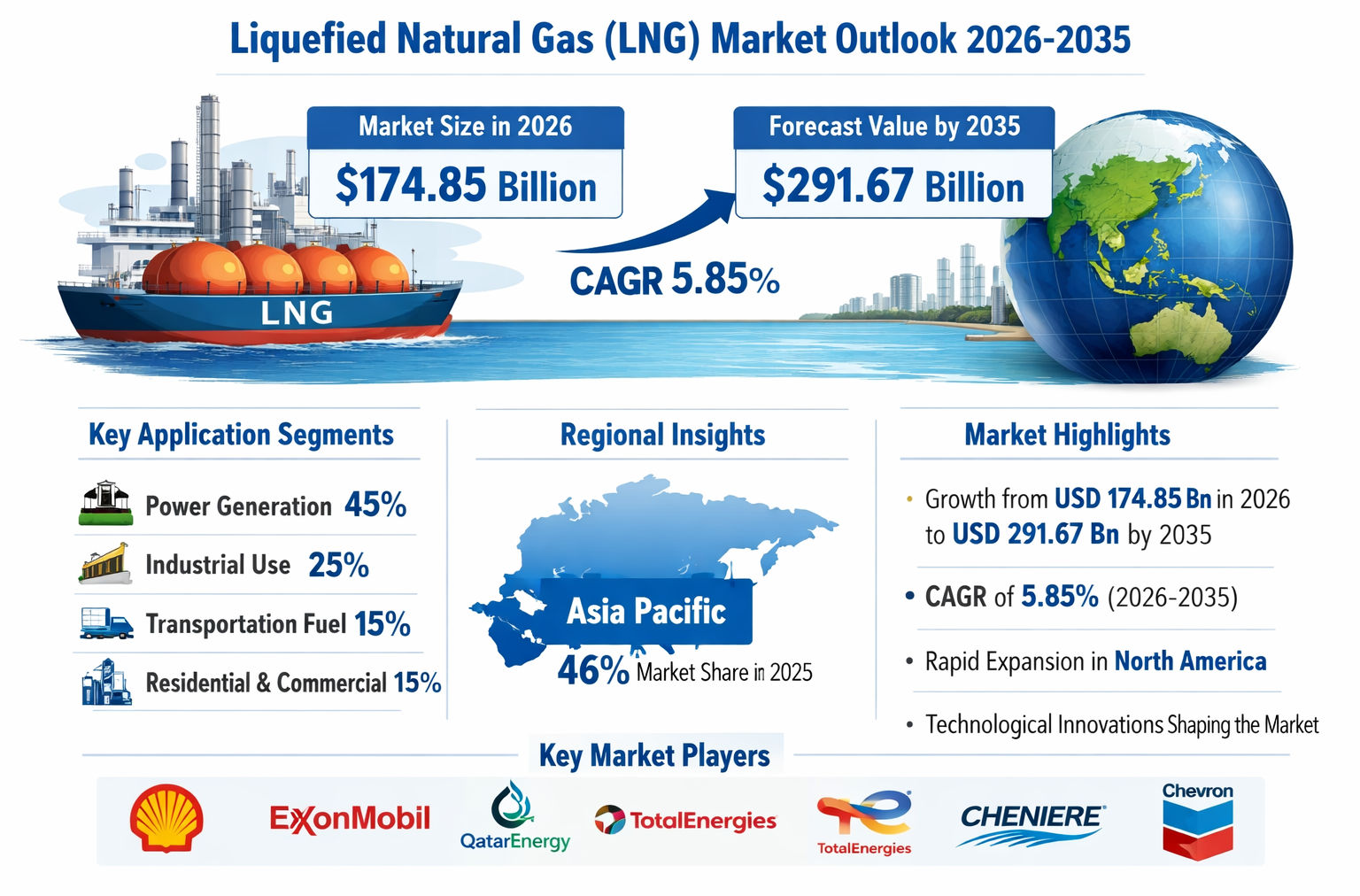
Key Application Segments and Trends
1. Power Generation
- Market Share (2025): 45%
- Growth Drivers: LNG is replacing coal and oil in power generation due to its lower carbon emissions. Combined-cycle gas turbines, which use LNG as a flexible baseload supplier, are critical for grid stability, particularly during renewable energy integration.
- Forecast: Continued growth driven by energy transition policies and increasing electricity demand.
2. Industrial Use
- Market Share (2025): 25%
- Growth Drivers: Industrial sectors such as chemicals, metals, and manufacturing are turning to LNG for its cost-effectiveness and lower emissions compared to conventional fuels.
- Forecast: The segment is expected to grow steadily, with LNG’s role in reducing industrial emissions becoming more prominent.
3. Transportation Fuel
- Market Share (2025): 15%
- Growth Drivers: LNG adoption in heavy-duty vehicles, marine shipping, and rail is on the rise due to its role in reducing carbon emissions in the transport sector. The segment is expected to grow at the fastest pace.
- Forecast: This segment will experience the highest CAGR, driven by decarbonization commitments and the growing adoption of LNG in the transport industry.
4. Residential and Commercial
- Market Share (2025): 15%
- Growth Drivers: Increasing urbanization and the shift to cleaner fuels are boosting LNG usage for heating, cooking, and energy needs in residential and commercial sectors.
- Forecast: Steady growth driven by energy demand in urban areas.
Regional Insights
1. Asia Pacific: Market Leader
- Market Share (2025): 46%
- Growth Drivers: Asia Pacific is the largest LNG market, with strong demand from China, Japan, and India. The region’s transition from oil-linked contracts to spot market pricing, coupled with the rapid implementation of FSRUs, is fueling growth.
- Forecast: The market is expected to continue expanding, with China being the dominant demand driver.
2. North America: Fastest Growth
- Market Share (2025): 18%
- Growth Drivers: North America, led by the U.S., is rapidly transitioning from an importer to a key LNG exporter. The shale revolution and growing LNG infrastructure are pivotal to the region’s market expansion.
- Forecast: North America will experience the fastest CAGR as export capacity increases and domestic consumption grows.
3. Europe: Key Rebalancing Hub
- Market Share (2025): 21%
- Growth Drivers: Europe’s push for energy security, reduced pipeline dependence, and stringent decarbonization policies are boosting LNG demand.
- Forecast: Continued growth in LNG imports, driven by the rising importance of LNG in balancing the energy grid during renewable energy expansion.
Technological Innovations Shaping the LNG Market
- Floating LNG (FLNG): This emerging technology allows for offshore gas extraction and liquefaction, reducing the need for onshore infrastructure and enabling the exploitation of offshore gas reserves.
- AI and Big Data: Artificial intelligence (AI) and big data analytics are improving LNG logistics, fleet management, and the detection of methane leaks. These technologies also optimize maintenance schedules and predict fluctuations in supply and demand.
- Carbon Capture and Storage (CCS): CCS technology is becoming increasingly integrated into LNG facilities, helping to reduce carbon emissions and meet environmental standards.
Competitive Landscape
Key players in the LNG market include:
- Shell: A leader in the global LNG market, providing floating liquefaction, carbon-neutral cargoes, and maritime bunkering infrastructure.
- TotalEnergies: Focused on small-scale LNG distribution and expanding export capacity in the U.S.
- ExxonMobil: Known for its high-capacity liquefaction technology and long-term energy security contracts.
- QatarEnergy: Controls some of the lowest-cost production basins globally and continues to expand supply through major projects.
- Chevron: Dominates supply pathways in Asia Pacific with LNG supply from large-scale projects.
Recent Strategic Moves
- Venture Global & Viton (2026): Executed a binding purchase agreement for 1.5 million tonnes per annum of U.S. LNG.
- ST LNG & Baker Hughes (2026): Partnered for offshore LNG export terminal technology in Texas.
Conclusion and Future Outlook
The liquefied natural gas (LNG) market is on track for substantial growth, driven by technological advancements, shifting trade dynamics, and rising demand for cleaner energy sources. Asia Pacific will remain the market leader, while North America’s rise as an LNG exporter signals a major shift in global trade patterns. The future of LNG lies in its ability to provide a flexible, cleaner alternative to traditional energy sources, bolstered by innovations like FLNG, AI-powered logistics, and carbon capture technologies.
As energy transition policies take hold globally, the LNG market will play a key role in shaping the future of energy security and sustainability. The next decade promises significant growth, especially in emerging economies where LNG is becoming a critical component of the energy mix.
| Region | Market Share (2025) | CAGR (2026-2035) | 2025 Market Size (USD Billion) | 2035 Market Size (USD Billion) |
|---|---|---|---|---|
| Asia Pacific | 46% | 5.96% | 75.99 | 135.63 |
| North America | 18% | Fastest Growing | 29.74 | 54.67 |
| Europe | 21% | Moderate Growth | 34.63 | 62.45 |
| Middle East & Africa | 9% | Steady | 14.87 | 26.60 |
| Latin America | 6% | Rapid Growth | 9.91 | 17.80 |
This table highlights key regional insights, showcasing the current market share and projected growth by 2035.
Contact Us https://www.towardschemandmaterials.com/contact-us
About Us
Towards Chem and Materials is a leading global consulting firm specializing in providing comprehensive and strategic research solutions across the chemical and materials industries. With a highly skilled and experienced consultant team, we offer a wide range of services designed to empower businesses with valuable insights and actionable recommendations.
Email: [email protected]
Web: https://www.towardschemandmaterials.com/
For Latest Update Follow Us: https://www.linkedin.com/company/towards-chem-and-materials/?viewAsMember=true


Leave a Reply