The global Water-Based Resins Market is undergoing a transformative expansion as industrial sectors move away from solvent-borne systems to meet aggressive ESG mandates. Valued at USD 60.95 billion in 2025, the market is poised to grow to USD 118.23 billion by 2035, exhibiting a robust CAGR of 6.85%. This growth is underpinned by a projected volume increase from 20.45 million tons to 37.14 million tons over the same period. As a Senior Analyst, I observe that the “green shift” is no longer just a regulatory burden but a high-margin opportunity for manufacturers to innovate in high-performance, low-VOC (Volatile Organic Compound) chemistries.
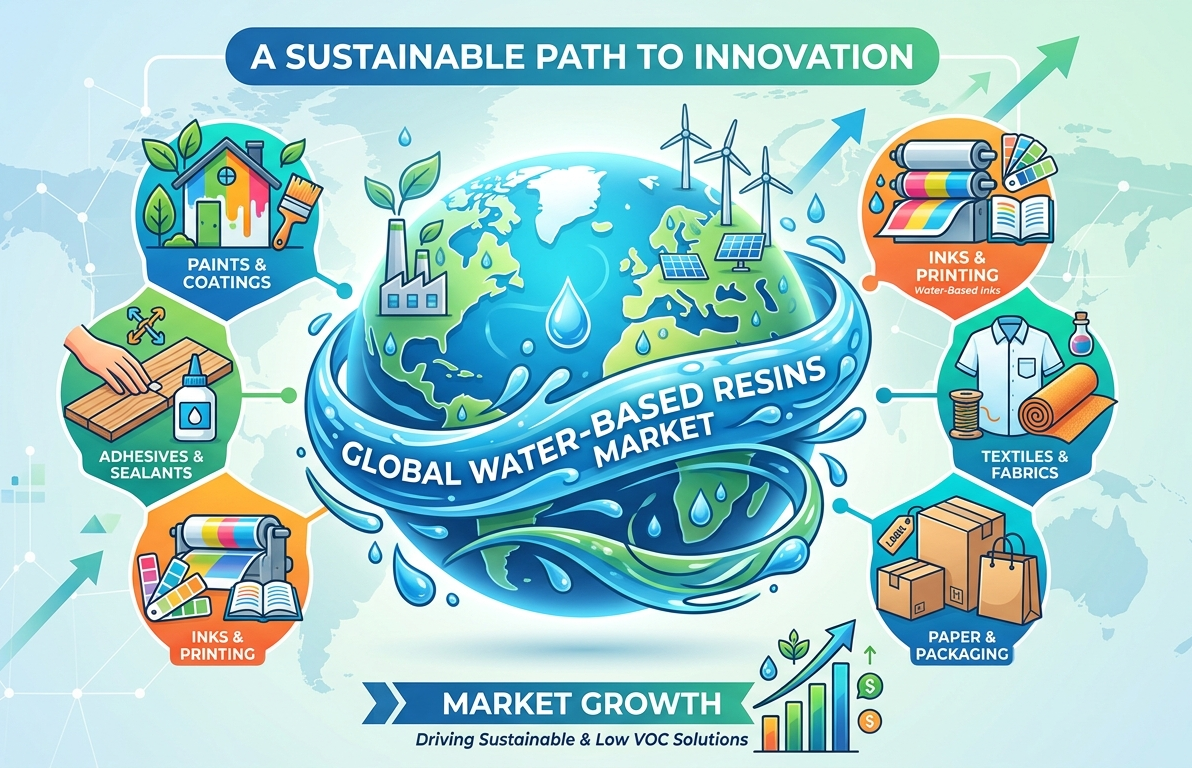
Market Overview: The Rise of Sustainable Chemistry
Water-based resins utilize water as the primary carrier medium instead of fossil-fuel-derived organic solvents. This fundamental shift significantly reduces the release of toxic emissions during the curing process. While historically limited by drying times and moisture sensitivity, modern water-based resins now rival their solvent-based counterparts in durability and finish. The market is currently dominated by Asia Pacific (41% share), driven by rapid urbanization and infrastructure projects in India and China.
What is the Current Market Growth?
The market is entering a phase of accelerated adoption, particularly in the Polyurethane Dispersions (PUD) and Acrylic segments. While the broader market grows at 6.85%, specific sub-sectors like PUD are outperforming with a 7.5% CAGR, reflecting a shift toward premium, high-durability applications in the automotive and textile industries.
What are the Key Market Trends?
-
Performance Parity Engineering: Heavy investment in R&D is closing the performance gap between water-based and solvent-based resins, particularly in corrosion resistance and high-gloss finishes.
-
Multifunctional Resin Systems: There is a surge in demand for resins that offer integrated benefits, such as “one-coat” systems that provide both UV protection and microbial resistance.
-
Expansion into Packaging Inks: Beyond traditional coatings, water-based resins are becoming the standard for food-safe packaging inks due to their non-toxic nature.
-
Bio-Based Feedstock Integration: Manufacturers are increasingly incorporating plant-derived monomers into water-based formulations to further lower the carbon footprint.
-
Smart Production & Digitalization: The adoption of advanced formulation techniques and climate-monitored supply chains ensures product consistency and stability during transit.
What are the Recent Government Initiatives?
Governments are aggressively tightening environmental “safety nets,” which serves as a primary catalyst for water-based resin adoption.
-
China’s VOC Audit Mandates: The Chinese government has implemented stringent monthly audits on industrial VOC emissions, effectively forcing a transition to water-based systems in the Yangtze River Delta and other industrial hubs.
-
EU REACH & Green Deal: Ongoing updates to the REACH (Registration, Evaluation, Authorisation, and Restriction of Chemicals) regulations continue to phase out hazardous solvents, making water-based alternatives the only viable path for market access.
-
The US Inflation Reduction Act (IRA): While primarily energy-focused, the IRA provides indirect support through “Green Building” tax credits, favoring low-emission materials in construction.
-
India’s Green Pathway: Recent legislative updates to the Environment (Protection) Act emphasize “pollution control to sustainable development,” providing subsidies for chemical plants that switch to aqueous-based synthesis.
Market Dynamics: Drivers and Benefits
Why Is This Market Important?
This market is the backbone of the “Low-VOC” revolution. It directly impacts air quality and worker safety in manufacturing environments. Without water-based resins, the global construction and automotive industries would struggle to meet modern environmental compliance standards.
What Are the Key Factors Driving the Market?
The primary drivers are Environmental Regulation and Consumer Health Awareness. There is a massive “pull” from end-consumers for low-odor, non-toxic paints and adhesives. Furthermore, the volatility of fossil-fuel-based solvent prices makes water-based resins a more stable long-term economic choice.
Detailed Market Segments: Insight & Shifts
| Segment Category | Dominant Segment (2025) | Fastest Growing (CAGR) | Analyst Insight |
| Resin Type | Acrylic (38% Share) | Polyurethane (PUD) (7.5%) | PUD is winning in premium automotive interiors. |
| Application | Paints & Coatings (54%) | Adhesives & Sealants (7.3%) | Shift toward eco-friendly tapes and packaging. |
| End-Use | Construction (36%) | Automotive (7.2%) | OEM push for sustainable vehicle coatings. |
| Distribution | Direct/B2B (57%) | Retail/E-commerce (7.6%) | DIY segment growth through online platforms. |
| Solid Content | Medium Solid (46%) | High Solid (7.4%) | High solid resins reduce transport costs/emissions. |
Competitive Landscape: Top Companies & Recent Developments
1. BASF SE
-
About: A German-based global chemical leader with a massive focus on sustainable dispersions.
-
Products: Joncryl (for inks) and Acronal (for coatings) brands.
-
Market Cap: ~$48.5 Billion.
-
Recent Activity: Opened a new zero-CO2 production line for water-based dispersions in Heerenveen, Netherlands, in late 2024 to boost capacity for eco-friendly polymers.
2. Covestro AG
-
About: A world-leading supplier of high-tech polymer materials and dispersions.
-
Products: Bayhydrol and Bayhydur water-borne polyurethane resins.
-
Market Cap: ~$14.54 Billion.
-
Recent Activity: Showcasing breakthrough “circular” water-based resins made from recycled PET and bio-based content in early 2026.
3. Dow Inc.
-
About: An American materials science giant specializing in architectural and industrial coatings.
-
Products: MAINCOTE and RHOPLEX waterborne acrylic resins.
-
Market Cap: ~$38.2 Billion.
-
Recent Activity: Expanding its “Sustainable Future” portfolio with low-VOC resins specifically tailored for the booming APAC construction market.
4. Arkema S.A.
-
About: A French specialty chemicals company and leader in high-performance materials.
-
Products: Encor and Celocor water-based binders.
-
Market Cap: ~$5.1 Billion (€4.64B).
-
Recent Activity: Heavily investing in “solvent-to-water” conversion technology for industrial wood and metal finishes.
Future Perspective: Where is the Market Heading?
By 2035, I anticipate the market will move toward “Hyper-Hybrid” Resins. These will be formulations that combine the cost-effectiveness of acrylics with the durability of epoxies, all within a water-based medium. We will also see a total digitalization of the supply chain, where climate-monitored transit becomes standard to protect these thermally sensitive aqueous formulas. The future of the chemical industry is undeniably “blue”—powered by water, not solvents.
About Us
Towards Chemical and Materials is a leading global consulting firm specializing in providing comprehensive and strategic research solutions across the chemical and materials industries. With a highly skilled and experienced consultant team, we offer a wide range of services designed to empower businesses with valuable insights and actionable recommendations.
Our Trusted Data Partners
Precedence Research | Statifacts | Towards Packaging | Towards Healthcare | Towards Food and Beverages | Towards Chemical and Materials | Towards Consumer Goods | Nova One Advisor |
For Latest Update Follow Us: https://www.linkedin.com/company/towards-chem-and-materials/
USA: +1 804 441 9344
APAC: +61 485 981 310 or +91 87933 22019
Europe: +44 7383 092 044
Email: [email protected]


Leave a Reply