TowardsChem&Materials

Insights Driving the Chemistry of Innovation

Global Advanced Elastomers Market Dynamics: Material Science Driving Structural Performance and Industrial Longevity

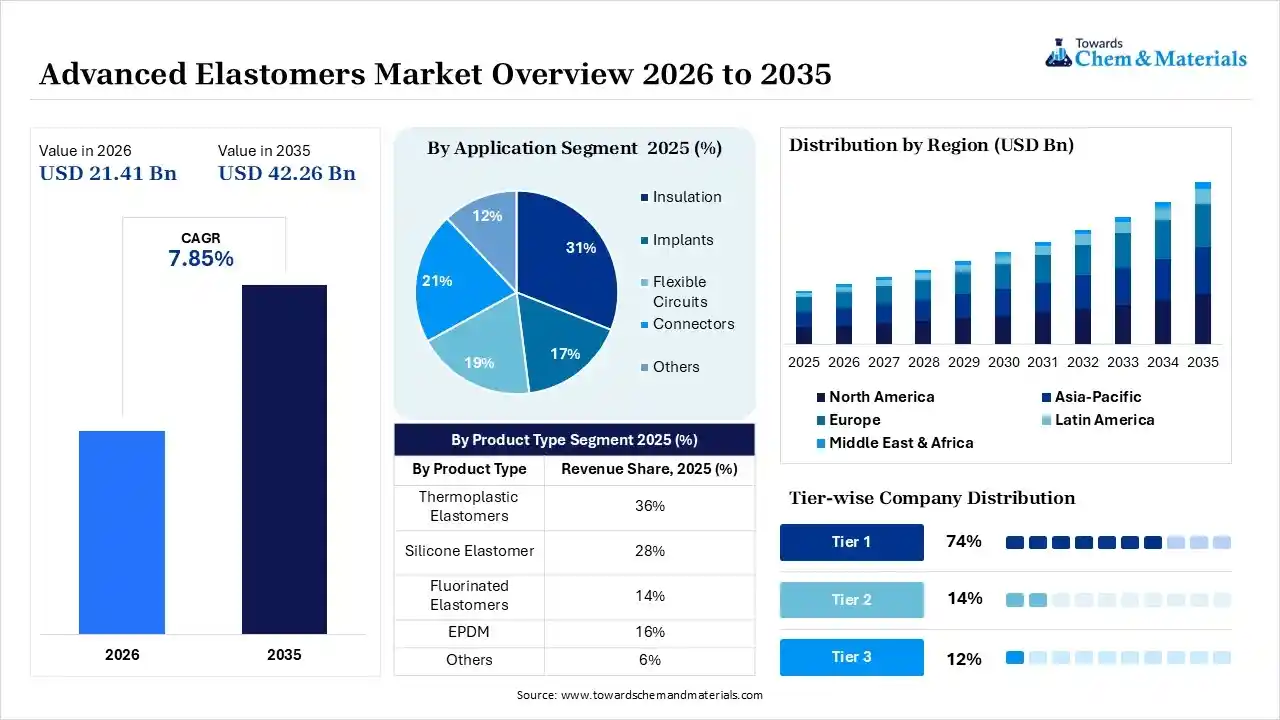
The global advanced elastomers market represents a high-value trajectory within the high-performance materials industry, expanding beyond the limitations of traditional rubber chemistry. Valued at USD 19.85 billion in 2025, the market is estimated to reach USD 21.41 billion in 2026. Long-term strategic projections indicate that the market will achieve a value of USD 42.26 billion by 2035, exhibiting a compound annual growth rate (CAGR) of 7.85% over the forecast period from 2026 to 2035. This steady expansion underscores an industrial transition toward specialized engineering polymers capable of maintaining structural integrity under extreme thermal, chemical, and physical stress.
Market Overview: What is the Advanced Elastomers Market?

The advanced elastomers market encompasses the synthesis, compounding, and molecular engineering of high-performance elastomeric materials designed to cross-link or process under demanding environments. Unlike conventional rubbers, advanced elastomers—such as thermoplastic polyurethanes (TPUs), silicone elastomers, and specialized fluoroelastomers—combine the fluid flexibility of macromolecules with the structural resilience of cross-linked networks. They are engineered to improve mechanical properties like tensile strength, elongation, and compression set in applications under constant stress, heat, or harsh operating conditions. These characteristics make them valuable for manufacturing seals, gaskets, biopharmaceutical tubing, and insulation layers.

Market Dynamics: What Are the Key Factors Driving the Market?

1. What Are the Primary Drivers for This Market?

Industrial component modernization remains a strong growth driver. As the automotive and electronics sectors push toward miniaturization and electrification, the demand for lightweight, durable, and thermal-resistant components has accelerated. Advanced elastomers support these efforts by reducing assembly weight and replacing rigid metals or degrading rubbers under the hood.

2. Why Is It Market Important?

Advanced elastomers are essential for ensuring system reliability in high-value industries like healthcare, aerospace, and electronics. They maintain their sealing and structural properties when exposed to aggressive industrial fluids, extreme low temperatures, and continuous mechanical stress. This performance helps minimize component failures, lower maintenance costs, and extend the operating life of complex equipment.

What are the Benefits of Using Advanced Elastomers?

Compared to standard polymers, advanced elastomers offer distinct mechanical and operational advantages:

  • Exceptional Thermal & Chemical Stability: They maintain structural flexibility across temperature extremes and resist degradation when exposed to harsh solvents, oils, and industrial chemicals.

  • Enhanced Mechanical Performance: They provide high tensile strength, tear resistance, and optimal compression-set properties under sustained physical stress.

  • Design and Process Flexibility: Thermoplastic variants can be easily processed and recycled using standard molding and extrusion methods, helping reduce manufacturing waste and component cycle times.

  • Biocompatibility and Safety: Medical-grade formulations comply with strict regulatory requirements, making them suitable for diagnostics, wearable health devices, and drug delivery systems.

Key Segments & Regional Trends

Which Segment Accounted for the Largest Market Share?

By product type, the thermoplastic polyurethane (TPU) segment led the global performance materials market with a 36% revenue share in 2025, driven by its versatility, ease of processing, and recyclability. From an end-use perspective, the industrial sector commanded the largest portion of the market at 34% in 2025, supported by the demand for customized medical engineering solutions and durable sealing systems. Geographically, the Asia Pacific region held the largest revenue share at 42% in 2025, expanding at a 7.97% CAGR due to rapid industrialization, automotive manufacturing, and infrastructure development. North America followed with a 24% share in 2025, supported by investments in biopharmaceutical processing and healthcare research.

Data Presentation: Market Metric Mapping

The following matrix highlights the core structural allocations and forecasted metrics across product types and applications.

Market Metric Attribute 2025 Baseline Status 2026 Current Estimate 2035 Long-Term Projection Dynamic Segment Growth Leader
Global Market Value USD 19.85 Billion USD 21.41 Billion USD 42.26 Billion Global CAGR: 7.85% (2026–2035)
Dominant Product Segment TPU (36% Share) Stable Leadership Material Transition Silicone Elastomers (High Forecast Growth)
Primary End-Use Segment Industrial (34% Share) Expanding Footprint Advanced Applications Medical Segment (6.35% CAGR)
Regional Share Leader Asia Pacific (42% Share) Dynamic Volume Intake Regional Hub Consolidation Asia Pacific (Fastest CAGR: 7.97%)

Market Recent Government Initiatives: What is Shaping the Industry?

Government safety regulations and green mandates heavily influence the adoption of advanced elastomers globally:

  • Medical Device & Biocompatibility Regulations: Stricter standards from agencies like the US FDA and European Medical Device Regulation (MDR) favor the use of clean, plasticizer-free advanced elastomers over legacy PVC compounds in fluid-handling systems.

  • Vehicle Emissions & Fuel Efficiency Standards: Global initiatives pushing for lower automotive carbon footprints encourage the use of lightweight advanced elastomeric hoses, structural seals, and engine components to replace heavier alternatives.

  • Industrial Waste & Circularity Mandates: Emerging corporate sustainability rules encourage a shift toward recyclable thermoplastic elastomers (TPEs) that fit within circular manufacturing frameworks.

Competitive Landscape: Top Companies and Strategic Portfolio Focus

Dow Inc.

  • About: Dow is a global materials science company that develops high-performance silicone elastomers, plastics, and industrial intermediates for diverse end markets.

  • Products: SILASTIC™ Silicone Rubber, Nordel™ EPDM, and specialized thermoplastic vulcanizates (TPVs) designed for automotive weatherstripping and electrical insulation.

  • Market Cap: Approximately USD 20.13 Billion (as of mid-2026).

DuPont de Nemours, Inc.

  • About: DuPont is a technology-focused multi-industrial manufacturer specializing in advanced engineered polymers, resins, and medical-grade materials.

  • Products: Kalrez® Perfluoroelastomer parts, Vamac® Ethylene Acrylic Elastomers, and Liveo™ Pharma TPE Ultra-Low Temp Tubing lines.

  • Market Cap: Approximately USD 58.60 Billion (as of mid-2026).

BASF SE

  • About: BASF is a large multinational chemical producer that provides specialty performance materials, engineering plastics, and polyurethanes across global markets.

  • Products: Elastollan® Thermoplastic Polyurethane (TPU) grades, Cellasto® microcellular polyurethane components, and customized thermoplastic solutions.

  • Market Cap: Approximately EUR 42.60 Billion (as of mid-2026).

ExxonMobil Chemical

  • About: The petrochemical division of Exxon Mobil Corporation, specializing in high-volume performance polymers, synthetic rubbers, and specialty hydrocarbon feedstocks.

  • Products: Santoprene™ Thermoplastic Elastomers (TPEs), Vistalon™ EPDM rubber, and Exact™ plastomers for durable consumer and packaging applications.

  • Market Cap: Parent enterprise valued at approximately USD 568.00 Billion (as of mid-2026).

Recent Developments by Major Companies: Innovation in Material Science

Major market players are focusing their investments on bio-sourced formulations and highly specialized product lines:

  • Ultra-Low Temperature Material Solutions: In April 2025, DuPont introduced its Liveo™ Pharma TPE Ultra-Low Temp Tubing. This thermoplastic elastomer is engineered for biopharmaceutical processing steps that require flexible, durable, and precise material performance at very low temperatures.

  • Bio-Based Feedstock Integration: Leading manufacturers are incorporating renewable, plant-based materials into their TPU and TPE production lines, allowing customers to reduce their carbon footprints without losing physical performance.

  • Automotive Electrification Enhancements: Chemical companies are introducing new silicone and fluoroelastomer grades with optimized dielectric strength, thermal management properties, and flame-retardant performance specifically for electric vehicle battery packs.

What is the Future of the Market?

The advanced elastomers market is moving toward a more sustainable and technically specialized future. Key drivers like product miniaturization, green chemistry, and the growth of wearable health devices will likely push the demand for high-purity materials even further. As manufacturing lines shift toward zero-waste processes, advanced thermoplastic elastomers that blend the high performance of vulcanized rubber with the recyclability of plastics are well-positioned to lead the next generation of materials engineering.

About Us

Towards Chemical and Materials is a leading global consulting firm specializing in providing comprehensive and strategic research solutions across the chemical and materials industries. With a highly skilled and experienced consultant team, we offer a wide range of services designed to empower businesses with valuable insights and actionable recommendations.

Our Trusted Data Partners

Precedence Research | Statifacts | Towards Packaging | Towards Healthcare | Towards Food and Beverages | Towards Chemical and Materials | Towards Consumer Goods | Nova One Advisor |

For Latest Update Follow Us: https://www.linkedin.com/company/towards-chem-and-materials/

USA: +1 804 441 9344

APAC: +61 485 981 310 or +91 87933 22019

Europe: +44 7383 092 044

Email: [email protected]

Web:  https://www.towardschemandmaterials.com/

Leave a Reply

Your email address will not be published. Required fields are marked *