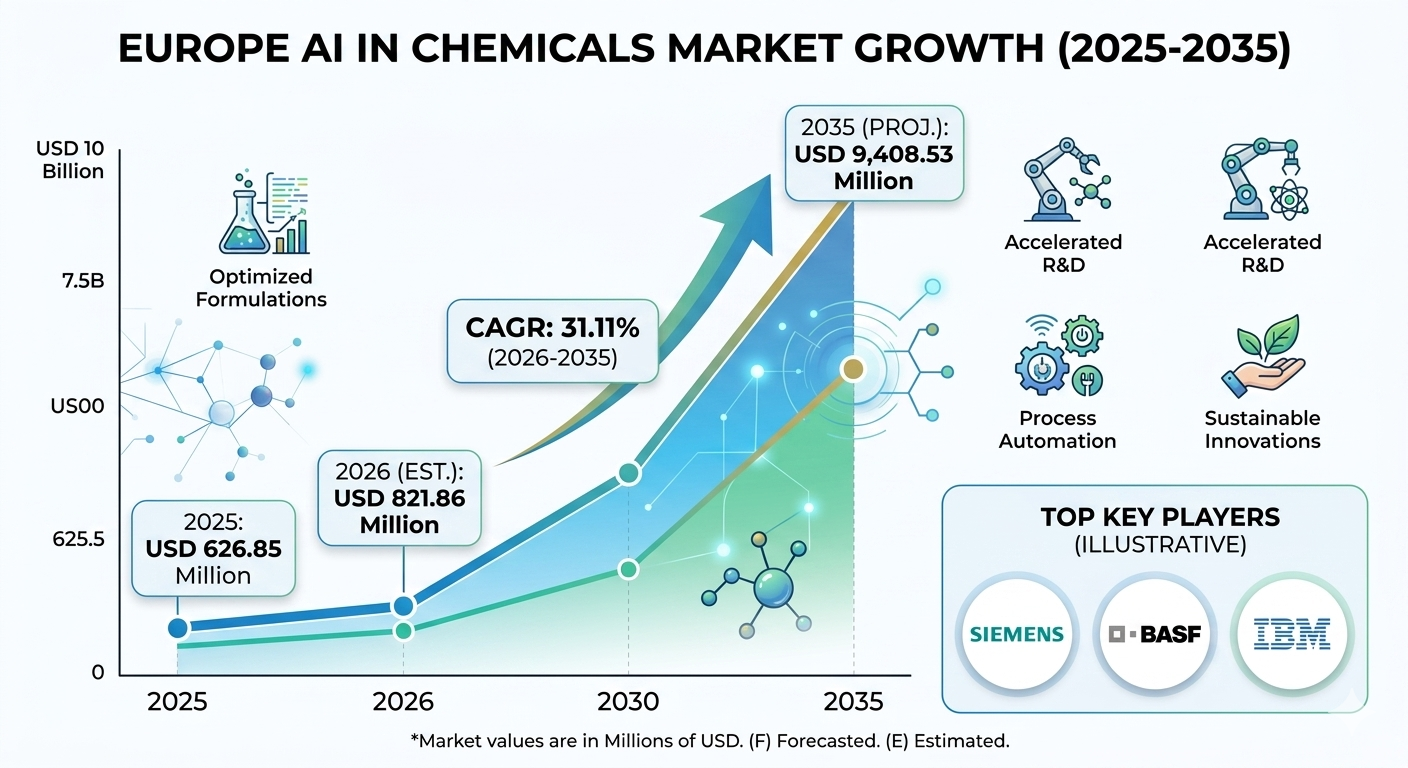
The transition toward digitalized chemistry networks is moving at a remarkable pace across European industrial hubs. The Europe AI in chemicals market size was valued at USD 626.85 million in 2025 and is estimated to reach USD 821.86 million in 2026. Driven by breakthroughs in generative chemistry, automated plant operations, and technical compliance mandates, the market is projected to reach USD 9,408.53 million by 2035. This rapid expansion represents a phenomenal compound annual growth rate (CAGR) of 31.11% over the forecast period from 2026 to 2035.
Market Overview: What is Driving AI Adoption in European Chemical Infrastructure?
Integrating artificial intelligence into the chemical sector involves deploying advanced machine learning algorithms, deep neural networks, and digital twin architectures across diversified molecular datasets. This technical modernization allows regional enterprises to run continuous simulation models, synchronize industrial IoT sensors, and manage thermal dynamics with incredible precision.
Rather than relying entirely on manual, trial-and-error laboratory experimentation, modern European facilities utilize AI to achieve automated operational conclusions. This strategic pivot significantly lowers the time-to-market for novel chemicals, optimizes real-time carbon footprints, and protects worker safety in volatile processing environments.
Market Dynamics: Analyzing Drivers, Restraints, and Industrial Opportunities
What Are the Primary Drivers for This Market?
-
Demand for High-Precision Efficiency: European chemical manufacturers operate in an energy-intensive landscape. By deploying AI-deep reinforcement learning models, operators can adjust energy inputs and manage thermodynamic variance in real time, maximizing product yield for ultra-pure, electronic-grade chemicals.
-
Strict Safety and Environmental Compliance: Plant operators utilize predictive modeling to prevent toxic chemical leaks and optimize carbon capture systems. This structural framework directly aligns with regional worker safety protocols and green chemistry initiatives.
What Barriers Are Restraining Market Growth?
-
High Heterogeneity of Legacy Data Assets: Many traditional chemical manufacturing plants across Europe still run on a complex mix of legacy distributed control systems and disconnected data sheets. Standardizing and cleansing these fragmented data sets requires significant capital investment and time before precise machine learning models can be successfully trained, occasionally delaying rollouts.
What Are the Emerging Opportunities in Green Engineering?
-
Accelerated Molecular Substitution: The stringent European REACH (Registration, Evaluation, Authorisation and Restriction of Chemicals) regulations require the phase-out of hazardous compounds. This creates a massive opportunity to use generative AI to design alternative, non-toxic molecules. Furthermore, integrating AI with lifecycle assessment software allows producers to secure verified, real-time low-carbon product certifications.
Component Segment Shares
-
Software (48% Market Share): Dominating the marketplace in 2025, cloud-native platforms, simulation software, and laboratory informatics are essential for running molecular property predictions and autonomous process controls.
-
Hardware (27% Market Share): This segment is fueled by high-performance computing clusters and decentralized edge processing nodes capable of running fluid dynamics and thermal simulations in explosive environments.
-
Services (25% Market Share): Serving as the fastest-growing segment with a 35.18% CAGR, services are highly sought after as chemical enterprises modernize legacy mainframes through specialized consulting and managed data engineering.
Core Technology Breakthroughs
-
Machine Learning (29% Market Share): As the primary technological segment, advanced supervised and reinforcement learning frameworks are widely used to execute predictive formulations and autonomously adjust plant flow rates.
-
Predictive Analytics (16% Market Share): This segment converts continuous asset sensor streams into actionable supply forecasting and reaction simulations, avoiding costly plant downtime.
-
Computer Vision (13% Market Share): Utilizing convolutional neural networks linked with industrial optical arrays, computer vision automates continuous quality inspections and detects invisible gas leaks via thermal imaging.
-
Digital Twin Technology (12% Market Share): Expanding at a rapid 35.11% CAGR, digital twins synthesize real-time sensor telemetry with thermodynamic equations to build exact virtual replicas of active chemical production lines.
Detailed Application and End-User Framework
Critical Application Areas
-
Process Optimization (24% Market Share): Leading the application category, this involves integrating closed-loop control systems directly into the production line to stabilize thermal fluctuations and eliminate raw material waste.
-
Predictive Maintenance (15% Market Share): Combines continuous acoustic and vibration telemetry with deep anomaly-detection algorithms to monitor high-pressure distillation columns and prevent catastrophic equipment failures.
-
Drug Discovery & Molecular Design (14% Market Share): Expanding at the fastest application rate with a 35.62% CAGR, this segment leverages generative chemistry and high-velocity computational screening to target complex atomic interactions for novel specialty polymers.
Primary End-User Industries
-
Specialty Chemicals (22% Market Share): This segment leads the market due to the intense downstream demand for high-performance polymers, specialized electronic solvents, and eco-compliant coatings engineered through graph neural networks.
-
Petrochemicals (18% Market Share): Refiners utilize reinforcement learning within steam crackers and distillation columns to safely maximize raw monomer yields under strict EU carbon caps.
-
Pharmaceutical Chemicals (16% Market Share): Growing at the fastest pace with a 35.84% CAGR, active pharmaceutical ingredient manufacturers rely on molecular generative AI to map complex docking setups while ensuring clinical compliance.
Why Did Germany Dominate the European Market in 2025?
Germany firmly led the European marketplace by capturing a 29% market share in 2025, with revenues estimated at USD 181.79 million and projected to climb to USD 2,775.52 million by 2035. This industrial dominance is anchored by robust government support, specialized manufacturing clusters, and strict alignment with the EU AI Act.
German chemical corporations utilize advanced, on-premise supercomputing networks and edge-AI processing nodes to run unified thermodynamic process tuning. This centralized technical framework allows domestic manufacturers to synthesize REACH-compliant specialty compounds safely without risking proprietary intellectual property leakage.
Key Companies Profiled: Strategic Insights and Offerings
1. Schneider Electric
-
About: A European multinational leader in digital transformation, energy management, and industrial automation.
-
Products: EcoStruxure for Chemicals, AI-driven predictive maintenance software, edge computing architectures, and autonomous process automation systems.
-
Market Capitalization: Approximately USD 120 Billion.
2. Siemens AG
-
About: A German engineering powerhouse providing advanced digital enterprise software, automation systems, and high-performance computing setups for processing sectors.
-
Products: gPROMS predictive modeling software, Simatic AI Guard, Siemens Industrial Edge, and chemical plant digital twin validation platforms.
-
Market Capitalization: Approximately USD 155 Billion.
3. Honeywell International Inc.
-
About: A global industrial software and technology provider specializing in performance materials, aerospace, and processing technologies.
-
Products: Honeywell Forge Predictive Maintenance, Experion Orion Process Knowledge Systems, and automated plant safety risk monitoring arrays.
-
Market Capitalization: Approximately USD 145 Billion.
4. NVIDIA Corporation
-
About: An advanced accelerated computing pioneer providing the core GPU cluster hardware and generative AI frameworks driving modern chemical synthesis.
-
Products: NVIDIA BioNeMo for molecular generation, specialized enterprise GPU architectures, and Omniverse digital twin simulation platforms.
-
Market Capitalization: Approximately USD 3.1 Trillion.
Recent Strategic Developments
-
March 2026 (AI-Orchestrated Lab Automation): Iktos announced a formal strategic collaboration with Chemspeed to integrate generative AI platforms with automated laboratory hardware. This partnership allows pharmaceutical and specialty chemical enterprises to accelerate discovery workflows and automate physical bench research.
-
October 2025 (Regulatory Standardization): CEN and CENELEC confirmed their full commitment to establishing unified European standards to support the rollout of the Artificial Intelligence Act (AIA). This framework clarifies high-risk classification criteria for automated chemical plant control systems and validated molecular discovery models.
Frequently Asked Questions (FAQs)
What is the current size of the Europe AI in chemicals market?
The Europe AI in chemicals market size was valued at USD 626.85 million in 2025 and is estimated to reach USD 821.86 million in 2026. It is projected to scale up to USD 9,408.53 million by 2035, expanding at a CAGR of 31.11%.
Which country holds the largest share in the European market?
Germany held the largest market share at 29% in 2025, driven by strong industrial infrastructure and advanced deployments of on-premise supercomputing clusters for chemical formulation.
What is the Europe AI in chemicals market used for?
The market focuses on using machine learning, computer vision, and digital twins to optimize chemical plant production yields, reduce manufacturing energy use, predict asset maintenance needs, and rapidly design sustainable, non-toxic alternative molecules.
How does digital twin technology benefit the chemical industry?
Digital twin technology blends real-time sensor data with complex thermodynamic equations to build virtual replicas of plant assets. This allows engineers to safely predict fluid dynamics, run simulated stress tests, and catch potential operational anomalies before they happen.
Who are the top companies providing AI solutions in this market?
Leading technology and automation companies in this space include Siemens, Schneider Electric, Honeywell International, NVIDIA Corporation, IBM Research Europe, and specialized chemical AI developers like Iktos.
About Us
Towards Chemical and Materials is a leading global consulting firm specializing in providing comprehensive and strategic research solutions across the chemical and materials industries. With a highly skilled and experienced consultant team, we offer a wide range of services designed to empower businesses with valuable insights and actionable recommendations.
Our Trusted Data Partners
Precedence Research | Statifacts | Towards Packaging | Towards Healthcare | Towards Food and Beverages | Towards Chemical and Materials | Towards Consumer Goods | Nova One Advisor |
For Latest Update Follow Us: https://www.linkedin.com/company/towards-chem-and-materials/
USA: +1 804 441 9344
APAC: +61 485 981 310 or +91 87933 22019
Europe: +44 7383 092 044
Email: [email protected]


Leave a Reply