TowardsChem&Materials

Insights Driving the Chemistry of Innovation

Dimethylaminoethyl Methacrylate Market Analysis: Driving Smart Polymers and Water Treatment Innovations

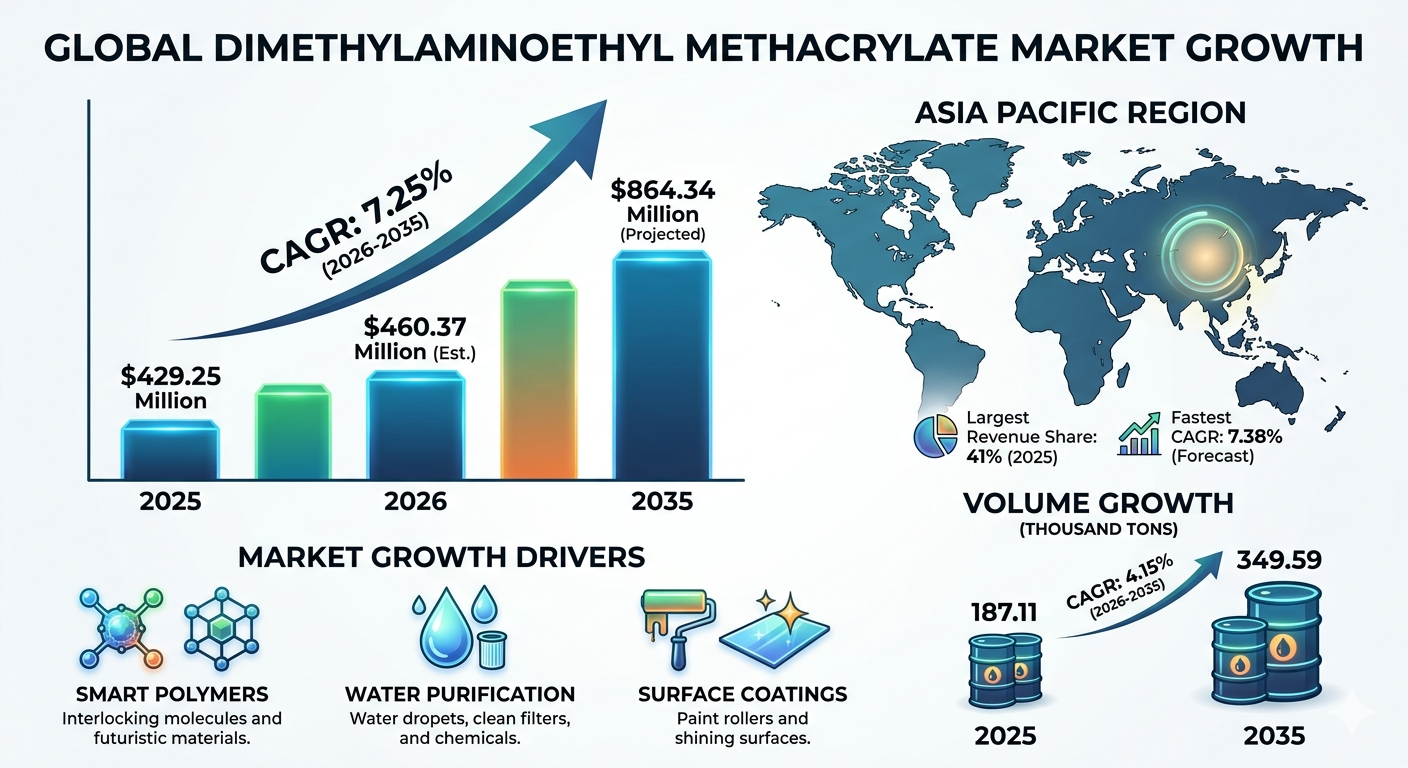
The global dimethylaminoethyl methacrylate (DMAEMA) market is undergoing a rapid evolution, driven by its indispensable role in producing functional macromolecules. Valued at USD 429.25 million in 2025, the market is estimated to reach USD 460.37 million in 2026. Maintaining a steady compound annual growth rate (CAGR) of 7.25% from 2026 to 2035, the market is projected to reach USD 864.34 million by 2035. (Interpolating this trajectory positions the market value at approximately USD 698 million by 2032).

In terms of volume, the industry expects a move from 187.11 thousand tons in 2025 to 349.59 thousand tons by 2035, exhibiting a volume CAGR of 4.15%. This structural variance between value and volume growth underscores a broader industrial migration toward high-purity, premium specialty grades.
Market Overview & Why It Is Important

Dimethylaminoethyl methacrylate is a versatile amine-functional monomer used to add cationic character, hydrophilicity, and chemical reactivity to polymer backbones.

This structural architecture makes it an essential building block across several critical industries:

  • Water Treatment: Its amine group easily converts into quaternary ammonium salts, creating highly efficient cationic flocculants that bind and clear negatively charged organic impurities from wastewater.

  • Smart Polymer Materials: DMAEMA responds sharply to changes in pH and temperature, making it a key component in advanced biomedical systems like controlled drug delivery and smart hydrogels.

  • Surface Coatings: It improves adhesion, pigment dispersion, and chemical resistance in high-performance automotive and industrial coatings.

What Are the Key Factors Driving the Market?

The Escalating Demand for Water Purification Chemicals

Strict environmental mandates worldwide are forcing industrial and municipal sectors to upgrade their wastewater treatment workflows. Cationic polyacrylamides derived from DMAEMA are crucial here because they offer fast settling times and exceptional dewatering performance.

The Rise of Smart Polymer Systems

In the medical and biotechnology sectors, there is a growing focus on stimuli-responsive materials. DMAEMA’s ability to switch between hydrophilic and hydrophobic states depending on environmental pH makes it a top choice for target-specific drug delivery systems and adaptive membrane technologies.

Advanced High-Performance Architectural Coatings

Modern industrial coatings require excellent long-term durability and resistance to harsh weather. DMAEMA serves as an efficient internal adhesion promoter, ensuring architectural paints bond strongly to low-energy surfaces without needing volatile organic primers.

What Are the Key Market Trends & Insights?

A major trend in the industry is the shift toward stabilizing DMAEMA monomers with bio-based or highly stable inhibitors. Because the monomer is naturally prone to premature polymerization during transport and storage, manufacturers are developing novel inhibitor packages that ensure a long shelf life without compromising downstream reactivity.

Geographically, the Asia-Pacific region dominated the landscape with a commanding 41% revenue share in 2025. Driven by expanding industrial hubs in China and India, the region is also projected to be the fastest-growing market, pushing forward at a CAGR of 7.38% over the forecast period.

Key Market Data Breakdown

Market Parameter 2025 Baseline Value 2026 Estimate 2035 Projection Forecast CAGR (2026–2035)
Global Market Size (Value) USD 429.25 Million USD 460.37 Million USD 864.34 Million 7.25%
Global Production Volume 187.11 Thousand Tons 199.15 Thousand Tons 349.59 Thousand Tons 4.15%
Asia-Pacific Market Share 41.0% 41.2% 43.5% 7.38%

Market Segments: Deep Dive

Which Segment Accounted for the Largest Market Share?

The Water Treatment Applications segment held the largest market share in 2025, accounting for over 38% of total volume consumption. This dominance stems from the massive, non-negotiable volumes of cationic flocculants required by municipal sewage facilities and heavy industries like pulp and paper, mining, and oil refining.

Other Vital Market Divisions

  • By Product Type / Purity: Standard Grade (98.5%) and High-Purity Specialty Grade (greater than 99.5%). High-purity grades are seeing rapid adoption in electronics and advanced medical applications.

  • By Form: Liquid form remains dominant due to its ease of metered dosing in continuous solution polymerization lines.

  • By Application: Flocculants & Coagulants, Adhesion Promoters, Soil Conditioners, Thickening Agents, and Pharmaceutical Excipients.

What Are the Benefits of Using DMAEMA?

Integrating DMAEMA into commercial polymer formulas offers several clear engineering advantages:

  • Excellent Cationic Substrate Affinity: It creates a strong permanent or pH-dependent positive charge that bonds exceptionally well with anionic substrates like cellulose, skin, hair, and biological membranes.

  • Dual Functionality: The molecule contains both a reactive acrylic double bond and a tertiary amine site, allowing for straightforward post-polymerization modifications like quaternization.

  • Enhanced Polymer Stability: It provides superior mechanical and shear stability when built into water-borne acrylic emulsions.

Competitive Landscape: Top Companies Profiled

Evonik Industries AG

  • About: A global leader in specialty chemicals headquartered in Essen, Germany.

  • Products: Markets high-grade methacrylate monomers under the VISIOMER® brand, including high-purity DMAEMA.

  • Market Capitalization: Approximately EUR 7.4 Billion (Mid-2026).

BASF SE

  • About: The world’s largest chemical producer, operating out of Ludwigshafen, Germany.

  • Products: Produces functional acrylic and methacrylic monomers utilized in industrial water treating and performance polymers.

  • Market Capitalization: Approximately EUR 45.2 Billion (Mid-2026).

Mitsubishi Gas Chemical Company, Inc. (MGC)

  • About: A prominent Japanese chemical manufacturer specializing in basic chemicals to advanced functional materials.

  • Products: Supplies specialty amino-alkyl methacrylates optimized for electronic chemicals and advanced coatings.

  • Market Capitalization: Approximately JPY 815 Billion (Mid-2026).

Fushun Anxin Chemical Co., Ltd.

  • About: A specialized Chinese chemical producer focusing on specialty acrylic esters and methacrylates.

  • Products: Large-scale supplier of industrial-grade DMAEMA for the domestic and international water flocculant markets.

  • Market Capitalization: Private Enterprise.

What Are the Recent Developments by Major Companies?

Major players are shifting their strategies toward vertical integration and improving process sustainability. Evonik and BASF have focused on upgrading their monomer manufacturing plants to reduce greenhouse gas emissions and lower energy consumption during vacuum distillation.

Additionally, companies are securing strategic supply agreements with water treatment giants to lock in steady volume demand. These partnerships are driving the development of tailored monomer blends that can be dropped directly into existing emulsion polymerization lines without requiring re-engineering.

What Are the Recent Government Initiatives?

Government actions around wastewater management and chemical safety are reshaping the market landscape. In Europe, strict industrial water recycling goals under the updated EU Urban Wastewater Treatment Directive are forcing plants to use advanced cationic polymeric clarifiers.

Meanwhile, regulatory bodies like the US EPA and China’s Ministry of Ecology and Environment are tightening rules on residual unreacted monomers in consumer goods. This has spurred a wave of manufacturing innovation focused on producing ultra-low-VOC (volatile organic compound) polymer emulsions, driving up demand for high-purity DMAEMA grades that leave minimal chemical trace.

What Is the Future of the Market?

The future of the DMAEMA industry lies at the intersection of green chemistry and advanced material design. Over the next decade, look for manufacturers to focus on replacing fossil-derived raw materials with bio-based methacrylic acid and bio-derived dimethylaminoethanol to produce a lower-carbon DMAEMA monomer.

As smart industries like personalized medicine and smart agricultural coatings scale up, the demand for this versatile molecule will continue to shift from low-margin bulk applications to high-value, high-purity technology sectors.

About Us

Towards Chemical and Materials is a leading global consulting firm specializing in providing comprehensive and strategic research solutions across the chemical and materials industries. With a highly skilled and experienced consultant team, we offer a wide range of services designed to empower businesses with valuable insights and actionable recommendations.

Our Trusted Data Partners

Precedence Research | Statifacts | Towards Packaging | Towards Healthcare | Towards Food and Beverages | Towards Chemical and Materials | Towards Consumer Goods | Nova One Advisor |

For Latest Update Follow Us: https://www.linkedin.com/company/towards-chem-and-materials/

USA: +1 804 441 9344

APAC: +61 485 981 310 or +91 87933 22019

Europe: +44 7383 092 044

Email: sales@towardschemandmaterials.com

Web:  https://www.towardschemandmaterials.com/

Leave a Reply

Your email address will not be published. Required fields are marked *