Executive Summary
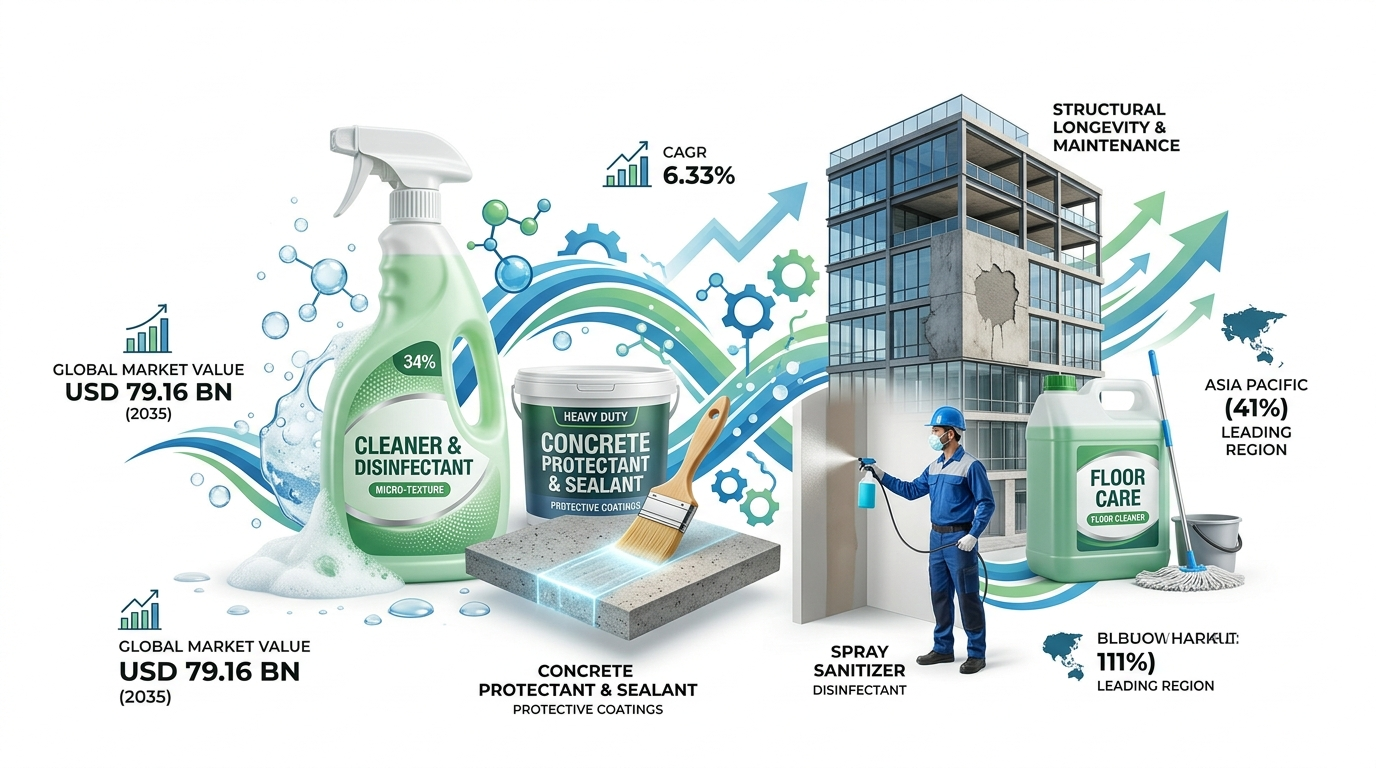
The global building maintenance chemicals market is experiencing a period of steady growth. Valued at USD 42.85 billion in 2025, the market is estimated to reach USD 45.56 billion in 2026. Driven by the rising demand for high-performance concrete materials and sustainable construction practices, the industry is projected to reach a market value of USD 79.16 billion by 2035. This expansion represents a steady CAGR of 6.33% during the forecast period from 2026 to 2035.
In terms of physical volume, demand is expected to scale from 38.75 million tons in 2025 to 66.50 million tons by 2035, expanding at a volume CAGR of 5.55%. This difference between value and volume growth underscores a broader structural shift toward premium, highly specialized, and environmentally sustainable formulations that command higher prices in the global market.
Market Overview: What Are Building Maintenance Chemicals?
Building maintenance chemicals comprise a specialized array of formulations designed to protect, clean, restore, and maintain commercial, institutional, residential, and industrial structures. Unlike standard consumer cleaning products, these industrial-grade materials are engineered to face demanding environmental stresses, high foot traffic, and strict regulatory standards. The primary category groups include:
-
Cleaning Formulations: Heavy-duty floor degreasers, sanitizers, glass cleaners, and specialized surface disinfectants.
-
Protective Coatings & Sealers: High-performance polyurethane and epoxy systems that shield surfaces from mechanical wear, chemical spills, and moisture.
-
Repair & Surface Agents: Structural concrete modifiers, waterproofing chemical matrices, and descaling compounds.
This sector is transitioning from standard reactive chemical formulations toward smart, proactive material technologies. Solutions like self-healing concrete treatments and low-VOC (volatile organic compounds) bio-surfactants are increasingly used to minimize long-term structural degradation and reduce high maintenance costs.
Market Dynamics: What Is Driving Market Growth?
What Are the Primary Drivers for This Market?
The key factor driving market growth is the accelerating global demand for high-performance concrete and specialized structural preservation materials. Modern engineering demands material strength that can withstand severe environmental conditions and heavy daily use. Proactive maintenance using advanced chemical synthesis significantly extends asset life cycles. This approach helps developers and asset managers avoid the high capital expenditures associated with premature structural failures.
Additionally, ongoing global urbanization and rapid infrastructure expansion act as powerful growth engines. As regional economies expand, the concentration of complex commercial developments, multi-family residential complexes, and modern public facilities increases. This trend sustains a continuous consumption cycle for facility cleaning and structural preservation chemicals.
What Are the Key Market Trends Shifting the Industry?
The most significant trend shaping the modern market is the quick shift toward green building practices and sustainable chemical solutions. Regulatory compliance and corporate environmental targets are forcing a transition away from traditional, harsh chemical formulas. Regulatory pressure is accelerating the development of low-VOC, non-toxic, and biodegradable maintenance products. These solutions must achieve high performance while meeting strict ecological safety criteria.
A secondary trend is the growing demand for long-term surface protection in industrial and commercial spaces. Facility managers are specifying advanced epoxy and polyurethane protective coatings to ensure long-term durability. These materials safeguard surfaces against chemical spills, heavy machinery operations, and intense foot traffic. Furthermore, cutting-edge technologies are introducing data-driven, proactive maintenance models. These include robotic application devices for high-rise exterior surface maintenance and digital supply chain monitoring tools.
What Is Hindering Market Growth?
The main factor restraining market expansion is the ongoing volatility of raw material prices. The building maintenance chemicals industry relies on key feedstocks, including specialized solvents, surfactants, and organic phosphates. These components are highly sensitive to geopolitical tensions and fluctuations in global crude oil prices. This constant pricing volatility directly increases manufacturing costs, compresses profit margins, and challenges supply chain stability for market players worldwide.
Where Do the Lucrative Opportunities Lie?
The ongoing growth of smart cities and large-scale mega-infrastructure initiatives offers excellent commercial opportunities. Governments worldwide are investing heavily in urban renewal, advanced transit networks, and energy production facilities. These complex environments require innovative maintenance chemistry. Developers need smart coatings, specialized disinfectants, and durable sealants that can integrate with smart building management systems and withstand continuous, long-term use.
Market Benefits of Using Advanced Maintenance Chemistry
Using specialized building maintenance chemicals offers concrete, measurable advantages for facility operations and structural longevity:
-
Extended Asset Lifecycles: High-performance protective coatings shield infrastructure from carbonation, moisture ingress, and chemical degradation, preventing early concrete failure.
-
Optimized Total Cost of Ownership (TCO): Transitioning from reactive, breakdown-driven repairs to data-backed, proactive chemical protection significantly lowers long-term maintenance costs.
-
Enhanced Health and Environmental Safety: Modern low-VOC formulations and bio-based disinfectants provide exceptional sanitization without compromising indoor air quality or violating strict safety regulations.
-
Improved Structural Resilience: Advanced chemical modifiers and waterproofing systems allow buildings to endure intense mechanical wear, high foot traffic, and environmental exposure.
Key Market Segments: Detailed Analytical Breakdown
The global building maintenance chemicals market features highly diverse product categories, functional applications, physical forms, and distribution channels.
Which Segment Accounted for the Largest Market Share?
By product type, the cleaning chemicals segment dominated the market, accounting for a 34% share in 2025. This position is sustained by rising hygiene standards across commercial and residential spaces, combined with shorter, more frequent cleaning cycles.
By form, the liquid segment held the largest market share at 48% in 2025. This dominance is driven by liquid formulations’ extensive compatibility with automated dosing infrastructure, ease of application, and fast action.
Product Type Segment Breakdown
-
Cleaning Chemicals (34% Market Share in 2025): Driven by expanding urban households and strict commercial sanitization rules.
-
Laundry Care Chemicals (18% Market Share in 2025): Maintained by steady demand from the institutional hospitality and healthcare sectors.
-
Dishwashing Chemicals (10% Market Share in 2025): Anticipated to expand at the fastest CAGR of 6.6% through 2035, supported by the global adoption of commercial kitchens and automated dishwashing equipment.
-
Surface Treatment Chemicals, Coatings, and Specialty Maintenance Agents: Comprising the remaining portion, focused on heavy-duty structural applications.
Application and End-Use Industry Segments
-
Residential Buildings (36% Market Share in 2025): The largest application segment, driven by rising disposable incomes and expanding global urban housing.
-
Commercial Buildings (27% Market Share in 2025): Supported by corporate office expansions, retail footprints, and professional property management.
-
Institutional Segment (19% Market Share in 2025): Poised to grow at the fastest CAGR of 6.8%, fueled by public school systems, government properties, and infrastructure investments.
-
Facility Management Services (29% Market Share in 2025): The dominant end-use industry, reflecting the ongoing trend toward outsourcing building operations to specialized professional entities.
-
Healthcare Sector (17% Market Share in 2025): Expected to grow at the fastest CAGR of 7.1%, due to strict infection control protocols and expanding healthcare infrastructure.
Form and Distribution Channel Segments
-
Liquid Formulations (48% Market Share in 2025): The leading physical form, expanding at a projected fastest CAGR of 6.7%.
-
Powder Formulations (22% Market Share in 2025): Valued for its extended shelf life and cost-effective bulk shipping profiles in institutional settings.
-
Spray Formulations (18% Market Share in 2025): Favored for direct, ready-to-use household applications and targeted cleaning.
-
Distributors & Wholesalers (34% Market Share in 2025): The dominant channel, offering robust bulk-supply logistics to commercial buyers.
-
Online Retail (16% Market Share in 2025): Projected to grow at the fastest CAGR of 7.2%, driven by the expansion of industrial e-commerce and home-delivery options.
Strategic Visualizations: Market Breakdown
The data insights below illustrate the regional and structural breakdown of the global market.
| Market Attribute Dimension | Segment Dominant Champion (2025 Share) | High-Growth Velocity Segment (Projected CAGR) |
| Geographic Region | Asia Pacific (41%) | Asia Pacific (7.1% CAGR) |
| Product Category Type | Cleaning Chemicals (34%) | Dishwashing Chemicals (6.6% CAGR) |
| Functional Application | Residential Buildings (36%) | Institutional Segment (6.8% CAGR) |
| End-Use Industry Sector | Facility Management (29%) | Healthcare Sector (7.1% CAGR) |
| Chemical Material Form | Liquid Formulations (48%) | Liquid Formulations (6.7% CAGR) |
| Logistics Supply Channel | Distributors & Wholesalers (34%) | Online Retail E-Commerce (7.2% CAGR) |
Regional Analysis: Asia Pacific and North America
How Did Asia Pacific Dominate the Global Market?
The Asia Pacific region led the global market with a 41% share in 2025, and it is projected to maintain the fastest CAGR at 7.1% through 2035. This market position is driven by steady urbanization and infrastructure spending in emerging economies. In China, government funding for renovating older infrastructure and expanding transportation hubs is a key driver. This investment fuels localized research and development into high-performance waterproofing systems and concrete coatings. Meanwhile, in India, massive commercial investments and public-private partnerships are creating consistent demand for asset maintenance chemicals.
What Are the Trends Shaping North America?
North America held a 20% market share in 2025. The market in this region is characterized by high sanitation standards, sophisticated facility management practices, and strict safety guidelines. The United States market focuses on specialized disinfectants for commercial healthcare facilities and food-processing plants. Additionally, rising consumer environmental awareness is driving a strong shift toward green chemical alternatives, sustainable raw materials, and low-VOC formulations.
Market Recent Government Initiatives
National regulatory frameworks and green building initiatives are increasingly steering the building maintenance chemicals landscape:
-
United States: The Environmental Protection Agency (EPA) continues to expand its voluntary Safer Choice program, certifying high-performance cleaning and maintenance chemicals that meet strict safety and ecological criteria.
-
European Union: Under the EU Green Deal and Eco-Label frameworks, regulations encourage the phase-out of Persistent, Bioaccumulative, and Toxic (PBT) substances, accelerating the adoption of bio-based surfactants and sustainable industrial cleaners.
-
China: Stricter measures aligned with international treaties (such as the Stockholm Convention) have restricted the use of per- and polyfluoroalkyl substances (PFAS) in specialty surface coatings, forcing manufacturers to innovate alternative chemical pathways.
Competitive Landscape: Key Market Players
The global building maintenance chemicals industry is consolidated among a select group of material science multi-nationals and specialized chemical synthesizers. The market features integrated players operating across multiple stages of the supply chain, from feedstock procurement to direct distribution.
BASF SE
-
About: BASF SE is a global chemical powerhouse headquartered in Ludwigshafen, Germany, operating across a highly integrated Verbund structure. The company is a key leader in the building materials and maintenance chemicals sector.
-
Products: High-performance polymers, raw surfactants, formulation additives, concrete performance chemical agents, and specialty eco-engineered protective resins.
-
Market Capitalization: Approximately USD 54.29 billion (as of May 2026).
Dow Inc.
-
About: Based in Midland, Michigan, Dow Inc. is a global materials science leader focused on developing innovative, sustainable, and high-performance solutions for the construction, consumer care, and industrial infrastructure segments.
-
Products: Advanced silicone sealants, acrylic binders, polyurethane protective coating raw materials, and functional chemical intermediates used in surface cleaning technologies.
-
Market Capitalization: Approximately USD 25.96 billion (as of May 2026).
Ecolab Inc.
-
About: Ecolab Inc. is a global sustainability leader headquartered in St. Paul, Minnesota. The company provides water, hygiene, and infection prevention solutions across institutional commercial facilities, healthcare centers, and hospitality sectors worldwide.
-
Products: Concentrated industrial disinfectants, automated facility sanitization systems, commercial kitchen warewashing chemicals, and specialized laundry care chemical lines.
-
Market Capitalization: Approximately USD 72.30 billion (as of May 2026).
Henkel AG & Co. KGaA
-
About: Headquartered in Düsseldorf, Germany, Henkel holds strong global market positions in both consumer goods and advanced industrial technologies, with its Adhesive Technologies division serving as a cornerstone for building repair markets.
-
Products: Structural tile adhesives, specialized concrete sealants, industrial surface cleaners, and protective elastic architectural coatings.
-
Market Capitalization: Approximately EUR 10.27 billion (Adhesive & Institutional valuation segment, as of May 2026).
Pidilite Industries Limited
-
About: Headquartered in Mumbai, India, Pidilite Industries is a leading manufacturer of consumer adhesives, sealants, and construction chemicals across South Asia, driving significant innovation in waterproofing and building repair methods.
-
Products: The iconic Dr. Fixit waterproofing product line, structural concrete modifiers, external wall coatings, and specialized joint sealants.
-
Market Capitalization: Approximately INR 1.35 trillion (as of May 2026).
Market Recent Developments by Major Companies
Strategic collaborations and product innovations are reshaping the competitive landscape. A notable milestone occurred in February 2026, when Rehab Technologies announced the launch of RBN (Repairing Buildings Nationally). This major strategic initiative, led by CEO and Public Policy Advisor Dr. P. Srinivasa Reddy, was introduced as a comprehensive national mission in India. The program addresses aging public infrastructure by systematically repairing deteriorating concrete structures using advanced polymer modifiers and waterproofing technologies.
Concurrently, major tier-one manufacturers like BASF and Dow are optimizing their product portfolios. They are divesting non-core assets, closing high-emission manufacturing lines, and increasing capital investments in bio-based surfactants and circular polymer lines to meet the strict demands of eco-conscious commercial clients.
Future of the Market: A Forward-Looking Perspective
The future of the global building maintenance chemicals market will be defined by the convergence of sustainability and smart material engineering. Traditional chemical approaches are steadily being replaced by intelligent systems that reduce human labor requirements and minimize lifetime facility maintenance costs.
Expect to see deep market penetration of self-healing surfaces, bio-mimetic protective coatings that resist dirt accumulation naturally, and antimicrobial surface treatments that remain active for extended periods. As corporate environmental mandates and real estate standards tighten worldwide, companies that invest heavily in transparent, sustainable production chains and low-carbon formulations will lead the market. The industry is evolving past standard cleaning and repair cycles toward a new standard of proactive structural preservation.
About Us
Towards Chemical and Materials is a leading global consulting firm specializing in providing comprehensive and strategic research solutions across the chemical and materials industries. With a highly skilled and experienced consultant team, we offer a wide range of services designed to empower businesses with valuable insights and actionable recommendations.
Our Trusted Data Partners
Precedence Research | Statifacts | Towards Packaging | Towards Healthcare | Towards Food and Beverages | Towards Chemical and Materials | Towards Consumer Goods | Nova One Advisor |
For Latest Update Follow Us: https://www.linkedin.com/company/towards-chem-and-materials/
USA: +1 804 441 9344
APAC: +61 485 981 310 or +91 87933 22019
Europe: +44 7383 092 044
Email: [email protected]


Leave a Reply