Executive Summary
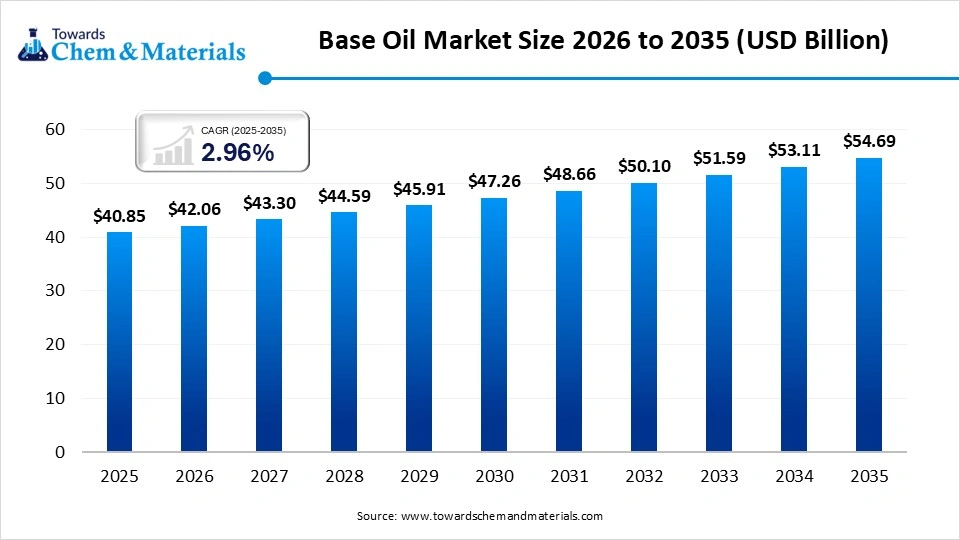
The global base oil market is poised for steady growth over the forecast period from 2026 to 2035, with an estimated market size of USD 42.06 billion in 2026, expanding to USD 54.69 billion by 2035. This growth represents a Compound Annual Growth Rate (CAGR) of 2.96%. The Asia Pacific region holds the dominant position in the market, commanding a 51.00% share in 2025. Key drivers for this growth include increasing demand for high-quality lubricants in automotive and industrial applications, as well as technological advancements in base oil production.
Market Overview
Base oils are the foundation of lubricants used in various industrial, automotive, and commercial applications. These oils are refined from crude oil and are categorized into different groups based on their refining processes. The global base oil market is growing steadily due to the rising demand for high-performance lubricants across several industries, including automotive, machinery, and manufacturing.
Key market trends include the growing demand for Group II and Group III base oils, driven by the need for more eco-friendly, high-performance lubricants. The shift towards synthetic oils and advanced formulations is another trend that is expected to drive the market growth.
What Are the Primary Drivers for This Market?
Several factors are driving the growth of the base oil market:
- Increasing Industrialization and Automotive Growth: Rising demand for automotive oils due to increasing vehicle production and usage worldwide, especially in emerging markets, contributes significantly to market growth.
- Demand for High-Performance Lubricants: There is a growing shift towards high-performance lubricants, particularly those with lower viscosity and better temperature stability, which is expected to fuel the demand for Group II and Group III base oils.
- Technological Advancements: Advancements in refining technologies, such as hydrocracking, have led to the production of higher-quality base oils that are more eco-friendly and meet stringent regulatory standards.
- Environmental and Regulatory Pressures: With the increasing focus on sustainability, there is a growing demand for base oils that are less harmful to the environment and comply with stringent emission norms.
Get Premium Report Here : https://www.towardschemandmaterials.com/checkout/6280
Key Segments & Trends
By Base Oil Group
- Group I: Conventional base oils, typically used in applications where high performance is not as critical.
- Group II: Higher quality, refined oils that offer better oxidation stability and are used in applications like automotive oils.
- Group III: Synthetic base oils with superior performance, often used in high-performance automotive lubricants.
By Application
- Automotive Lubricants: This segment holds a significant share due to the increased production of vehicles globally. It includes engine oils, transmission fluids, and other vehicle lubricants.
- Industrial Lubricants: Lubricants used in industrial machinery, manufacturing, and heavy equipment. This segment is expanding with the rise in industrial activities across various regions.
- Other Applications: Includes uses in the marine, aerospace, and agricultural industries, which are expected to grow with advancements in related sectors.
Regional Growth
- Asia Pacific: As the largest regional market, Asia Pacific is expected to maintain its dominant position, supported by rapid industrialization and the burgeoning automotive industry in countries like China and India.
- North America: A strong automotive sector and the rise in demand for high-quality lubricants will drive market growth in this region.
- Europe: With stringent environmental regulations, the demand for eco-friendly and high-performance lubricants is increasing in Europe, particularly in the automotive sector.
Competitive Landscape
Key players in the base oil market include:
- ExxonMobil: A leading player with significant market share, especially in the production of high-quality Group II and Group III base oils.
- Royal Dutch Shell: With a wide range of products and a strong presence in both conventional and synthetic base oils, Shell continues to lead innovation in the sector.
- Chevron Corporation: Known for its comprehensive portfolio of base oils and a focus on sustainability in lubricant formulations.
- S-Oil Corporation: A major player in Asia, particularly in Group II and III base oils, with a focus on high-performance products for the automotive and industrial sectors.
Recent strategic moves include partnerships with automotive companies to supply synthetic oils and increasing investments in eco-friendly production processes.
Key Trends in Regional Growth
- Asia Pacific: Dominated by a 51.00% share in 2025, expected to see a steady increase due to growing automotive production and industrial demand.
- North America: Expected to grow at a CAGR of 3.5% due to a demand for premium lubricants and stricter environmental regulations.
- Europe: Growth at a CAGR of 2.5%, with a strong focus on eco-friendly solutions in lubricants.
Conclusion
The base oil market is poised for steady growth, with significant contributions from the automotive and industrial sectors. The rise in demand for high-performance lubricants, along with technological advancements in production, will drive the market forward. As Asia Pacific continues to dominate, companies will need to adapt to changing regulations and environmental standards, capitalizing on the growing demand for sustainable and high-performance base oils. The industry is set to evolve with advancements in refining technologies and increasing competition from major market players.


Leave a Reply