Market Overview
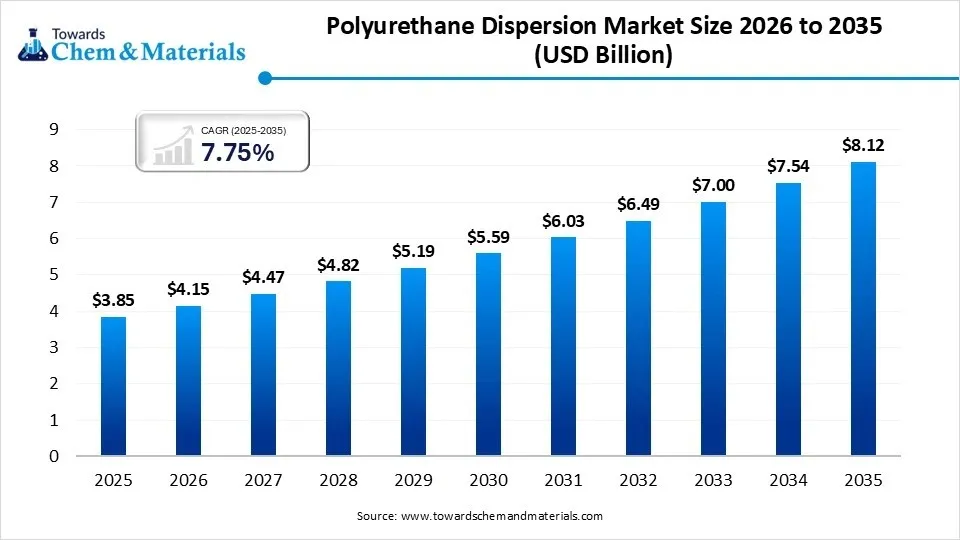
The global Polyurethane Dispersion (PUD) market, valued at USD 3.85 billion in 2025, is poised for substantial growth, reaching USD 8.12 billion by 2035, expanding at a compound annual growth rate (CAGR) of 7.75%. Polyurethane dispersions are water-based polymer resins where polyurethane particles are dispersed in water rather than organic solvents, offering a more sustainable option for industries across various sectors. As industries move towards eco-friendly solutions, PUDs are becoming increasingly integral in applications such as coatings, adhesives, textile coatings, and leather finishing.
One of the primary drivers of market growth is the increasing demand for sustainable coatings and adhesives, primarily due to stricter environmental regulations worldwide. Additionally, rapid urbanization in emerging economies and a surge in construction activities across the globe are expected to propel the demand for polyurethane dispersions.
Market Dynamics
The polyurethane dispersion market is influenced by several factors that shape its growth and trajectory. The increasing focus on sustainability is one of the primary drivers in the industry, as consumers and industries alike are moving towards environmentally friendly alternatives. With stricter emission and VOC (volatile organic compound) regulations across key regions, waterborne polyurethane dispersions have seen a significant rise in adoption, as they offer low-to-zero VOC emissions, aligning with regulatory demands.
Technological advancements also play a pivotal role in the market’s evolution. Innovations in polymer chemistry, nanotechnology integration, and bio-based raw materials are enabling the development of high-performance PUDs that boast enhanced durability, flexibility, adhesion, and scratch resistance. These advancements are especially beneficial for industries like automotive, where PUDs are increasingly used for car refinishing paints.
Additionally, global trade dynamics have influenced the polyurethane dispersion market. In 2024, the U.S. exported approximately USD 852 million worth of polyurethanes to several international markets. The increasing adoption of polyurethane dispersions in industries like construction, automotive, textiles, and furniture, especially in regions like Asia Pacific, which accounted for 42% of the global market share in 2025, contributes to the growing demand for these products.
Report Scope
| Report Attribute | Details |
| Market Size in 2026 | USD 4.15 Billion |
| Revenue Forecast in 2035 | USD 8.12 Billion |
| Growth Rate | CAGR 7.75% |
| Forecast Period | 2026 – 2035 |
| Base Year | 2025 |
| Dominant Region | Asia Pacific |
| Segment Covered | By Product , By Application, By Region |
| Key companies profiled | Covestro AG, BASF, The Dow Chemical Company, Mitsui Chemicals, Inc., The Lubrizol Corporation, Alberdingk Boley GmbH, Solvay, Bayer AG |
Market Segments
The polyurethane dispersion market can be divided into several segments based on product type, application, and region. These segments provide valuable insights into how the market is evolving and highlight the areas of most significant growth.
By Product
- Water-Based Dispersions: Waterborne polyurethane dispersions dominated the market with a 67.40% share in 2025. These dispersions are favored for their eco-friendly properties, and advancements in waterborne technology have led to the development of high-performance systems, making them the preferred choice across various industries, including textiles, adhesives, and coatings.
- Solvent-Based Dispersions: Although water-based dispersions hold the majority share, solvent-based dispersions are expected to grow at the fastest CAGR during the forecast period. This is due to their superior chemical resistance, durability, and film-forming capabilities, which are essential for high-performance industrial coatings, especially in automotive and construction applications.
By Application
- Paints and Coatings: The paints and coatings segment led the market with a share of 33.30% in 2025. This dominance is attributed to the increasing demand for sustainable coating technologies, particularly in the automotive, construction, and furniture sectors, where high-performance coatings are essential.
- Textile Finishing: The textile finishing segment is expected to grow at the fastest CAGR during the forecast period. This growth is driven by the increasing need for functional fabrics and the rising demand for synthetic leather, which uses polyurethane dispersions for finishes that offer water repellency, UV protection, and flame retardancy.
By Region
- Asia Pacific: The Asia Pacific region is expected to dominate the polyurethane dispersion market, with a 42% share in 2025. This region is seeing an increasing demand for PUDs across sectors like construction, automotive, textiles, and furniture. Rapid urbanization, coupled with the availability of cost-effective labor, makes Asia Pacific a hotspot for polyurethane dispersion consumption.
- North America: North America is projected to grow at the fastest CAGR due to the region’s ongoing shift toward sustainable coatings and technological innovations in waterborne solutions. The U.S. remains a key player in this transition, largely driven by stringent VOC regulations and growing adoption of advanced manufacturing processes.
- Europe: Europe accounted for 22% of the market in 2025 and is expected to continue its growth due to an increasing demand for high-performance building insulation materials and eco-friendly coatings. Innovations in PUD formulations and regulatory policies promoting sustainability will further drive the region’s market expansion.
Key Companies in the Polyurethane Dispersion Market
Several key players dominate the polyurethane dispersion market, leading the charge in innovation and sustainability. These companies have established themselves as market leaders by offering a range of products and focusing on technological advancements that improve performance and environmental compliance.
Covestro AG
- About: Covestro AG is a global leader in the production of high-performance materials, including polyurethane dispersions. The company focuses on developing sustainable solutions for various industries, from construction to automotive.
- Products: Covestro offers a wide range of polyurethane dispersions used in coatings, adhesives, and textiles, among other applications.
- Market Cap: Covestro has a market capitalization of over USD 10 billion, making it one of the leading companies in the polyurethane market.
BASF
- About: BASF is one of the world’s largest chemical companies, with a strong presence in the polyurethane dispersion market. The company focuses on offering high-performance, sustainable waterborne dispersions for applications in construction, automotive, and textiles.
- Products: BASF offers a range of polyurethane dispersions for coatings, adhesives, and sealants, with a focus on low-VOC products that meet environmental regulations.
- Market Cap: BASF’s market capitalization is over USD 70 billion, making it one of the key players in the global chemical market.
The Dow Chemical Company
- About: Dow is a major player in the global polyurethane dispersion market, focusing on sustainable, low-VOC technologies for coatings, adhesives, and sealants. Dow is known for its innovations in water-based technologies.
- Products: Dow’s product portfolio includes a variety of waterborne and low-VOC polyurethane dispersions, offering durability, flexibility, and adhesion in industrial applications.
- Market Cap: Dow’s market capitalization is around USD 40 billion.
The Lubrizol Corporation
- About: The Lubrizol Corporation specializes in high-performance polymers and additives, including polyurethane dispersions. The company is known for its innovative solutions across industries like automotive, coatings, and textiles.
- Products: Lubrizol offers a range of dispersions for coatings and adhesives, focusing on waterborne solutions that offer enhanced environmental performance.
- Market Cap: Lubrizol has an estimated market capitalization of USD 9 billion.
Alberdingk Boley GmbH
- About: Alberdingk Boley GmbH is a leading manufacturer of polyurethane dispersions, specializing in eco-friendly solutions. The company serves industries such as coatings, adhesives, and textiles.
- Products: Alberdingk Boley provides a wide range of water-based polyurethane dispersions that offer high adhesion, flexibility, and durability for various applications.
- Market Cap: The company’s market capitalization is not publicly disclosed, as it is a private entity.
FAQs
- What is the projected size and growth rate of the polyurethane dispersion market from 2026 to 2035?
The polyurethane dispersion market is projected to grow from USD 4.15 billion in 2026 to USD 8.12 billion by 2035, at a CAGR of 7.75%. - Which region is expected to dominate the polyurethane dispersion market?
The Asia Pacific region is expected to dominate the polyurethane dispersion market, holding the largest revenue share of 42% in 2025. - What are the key drivers of growth in the polyurethane dispersion market?
The primary drivers include the increasing demand for sustainable coatings and adhesives, rapid urbanization, and stricter environmental regulations that push industries towards waterborne solutions. - What are the key product segments in the polyurethane dispersion market?
The key product segments include water-based dispersions, which dominate the market, and solvent-based dispersions, which are expected to grow at the fastest CAGR due to their high durability. - Which industries are primarily using polyurethane dispersions?
Polyurethane dispersions are widely used in industries such as construction, automotive, textile finishing, coatings, and leather processing, driven by the demand for sustainable and high-performance solutions.
This detailed analysis showcases how the polyurethane dispersion market is evolving and highlights the key players, trends, and segments that are shaping its future. With the increasing focus on sustainability, the demand for waterborne polyurethane dispersions is set to rise, creating a favorable environment for market growth over the coming decade.


Leave a Reply