The global ceramic membrane market is witnessing strong growth due to increasing demand for high-performance filtration technologies across industries. The market size was valued at USD 11.94 billion in 2025 and is projected to rise from USD 13.18 billion in 2026 to around USD 31.97 billion by 2035, expanding at a CAGR of 10.35% from 2026 to 2035.
In 2025, North America dominated the market with a revenue share of 22.02%, driven by strong environmental regulations and advanced wastewater treatment infrastructure. Increasing demand for clean water, high-purity filtration, and sustainable separation technologies across sectors such as pharmaceuticals, food & beverage, biotechnology, chemical processing, and water treatment is significantly fueling market expansion.
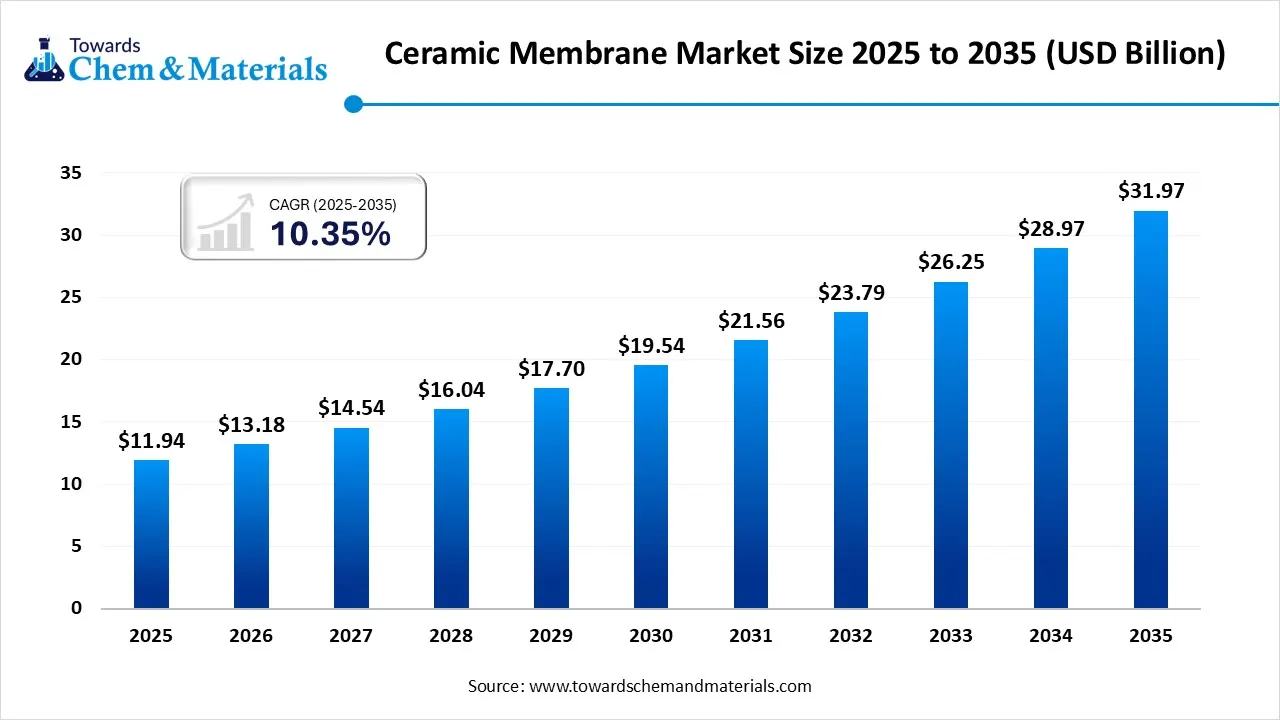
Download a sample of this report @ https://www.towardschemandmaterials.com/download-sample/1024
Ceramic Membrane Market Key Takeaways
-
The U.S. ceramic membrane market was valued at USD 1.98 billion in 2025 and is expected to grow at a CAGR of 10.87% between 2025 and 2035.
-
North America held the largest revenue share of 22.02% in 2025.
-
By technology, microfiltration dominated with 32.33% market share in 2025.
-
By application, the water and wastewater treatment segment accounted for the largest share of 48.09% in 2025.
-
The pharmaceutical segment is projected to expand at a CAGR of 12.35% during the forecast period.
Ceramic Membrane Market Overview
Ceramic membranes are inorganic artificial membranes made from materials such as aluminum, titanium, silicon, and zirconium combined with non-metals like oxides, nitrides, or carbides. These membranes are widely used for filtration and separation due to their excellent thermal stability, chemical resistance, and durability.
Ceramic membranes typically feature a three-layer sandwich structure, including:
-
Active layer: Responsible for separation processes
-
Intermediate layer: Enhances permeability and surface uniformity
-
Support layer: Provides mechanical strength
The active layer thickness ranges from 5–10 micrometers with 30–50% porosity, while the intermediate layer is around 30–45 micrometers thick with about 40% porosity. The microporous layer is approximately 1.5–2 micrometers thick with 40–45% porosity.
These membranes are generally manufactured using sol-gel synthesis and surface modification techniques. Their ability to perform under harsh conditions makes them suitable for applications such as liquid filtration, gas separation, and wastewater treatment.
Growing water scarcity, strict environmental regulations, and rising industrial demand for advanced filtration technologies are major factors accelerating the adoption of ceramic membranes worldwide.
Growing Demand from the Food & Beverage Sector
The food and beverage industry represents a major end-use sector for ceramic membranes due to their high separation efficiency and chemical stability.
In the dairy industry, ceramic membranes are widely used for:
-
Concentration and purification of sweeteners
-
Production of concentrated and isolated milk proteins
-
Fat separation and whey protein extraction
-
Microbial removal and skimmed milk filtration
In the beverage industry, ceramic membranes support processes such as:
-
Beer and wine production
-
Juice clarification to remove bacteria, pectin, and suspended solids
-
Vinegar sterilization and clarification
-
Soy sauce processing for turbidity and sediment removal
The expansion of restaurants, cafes, bars, catering services, and fast-food outlets globally is increasing demand for processed beverages and dairy products, which in turn is supporting the growth of the ceramic membrane market.
Ceramic Membrane Market Trends
Rising Water Scarcity
Growing water shortages in many regions are increasing the need for advanced purification technologies. Ceramic membranes play a key role in desalination and wastewater recycling.
Sustainability and Eco-friendliness
Ceramic membranes are long-lasting and reusable, reducing waste generation compared to polymeric membranes.
Expansion in Biomedicine
In the biopharmaceutical sector, ceramic membranes are used for purification of enzymes, therapeutic proteins, and monoclonal antibodies.
Increasing Industrial Wastewater
Rapid industrialization has increased wastewater generation. Ceramic membranes enable efficient removal of contaminants through cross-flow filtration systems.
Long Operational Lifespan
Their resistance to clogging and chemical damage results in long service life and lower operational costs.
Ceramic Membrane Market Segmental Insights
By Technology
Microfiltration Segment Dominated in 2025
The microfiltration segment accounted for the largest share of the market in 2025 due to its commercial availability, reliability, and wide industrial applications.
Microfiltration membranes have pore sizes between 0.1 and 10 microns and are widely used to remove:
-
Suspended solids
-
Bacteria
-
Large contaminants from water
This technology is widely applied in water treatment, pharmaceuticals, food processing, and biotechnology industries.
Ultrafiltration Segment Expected to Grow Rapidly
The ultrafiltration segment is projected to register the fastest growth during the forecast period.
Ultrafiltration membranes have pore sizes ranging from 0.001 to 0.1 microns, enabling separation of colloids, macromolecules, and high-molecular-weight substances. Rising demand for water reuse projects and stringent environmental regulations is accelerating adoption across industries such as textile, chemicals, pharmaceuticals, and food processing.
By Application
Water & Wastewater Treatment Dominated the Market
The water and wastewater treatment segment accounted for the largest share of 48.09% in 2025.
Ceramic membranes are highly effective in removing:
-
Particles
-
Bacteria
-
Viruses
-
Industrial contaminants
Growing urbanization, industrialization, and water scarcity are driving demand for advanced filtration solutions. Additionally, stricter environmental regulations are encouraging industries to adopt efficient wastewater treatment technologies.
Pharmaceutical Segment to Witness Fastest Growth
The pharmaceutical sector is expected to grow at the fastest rate due to increasing demand for high-purity filtration during drug manufacturing.
Ceramic membranes are used for:
-
Bioprocess filtration
-
Virus removal
-
Microorganism elimination
-
Protein and enzyme purification
The rapid expansion of biologics and vaccine manufacturing is further driving demand in this segment.
Ceramic Membrane Market Regional Insights
North America
North America led the global market in 2025 with a 22.02% revenue share. The regional market was valued at USD 2.60 billion in 2025 and is projected to reach USD 6.97 billion by 2035, growing at a CAGR of 10.36%.
Strong environmental regulations, advanced wastewater treatment infrastructure, and significant investments in industrial filtration technologies are major growth drivers in the region.
United States
The United States is expected to witness rapid growth due to:
-
Strict environmental regulations
-
Government investments in water treatment infrastructure
-
Technological advancements in filtration systems
-
High industrial demand for advanced purification technologies
Asia Pacific
The Asia Pacific region is expected to experience significant growth during the forecast period.
Rapid industrialization, urbanization, and water pollution are increasing the need for advanced water treatment technologies. Countries such as China, India, Japan, and South Korea are investing heavily in sustainable water management systems.
China
China dominates the regional market due to:
-
Large population and rising demand for clean water
-
Strong government support for environmental protection
-
Investments in municipal wastewater systems and rainwater treatment infrastructure
Europe
Europe is witnessing steady growth driven by strict environmental policies, sustainability initiatives, and advanced industrial infrastructure. Continuous technological innovation and strong presence of leading membrane manufacturers are supporting regional expansion.
Latin America
Latin America is emerging as a promising market due to industrialization, water scarcity, and stricter wastewater regulations. Mining operations in countries such as Chile and Peru require durable ceramic membranes to treat corrosive, metal-laden wastewater.
Middle East & Africa
The Middle East and Africa are becoming important markets due to severe water scarcity and growing desalination demand. Governments in countries like Saudi Arabia, the UAE, and Egypt are investing heavily in water infrastructure and sustainable treatment technologies.
To own our research study instantly, Click here @ https://www.towardschemandmaterials.com/checkout/1024
Recent Developments in the Ceramic Membrane Market
-
January 2025: Researchers at NIT Rourkela developed an eco-friendly method for removing carcinogenic dyes from wastewater using nanocomposite-based ceramic membranes combined with microbubble technology.
-
February 2025: Cerafiltec supplied ceramic membrane technology for an xAI supercomputer data center in Tennessee, enabling reuse of 49.2 MLD of municipal water for cooling operations.
-
November 2024: Scottish Water announced a membrane capital investment project worth £500–£800 million to upgrade water treatment infrastructure.
You can place an order or ask any questions, please feel free to contact us at sales@towardschemandmaterials.com
Leading Companies in the Ceramic Membrane Market
Major companies operating in the market include:
-
Hyflux Ltd.
-
Pall Corporation
-
Kovalus Separation Solutions
-
Veolia
-
Nanostone
-
Tami Industries
-
METAWATER Co., Ltd.
-
ITN Nanovation AG
-
SIVA Unit
-
Jiangsu Jiuwu Hi-Tech Co. Ltd
-
LiqTech Holdings A/S
-
Atech Innovation GmbH
-
H2O Innovation Inc.
-
Nijhuis Saur Industries
-
Saint-Gobain S.A.
-
Aquabrane Water
-
CTI Oxidation
About Us
Towards Chemical and Materials is a leading global consulting firm specializing in providing comprehensive and strategic research solutions across the chemical and materials industries. With a highly skilled and experienced consultant team, we offer a wide range of services designed to empower businesses with valuable insights and actionable recommendations.
Explore the comprehensive statistics and insights on healthcare industry data and its associated segmentation: Get a Subscription




Leave a Reply