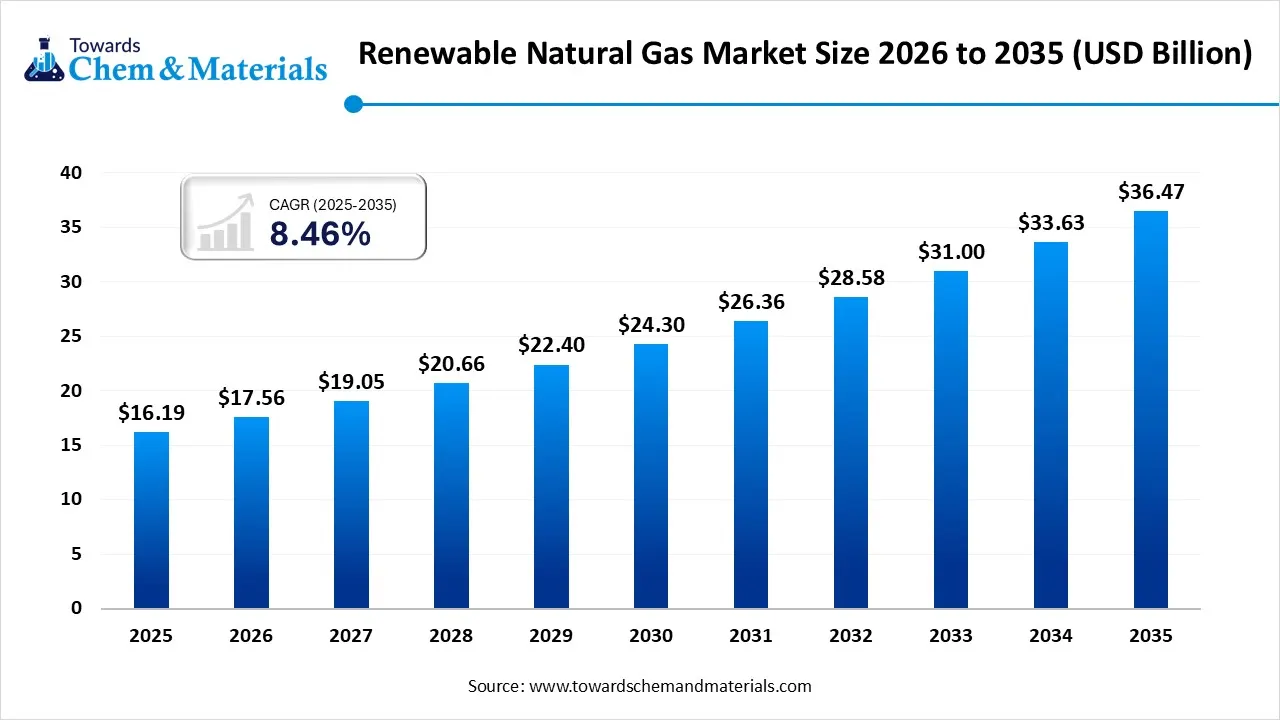
The global renewable natural gas (RNG) market was valued at USD 16.19 billion in 2025 and is projected to grow from USD 17.56 billion in 2026 to approximately USD 36.47 billion by 2035, expanding at a CAGR of 8.46% between 2026 and 2035. The market’s steady growth is primarily driven by rising environmental concerns, strong decarbonization policies, and increasing adoption of alternative fuels across multiple industries.
Renewable natural gas—also known as biomethane—is produced by upgrading biogas generated from organic waste sources such as landfill gas, livestock manure, agricultural residues, food waste, and wastewater treatment byproducts. After purification, RNG meets pipeline-quality natural gas standards and can be seamlessly integrated into existing gas infrastructure, including transportation systems and industrial networks.
Download a sample of this report @ https://www.towardschemandmaterials.com/download-sample/5638
Market Overview and Key Takeaways
-
North America dominated the renewable natural gas market with the largest revenue share of 37% in 2025.
-
By feedstock, the landfill segment accounted for the highest revenue share of 46% in 2025, supported by well-established landfill gas recovery systems.
-
By application, vehicle fuel led the market with a 44% revenue share, reflecting the growing shift toward low-carbon transportation fuels.
-
By product type, Compressed Renewable Natural Gas (C-RNG) dominated with a 66% revenue share, owing to its widespread use in heavy-duty transportation and fleet operations.
The Surge in Alternative Fuel Applications Driving Growth
One of the most significant growth drivers for the RNG market is the rising application of alternative fuels, particularly in the transportation sector. Governments worldwide are implementing low-carbon fuel standards, renewable fuel mandates, and carbon pricing mechanisms to reduce greenhouse gas emissions. RNG offers a practical solution, as it can displace fossil-based natural gas without requiring major infrastructure modifications.
Importantly, RNG production helps mitigate methane emissions by capturing gas released during the decomposition of organic waste. Since methane is a potent greenhouse gas, its capture and conversion into usable fuel significantly reduce environmental impact. To encourage production, governments are offering fiscal incentives, tax credits, and subsidies, strengthening the economic viability of RNG projects.
Key Trends Influencing the Renewable Natural Gas Market
Technological innovation plays a crucial role in shaping the market. Advances in methane capture systems, biogas upgrading technologies, and waste-to-energy processes are making RNG production more cost-effective and competitive with conventional fossil fuels. Enhanced monitoring systems and automation tools are further improving plant efficiency and operational reliability.
Another major trend is the increasing global awareness of climate change and the harmful effects of fossil fuels. Consumers, corporations, and municipalities are actively seeking cleaner energy alternatives, accelerating demand for RNG.
Collaborations between agricultural cooperatives, farmers, and energy developers are also expanding. These partnerships help secure long-term feedstock supply, improve project economics, and create synergies between waste management and energy production industries. Such decentralized models are boosting renewable gas production, particularly in rural areas.
To own our research study instantly, Click here @ https://www.towardschemandmaterials.com/checkout/5638
Market Dynamics
Market Drivers
The renewable natural gas market is strongly supported by global decarbonization efforts and methane reduction strategies. Renewable fuel standards, landfill gas recovery mandates, and grid injection frameworks are encouraging utilities and energy providers to incorporate RNG into supply portfolios.
Additionally, rising availability of organic feedstocks—such as livestock manure, municipal solid waste, and food waste—is enabling continuous expansion of anaerobic digestion facilities. Utilities, fleet operators, and industrial users are increasingly adopting RNG as a low-carbon alternative that integrates seamlessly into existing infrastructure.
Market Restraints
Despite strong growth prospects, the market faces several constraints. High capital investments required for anaerobic digesters, gas upgrading systems, and pipeline interconnection infrastructure can limit project deployment. Feedstock supply variability—often influenced by seasonal agricultural cycles—can affect plant efficiency and profitability.
Regulatory complexity, including environmental permits and gas quality standards, may delay project approvals. In regions with limited pipeline networks, interconnection challenges reduce commercial viability. Furthermore, volatility in conventional natural gas prices can affect RNG competitiveness without sustained policy support.
Market Opportunities
Significant opportunities lie in expanding RNG adoption across transportation, power generation, and industrial heating—sectors where electrification remains difficult. Growth in renewable fuel credit markets and carbon offset programs is improving project economics and attracting institutional investment.
Technological improvements in gas upgrading and carbon capture integration are paving the way for negative-emission fuel solutions. Moreover, decentralized RNG systems are contributing to rural economic development by linking agriculture, waste management, and local energy supply chains.
Market Challenges
Ensuring long-term feedstock sustainability while avoiding land-use conflicts remains a critical challenge. Scaling RNG production beyond regional deployment requires stable policy frameworks, infrastructure coordination, and skilled workforce development.
Community concerns related to facility siting, odor management, and traffic can delay project approvals if stakeholder engagement is inadequate. In addition, inconsistencies in RNG certification systems and quality standards across regions complicate cross-border trade and market integration.
You can place an order or ask any questions, please feel free to contact us at [email protected]
Recent Industry Developments
The market has witnessed notable advancements in both commercial deployment and research innovation.
-
In January 2026, Hillsborough County, Florida selected Waga Energy to build, own, and operate an RNG production unit at the Southeast County Landfill in Lithia, Florida, reinforcing the role of landfill-based RNG projects in North America.
-
In October 2025, researchers at the University of British Columbia discovered a methane-producing bacterium at the Surrey Biofuel Facility capable of converting food waste into renewable natural gas, opening new possibilities for carbon-neutral fuel production.
Competitive Landscape
The renewable natural gas market is characterized by strategic partnerships, acquisitions, and capacity expansion initiatives. Leading companies are focusing on expanding feedstock sources, improving upgrading technologies, and securing long-term fuel offtake agreements.
Key players operating in the market include:
-
Clean Energy Fuels Corp. (United States)
-
Montauk Renewables, Inc. (United States)
-
VERBIO Vereinigte BioEnergie AG (Germany)
-
Eni S.p.A. (Italy)
-
TotalEnergies SE (France)
-
BP plc (United Kingdom)
-
Engie SA (France)
-
Orsted A/S (Denmark)
-
Technip Energies N.V. (France)
-
VARO Energy (Switzerland)
-
Gazprom PJSC (Russia)
-
FortisBC Energy Inc. (Canada)
-
Dominion Energy, Inc. (United States)
About Us
Towards Chemical and Materials is a leading global consulting firm specializing in providing comprehensive and strategic research solutions across the chemical and materials industries. With a highly skilled and experienced consultant team, we offer a wide range of services designed to empower businesses with valuable insights and actionable recommendations.
Explore the comprehensive statistics and insights on healthcare industry data and its associated segmentation: Get a Subscription


Leave a Reply