The PAN-based carbon fiber market in Asia Pacific has gained substantial traction in recent years, driven by rising demand for lightweight, high-performance materials in various sectors such as aerospace, automotive, and wind energy. As countries in this region advance their manufacturing and infrastructure, the market is witnessing significant growth. This article provides a comprehensive analysis of the market, covering the growth trends, dynamics, insights, and key segments, along with a spotlight on the leading players in the PAN-based carbon fiber industry.
Market Overview: The Expanding PAN-Based Carbon Fiber Market
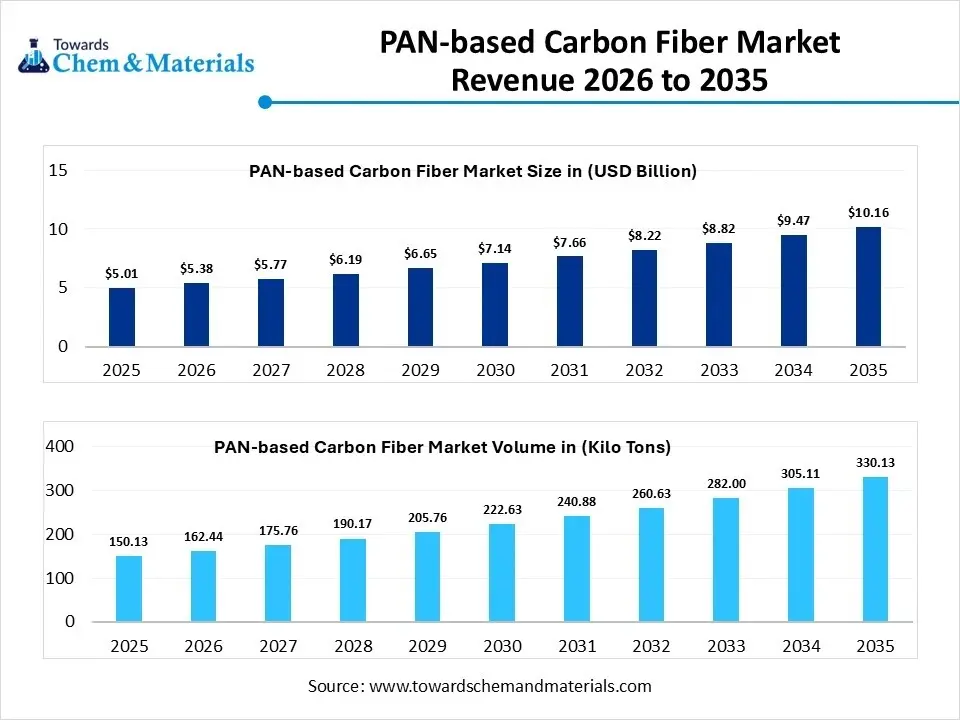
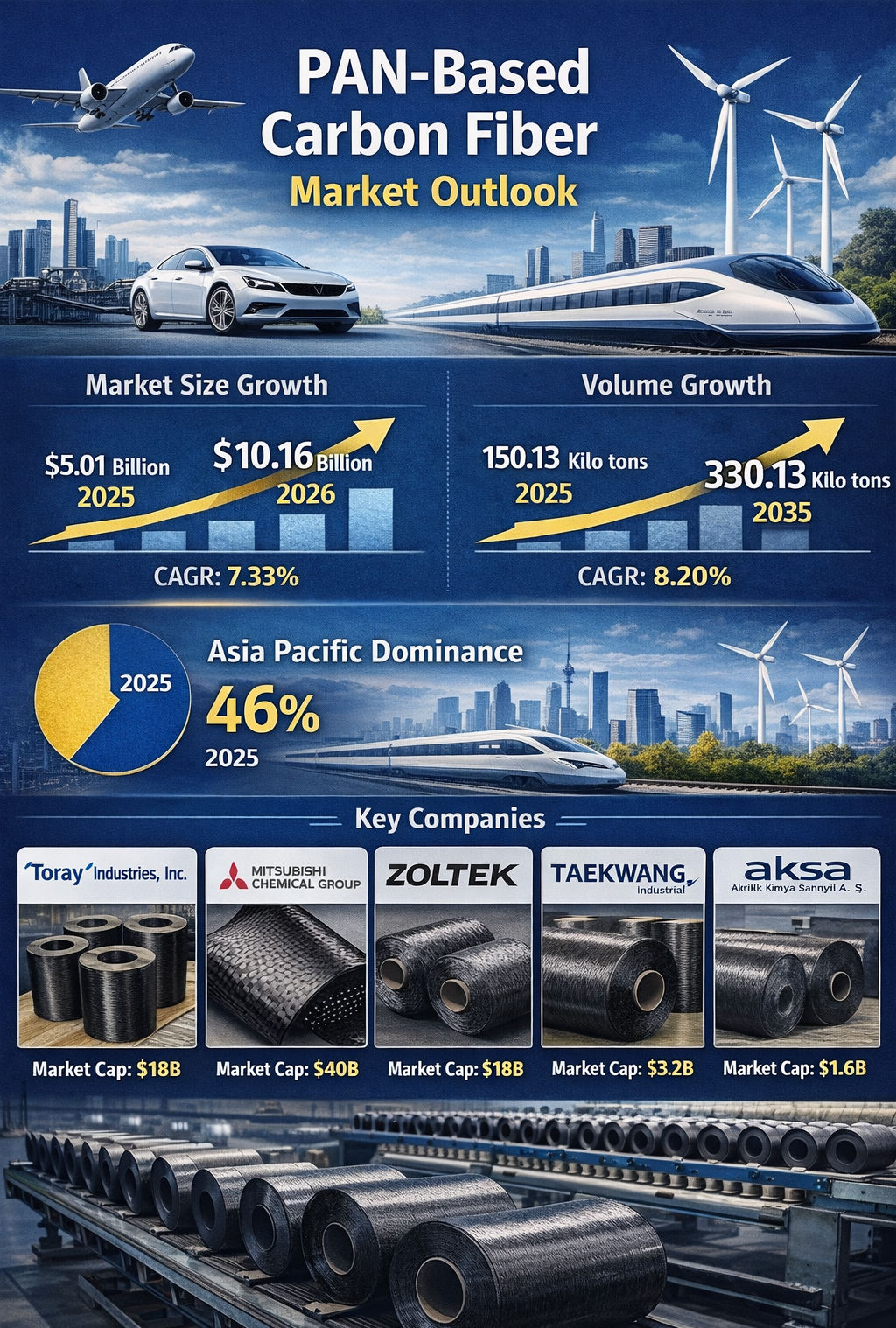
The PAN-based carbon fiber market is projected to experience remarkable growth over the coming years, driven by increasing demand for high-strength, lightweight materials used in a wide range of applications. In 2025, the global market size is estimated at USD 5.01 billion, with a forecasted rise to USD 10.16 billion by 2035. This represents a Compound Annual Growth Rate (CAGR) of 7.33% from 2026 to 2035. In terms of volume, the market is expected to grow from 150.13 kilo tons in 2025 to 330.13 kilo tons by 2035, a CAGR of 8.20% over the same period.
Asia Pacific dominates the PAN-based carbon fiber market, accounting for 46% of the market share in terms of volume in 2025. Countries such as China, Japan, South Korea, and India are making significant strides in adopting PAN-based carbon fiber for use in various industries, such as aerospace, automotive, wind energy, and infrastructure.
Download Sample here :https://www.towardschemandmaterials.com/download-sample/6162
Market Dynamics: Key Factors Driving Growth
Drivers
-
Lightweighting for Fuel Efficiency: The demand for lightweight materials is growing in the aerospace and automotive sectors, as manufacturers look to reduce fuel consumption and improve vehicle efficiency. PAN-based carbon fiber plays a crucial role in reducing weight without compromising strength, making it an ideal material for aircraft, vehicles, and electric vehicles (EVs).
-
Energy Efficiency in Wind Energy: In the wind energy sector, PAN-based carbon fiber is crucial for creating strong, lightweight wind turbine blades. These materials allow wind turbines to capture more energy while maintaining structural integrity and minimizing maintenance needs, which is contributing to the increasing demand for carbon fibers in this industry.
-
Technological Advancements in Manufacturing: Significant improvements in manufacturing processes, such as advancements in fiber production and cost reductions, are making PAN-based carbon fibers more accessible and affordable. These innovations are driving greater adoption across sectors such as aerospace, automotive, and industrial applications.
-
Sustainability Initiatives: As global industries push toward sustainability, there is increasing demand for environmentally friendly production processes. The push for greener manufacturing methods is encouraging the development of sustainable PAN-based carbon fiber, further expanding its role in industries such as automotive and wind energy.
Challenges
-
High Production Costs: Despite the numerous advantages, the high cost of producing PAN-based carbon fibers remains a challenge. The cost of raw materials, production techniques, and energy consumption are still significant barriers to broader adoption, particularly in sectors that are price-sensitive.
-
Supply Chain Constraints: The supply chain for raw materials, particularly PAN precursor materials, can be volatile, which may lead to production delays and price fluctuations. Ensuring a stable and cost-effective supply chain is crucial for meeting the rising demand for PAN-based carbon fiber.
-
Environmental Concerns: While PAN-based carbon fiber offers numerous benefits in terms of energy efficiency and performance, the material’s environmental impact, particularly in terms of its production and end-of-life disposal, is a concern. Industry stakeholders are focusing on developing efficient recycling processes and greener manufacturing technologies.
Report Scope
| Report Attribute | Details |
| Market Size and Volume in 2026 | USD 5.38 Billion / 162.44 Kilo Tons |
| Revenue Forecast in 2035 | USD 10.16 Billion / 330.13 Kilo Tons |
| Growth Rate | CAGR 7.33% |
| Forecast Period | 2026 – 2035 |
| Base Year | 2025 |
| Units Considered | Value (Billion / Million), Volume (Kilo Tons) |
| Dominant Region | Asia Pacific |
| Segment Covered | By Grade, By Tow Size, By End-User Industry, By Application, By Regions |
| Key companies profiled | Toray Industries, Inc. (Japan), Mitsubishi Chemical Group (Japan), Zoltek, Taekwang Industrial Co., Ltd. (South Korea),Aksa Akrilik Kimya Sanayii A.S. (Turkey), Teijin Limited, Hexcel Corporation, SGL Carbon SE, Formosa Plastics Corporation, Hyosung Advanced Materials, Zhongfu Shenying Carbon Fiber Co., Ltd., Jilin Chemical Fiber Group,Toho Tenax (Teijin Group) |
Market Insights: Emerging Trends Shaping the Industry
Several emerging trends are influencing the growth of the PAN-based carbon fiber market:
-
Increased Use in Electric Vehicles (EVs): The automotive industry, especially in Asia Pacific, is undergoing a significant transformation with the rise of electric vehicles. PAN-based carbon fiber is being used to manufacture lightweight, energy-efficient EVs that offer better driving range and performance. The increased adoption of EVs is expected to be a key driver for the PAN-based carbon fiber market in the coming years.
-
Advancements in Recycling Technologies: As sustainability becomes a growing priority, several companies are investing in developing more efficient carbon fiber recycling methods. Companies like Carbon Fiber Recycling LLC have launched sustainable, precision-milled recycled carbon fibers, significantly reducing CO2 emissions compared to virgin fibers.
-
Strategic Partnerships and Collaborations: Companies in the PAN-based carbon fiber market are increasingly entering strategic collaborations to improve their product offerings and manufacturing capabilities. Partnerships between companies such as 8 Clockwise and CarboMat focus on scaling sustainable carbon fiber production and battery materials, marking a shift toward a more sustainable supply chain in the industry.
-
Expansion of Aerospace and High-End Manufacturing Applications: The increasing demand for high-strength materials in aerospace and high-end manufacturing is contributing to the growth of PAN-based carbon fiber. Innovations in material performance, such as the development of T1000-grade carbon fibers for aerospace, are pushing the limits of PAN-based carbon fiber applications.
More Insights in Towards Chemical and Materials:
- Natural Gas Market : The global natural gas market size accounted for USD 4.19 trillion in 2024 and is predicted to increase from USD 4.41 trillion in 2025 to approximately USD 6.96 trillion by 2034, expanding at a CAGR of 5.20% from 2025 to 2034.
- Gas Separation Membrane Market : The global gas separation membrane market size was valued at approximately USD 1.85 billion in 2024 and is projected to grow at a CAGR of 6.95% from 2025 to 2034, reaching a value of USD 3.62 billion by 2034.
- Bio-Renewable Chemicals Market : The global bio-renewable chemicals market size was valued at USD 15.11 billion in 2024 and is growing to approximately USD 39.01 billion by 2034, with a developing compound annual growth rate (CAGR) of 9.95% over the forecast period 2025 to 2034.
- Natural Aroma Chemicals Market : The global natural aroma chemicals market size was reached at USD 4.55 billion in 2024 and is estimated to surpass around USD 5.91 billion by 2034, growing at a compound annual growth rate (CAGR) of 2.65% during the forecast period 2025 to 2034.
- Natural Ferulic Acid Market : The global natural ferulic acid market size was reached at USD 14.82 billion in 2024 and is expected to hit around USD 30.40 billion by 2034, exhibiting a compound annual growth rate (CAGR) of 7.45% during the forecast period 2025 to 2034.
- Standard Modulus Carbon Fiber Market: The global standard modulus carbon fiber market size was estimated at USD 3.80 billion in 2025 and is expected to increase from USD 4.07 billion in 2026 to USD 7.56 billion by 2035, growing at a CAGR of 7.11% from 2026 to 2035. In terms of volume, the market is projected to grow from 112.13 million tons in 2025 to 220.33 million tons by 2035. growing at a CAGR of 6.99% from 2026 to 2035. Asia Pacific dominated the standard modulus carbon fiber market with the largest volume share of 45.12% in 2025.
- Propylene Carbonate Market : The global propylene carbonate market size was estimated at USD 448.69 million in 2025 and is expected to increase from USD 474.36 million in 2026 to USD 782.56 million by 2035, growing at a CAGR of 5.72% from 2026 to 2035. In terms of volume, the market is projected to grow from 750.11 kilo tons in 2025 to 1600.22 kilo tons by 2035. growing at a CAGR of 7.87% from 2026 to 2035. Asia Pacific dominated the propylene carbonate market with the largest volume share of 46% in 2025.
Market Segments: Key Categories of PAN-Based Carbon Fiber
The PAN-based carbon fiber market is categorized into several segments based on grade, tow size, end-user industries, and applications:
-
By Grade:
-
Standard Modulus: This grade of carbon fiber is widely used in general applications that require moderate strength and stiffness.
-
Intermediate Modulus: Carbon fibers in this grade offer higher strength and stiffness compared to standard modulus fibers.
-
High Modulus: These fibers are used in applications requiring extreme stiffness and low strain, such as aerospace and high-performance automotive parts.
-
Ultra-High Modulus / Specialty: This grade targets ultra-high-performance applications, including specialized aerospace and military applications.
-
-
By Tow Size:
-
<6k: Small tow size carbon fibers are used in lightweight applications where minimal material strength is required.
-
6k–12k: This is the most commonly used tow size, providing a balance between strength and performance.
-
>12k: Larger tow sizes are employed in high-strength industrial applications and large structures like wind turbine blades.
-
-
By End-User Industry:
-
Aerospace & Defense: The aerospace industry is one of the largest consumers of PAN-based carbon fiber, using it in aircraft structures, components, and defense equipment.
-
Wind Energy: PAN-based carbon fiber is increasingly used in the production of wind turbine blades for better energy capture and longevity.
-
Automotive & Transportation: Lightweight, high-strength carbon fibers are used in the production of vehicles, particularly electric vehicles, to improve fuel efficiency and performance.
-
Industrial: PAN-based carbon fiber is used in a variety of industrial applications, including manufacturing equipment, sports equipment, and construction.
-
Sporting Goods & Consumer Products: Carbon fiber is used in products such as bicycles, golf clubs, and other performance-oriented sporting goods.
-
-
By Application:
-
Structural Components: PAN-based carbon fiber is used in structural parts of various applications, from automotive to aerospace.
-
Wind Turbine Blades: The wind energy sector is one of the largest consumers of PAN-based carbon fiber, particularly for manufacturing turbine blades.
-
Interior & Secondary Parts: This includes the use of carbon fiber in non-structural applications, such as automotive interiors and secondary aerospace parts.
-
Pressure Vessels & Cylinders: PAN-based carbon fiber is used in pressure vessels and cylinders due to its strength and ability to withstand extreme pressures.
-
Top Companies in the PAN-Based Carbon Fiber Market
-
Toray Industries, Inc.
-
About: Toray Industries, headquartered in Japan, is the global leader in PAN-based carbon fiber and precursor materials. It is a major supplier for aerospace, automotive, and industrial applications.
-
Products: Toray manufactures TORAYCA® carbon fibers, which are used extensively in various sectors including automotive, aerospace, and wind energy.
-
Market Cap: Approximately $18 billion USD.
-
-
Mitsubishi Chemical Group
-
About: Mitsubishi Chemical Group, also based in Japan, produces premium PAN-based carbon fibers under the brand DIALEAD™, which are used in ultra-high-strength and high-modulus applications.
-
Products: DIALEAD™ PAN-based carbon fibers, targeting aerospace and industrial components.
-
Market Cap: Around $40 billion USD.
-
-
Zoltek
-
About: A subsidiary of Toray, Zoltek focuses on cost-effective PAN-based carbon fibers, especially for the automotive, wind energy, and infrastructure sectors.
-
Products: Panex® fiber products, used primarily in commercial and industrial applications.
-
Market Cap: Part of Toray Industries, which has a market cap of $18 billion USD.
-
-
Taekwang Industrial Co., Ltd.
-
About: Taekwang is a South Korean manufacturer specializing in PAN precursor and carbon fiber products, catering to aerospace, automotive, and industrial markets.
-
Products: PAN precursor and carbon fiber materials used in various industries.
-
Market Cap: Approximately $3.2 billion USD.
-
-
Aksa Akrilik Kimya Sanayii A.S.
-
About: Aksa is a Turkish producer of PAN precursors and carbon fiber materials, with a strong presence in Europe and Asia.
-
Products: PAN precursors and carbon fiber materials for textile and technical markets.
-
Market Cap: Approximately $1.6 billion USD.
-
Frequently Asked Questions
1. What is driving the growth of the PAN-based carbon fiber market in Asia Pacific?
-
The growth is primarily driven by increasing demand for lightweight, high-strength materials in aerospace, automotive, wind energy, and industrial applications.
2. What are the key challenges faced by the PAN-based carbon fiber market?
-
High production costs, supply chain limitations, and the environmental impact of manufacturing are the primary challenges.
3. Which sectors are the largest consumers of PAN-based carbon fiber?
-
The aerospace, automotive, and wind energy sectors are the largest consumers of PAN-based carbon fiber.
4. How is technology impacting the PAN-based carbon fiber market?
-
Advancements in manufacturing processes and improvements in fiber production are making PAN-based carbon fiber more affordable and accessible.
5. What is the expected CAGR for the PAN-based carbon fiber market?
-
The market is expected to grow at a CAGR of 7.33% from 2026 to 2035.
Immediate Delivery Available | Buy This Premium Research Report@ https://www.towardschemandmaterials.com/checkout/6162
About Us
Towards Chemical and Materials is a leading global consulting firm specializing in providing comprehensive and strategic research solutions across the chemical and materials industries. With a highly skilled and experienced consultant team, we offer a wide range of services designed to empower businesses with valuable insights and actionable recommendations.
Our Trusted Data Partners
Precedence Research | Statifacts | Towards Packaging | Towards Healthcare | Towards Food and Beverages | Towards Chemical and Materials | Towards Consumer Goods | Nova One Advisor |
For Latest Update Follow Us: https://www.linkedin.com/company/towards-chem-and-materials/
USA: +1 804 441 9344
APAC: +61 485 981 310 or +91 87933 22019
Europe: +44 7383 092 044
Email: [email protected]


Leave a Reply