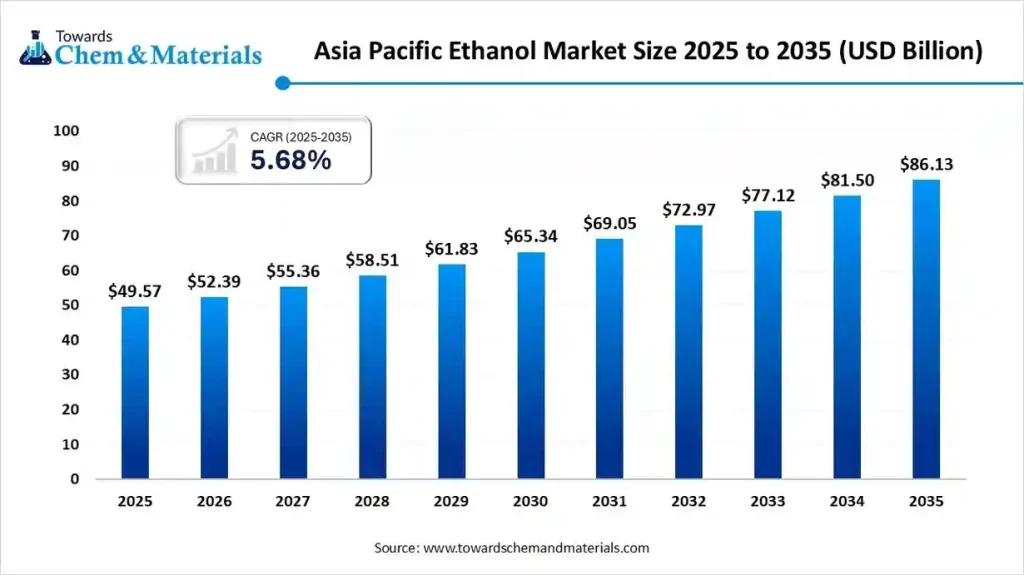
The Asia Pacific ethanol market stands at a critical juncture in 2025, driven by ambitious government mandates and the urgent need for cleaner transportation fuels. Valued at a substantial USD 49.57 billion in 2025, the market is poised for robust expansion, with projections indicating growth to USD 86.13 billion by 2035, exhibiting a compound annual growth rate (CAGR) of 5.68% over the forecast period from 2026 to 2035. Extensive availability of sugarcane and corn feedstocks, coupled with supportive governmental policies and continuous technological innovations in production, fuels this remarkable growth.
Get All the Details in Our Solutions –Download Sample: https://www.towardschemandmaterials.com/download-sample/6075
Key Takeaways for 2025
The competitive landscape in 2025 showcases clear segment dominance, reflecting the region’s priorities in biofuel production:
- Feedstock Focus: The sugar-based ethanol segment captured the largest revenue share at 44%, emphasizing the strong link between the region’s major agricultural output (sugarcane and molasses) and its ethanol industry.
- Production Method: Fermentation-based ethanol overwhelmingly led the market with a commanding 86% revenue share, underscoring its maturity and cost-effectiveness as the primary conversion technology for both sugar and grain feedstocks.
- Grade Dominance: Fuel-grade ethanol accounted for the largest revenue share at 61%, directly reflecting the primary market driver: the governmental push for blending ethanol with gasoline to meet energy security and climate goals.
- Application Leader: Consequently, the fuel & fuel blending segment dominated the market, seizing a significant 58% revenue share, confirming its role as the backbone of ethanol demand in the Asia Pacific region.
2025 Buyer Playbook: What Actually Decides Deals
In the 2025 Asia Pacific ethanol market, buyers — primarily large oil marketing companies, industrial chemical manufacturers, and pharmaceutical firms — base their purchasing decisions on a complex combination of factors beyond just price:
- Regulatory Compliance and Security of Supply: The most critical factor is a supplier’s proven ability to guarantee a consistent and high-volume supply of Fuel-Grade Ethanol that meets strict national blending mandates (e.g., India’s E20 program). Long-term supply contracts are favored to mitigate feedstock price volatility and ensure compliance.
- Sustainability Metrics (Carbon Intensity): Buyers, especially in markets like Japan and increasingly China, prioritize ethanol with a demonstrably lower carbon footprint. This pushes procurement toward producers using advanced techniques and non-food biomass (cellulosic/2G ethanol) or those with highly efficient, integrated bio-refinery models.
- Logistical Efficiency and Cost: Given ethanol’s bulk nature and the need for seamless blending, buyers favor suppliers with integrated logistics and a geographically strategic presence near major blending terminals and ports. This minimizes transportation costs and logistical risk, translating directly into a more competitive final price for the blended fuel.
- Technological Integration (Purity and Efficiency): For high-purity applications (pharmaceutical, cosmetic, industrial), buyers demand suppliers who utilize AI-based monitoring and advanced distillation to ensure consistent, high-grade product quality and transparency in operations.
For more information, visit the Towards Chemical and Materials website or email the team at [email protected]| +1 804 441 9344
More Insights in Towards Chemical and Materials:
· Ethanol Market: The global ethanol market is projected to grow from USD 114.98 billion in 2025 to USD 199.40 billion by 2035, growing at a compound annual growth rate (CAGR) of 5.66% over the forecast period from 2026 to 2035.
Ethanol 2.0 Market: The global ethanol 2.0 market size is calculated at USD 121.61 billion in 2025 and is predicted to increase from USD 130.35 billion in 2026 and is projected to reach around USD 243.50 billion by 2035, The market is expanding at a CAGR of 7.19% between 2026 and 2035.
· Bio-Renewable Chemicals Market : The global bio-renewable chemicals market size was valued at USD 15.11 billion in 2024 and is growing to approximately USD 39.01 billion by 2034, with a developing compound annual growth rate (CAGR) of 9.95% over the forecast period 2025 to 2034.
· Natural Aroma Chemicals Market : The global natural aroma chemicals market size was reached at USD 4.55 billion in 2024 and is estimated to surpass around USD 5.91 billion by 2034, growing at a compound annual growth rate (CAGR) of 2.65% during the forecast period 2025 to 2034.
· Natural Ferulic Acid Market : The global natural ferulic acid market size was reached at USD 14.82 billion in 2024 and is expected to hit around USD 30.40 billion by 2034, exhibiting a compound annual growth rate (CAGR) of 7.45% during the forecast period 2025 to 2034.
Quick Comparison Matrix
The regional ethanol ecosystem features distinct competitive approaches:
- India vs. China (Market Focus): India demonstrates a rapid and successful domestic drive, achieving the E20 blending target ahead of schedule, with major companies like EID Parry and Balrampur Chini Mills focusing on vertical integration from sugarcane to fuel. China, the largest market by share, shows a broader, more diversified approach, driven by large state-owned enterprises like Sinopec and COFCO, focusing on both domestic production and securing stable imports for various end-use grades.
- Production Process (Fermentation vs. Advanced): Fermentation represents the current volume-driving segment, dominating by an 86% share due to its proven, cost-effective use of sugar and grain. However, Cellulosic/Biochemical Conversion is forecast to experience the fastest CAGR, propelled by the need for non-food feedstocks and significant government support for next-generation (2G) technology, led by innovators like Praj Industries.
- Feedstock Strategy (Sugar vs. Cellulosic): While Sugar-Based feedstock currently secures the largest share (44%) due to its high yield and established processing infrastructure (especially in Southeast Asia and India), the future fastest growth belongs to Cellulosic & Advanced Ethanol. This shift reflects a strategic effort to overcome the “food vs. fuel” debate and leverage agricultural residues for greater sustainability.
Immediate Delivery Available | Buy This Premium Research Report@ https://www.towardschemandmaterials.com/checkout/6075
About Us
Towards Chemical and Materials is a leading global consulting firm specializing in providing comprehensive and strategic research solutions across the chemical and materials industries. With a highly skilled and experienced consultant team, we offer a wide range of services designed to empower businesses with valuable insights and actionable recommendations.
Our Trusted Data Partners
Precedence Research | Statifacts | Towards Packaging | Towards Healthcare | Towards Food and Beverages | Towards Chemical and Materials | Towards Consumer Goods | Nova One Advisor |
For Latest Update Follow Us: https://www.linkedin.com/company/towards-chem-and-materials/
USA: +1 804 441 9344
APAC: +61 485 981 310 or +91 87933 22019
Europe: +44 7383 092 044
Email: [email protected]


Leave a Reply