Market Overview
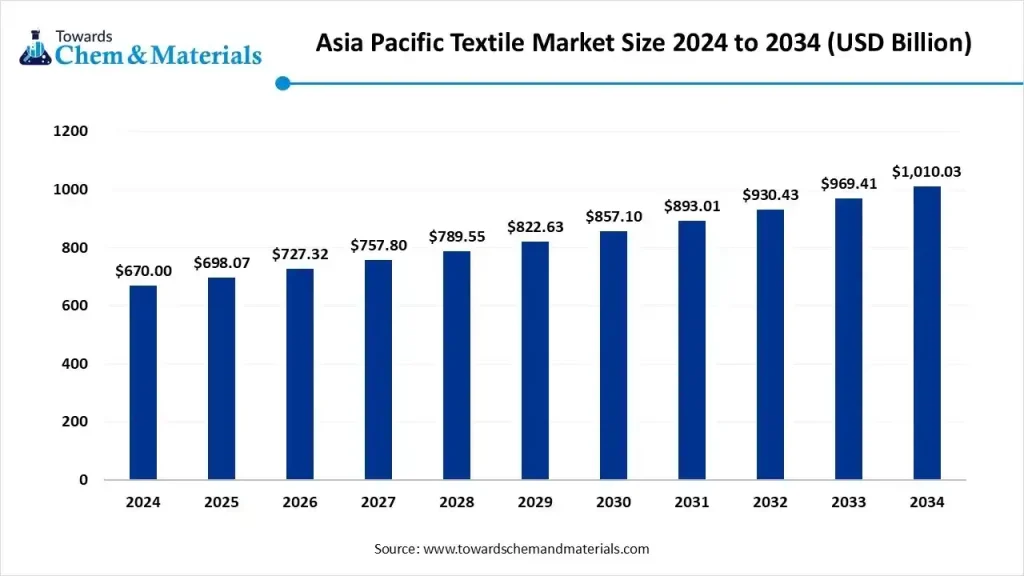
The Asia Pacific textile market is valued at USD 698.07 billion in 2025 and is projected to reach approximately USD 1,010.03 billion by 2034, expanding at a CAGR of 4.19% during the forecast period. The region remains the global hub for textile manufacturing and exports, supported by a strong industrial base, abundant labor force, and cost-efficient production facilities.
Countries like China, India, Bangladesh, and Vietnam are leading the market due to their extensive textile infrastructure and export-oriented production. The growing demand for home fabrics, apparel, and technical textiles is propelling significant investment in automation, sustainable materials, and digital manufacturing systems.
Asia Pacific’s competitive advantage lies in its low-cost production ecosystem, easy access to raw materials like cotton and polyester, and evolving trade networks. Furthermore, the shift toward eco-friendly fabrics, circular fashion, and waterless dyeing technologies is reshaping the regional textile industry, aligning it with global sustainability goals.
Download Sample here : https://www.towardschemandmaterials.com/download-sample/5969
Market Dynamics
Key Growth Drivers
-
Expanding Apparel and Fashion Industry
Rapid urbanization, rising disposable incomes, and increasing fashion consciousness are fueling apparel consumption across Asia Pacific. The surge in fast fashion and e-commerce platforms is further boosting textile demand across major economies. -
Industrial and Technical Textiles Expansion
The region is witnessing strong growth in technical textiles, driven by healthcare, automotive, and construction sectors. Applications include protective clothing, medical fabrics, filtration, and industrial reinforcements. -
Government Support and Infrastructure Development
Various governments in the region are offering production-linked incentives (PLIs), textile parks, and export subsidies to promote investment and sustainability in the sector. India’s Mega Integrated Textile Region and Apparel (MITRA) scheme is a key example. -
Rising Focus on Sustainable Production
Manufacturers are transitioning to organic cotton, recycled polyester, and biodegradable fibers to meet global sustainability standards. Companies are adopting green textile parks, renewable energy integration, and waterless dyeing technologies to reduce their environmental footprint.
Market Restraints
-
Volatility in Raw Material Prices
Fluctuations in cotton, polyester, and chemical prices significantly impact production costs and profit margins. -
Labor and Energy Challenges
Despite the cost advantage, rising labor wages and energy expenses in countries like China are pushing manufacturers toward automation or shifting production to lower-cost regions. -
Environmental and Regulatory Pressure
Growing scrutiny over water pollution, carbon emissions, and waste management has prompted stricter regulations, compelling textile companies to adopt cleaner technologies.
Opportunities
-
Digital and Smart Manufacturing Adoption
Integration of AI, IoT, and robotics in textile manufacturing enhances precision, reduces waste, and improves productivity. -
Bio-Based and Recycled Materials
The increasing adoption of organic fibers, bio-fabrics, and recycled textiles offers a competitive advantage and supports the circular economy. -
Global Expansion of Asian Manufacturers
Asian textile exporters are expanding into Europe and North America through warehouses, sales hubs, and nearshore operations, ensuring faster delivery and improved customer engagement.
Challenges
-
Competition from Emerging Economies
Low-cost producers from Africa and Latin America are entering the global textile space, intensifying market competition. -
Sustainability Implementation Costs
Transitioning to eco-friendly production requires high capital investment in R&D, water recycling systems, and cleaner manufacturing technologies.
For more information, visit the Towards Chemical and Materials website or email the team at sales@towardschemandmaterials.com| +1 804 441 9344
More Insights in Towards Chemical and Materials:
· U.S. Nanomaterials Market : The U.S. nanomaterials market size is calculated at USD 4.39 billion in 2025, expected to reach USD 5.01 billion by 2026, and is projected to be worth around USD 14.41 billion by 2034, growing at a compound annual growth rate (CAGR) of 14.11% over the forecast period from 2025 to 2034.
· Gas Separation Membrane Market : The global gas separation membrane market size was valued at approximately USD 1.85 billion in 2024 and is projected to grow at a CAGR of 6.95% from 2025 to 2034, reaching a value of USD 3.62 billion by 2034.
· U.S. Recycled Polyester Market : The U.S. recycled polyester market size is calculated at USD 3.13 billion in 2025, with an expected value of USD 3.43 billion in 2026, and is projected to reach USD 7.16 billion by 2034, growing at a CAGR of 9.65% from 2025 to 2034.
· U.S. Water and Wastewater Treatment Market : The U.S. water and wastewater treatment market size was approximately USD 130.31 billion in 2025, is estimated to reach USD 139.35 billion in 2026, and is projected to grow to around USD 238.36 billion by 2034, with an estimated compound annual growth rate (CAGR) of about 6.94% between 2025 and 2034.
· U.S. Aquaculture Market : The U.S. aquaculture market size is valued at USD 80.81 billion in 2025 and is expected to be worth around USD 126.55 billion by 2034, growing at a compound annual growth rate (CAGR) of 5.11% over the forecast period from 2025 to 2034.
U.S. Agrochemicals Market : The U.S. agrochemicals market size is calculated at USD 35.88 billion in 2025 and is predicted to increase from USD 36.58 billion in 2026 to approximately USD 42.69 billion by 2034, expanding at a CAGR of 1.95% from 2025 to 2034.
U.S. Aquaculture Market : The U.S. aquaculture market size is valued at USD 80.81 billion in 2025 and is expected to be worth around USD 126.55 billion by 2034, growing at a compound annual growth rate (CAGR) of 5.11% over the forecast period from 2025 to 2034.
Phenolic Resins Market : The global phenolic resins market size is accounted for USD 16.44 billion in 2025 and is anticipated to hit around USD 27.17 billion by 2034, growing at a compound annual growth rate (CAGR) of 5.74% over the forecast period from 2025 to 2034. Asia Pacific dominated the phenolic resins market with a market share of 31% in 2024.
U.S. Steel Rebar Market : The U.S. steel rebar market size reached USD 7.31 billion in 2025 and is expected to be worth around USD 11.59 billion by 2034, growing at a compound annual growth rate (CAGR) of 5.25% over the forecast period 2025 to 2034.
Sustainable Materials Market : The global sustainable materials market size is estimated at USD 375.38 billion in 2025 and is predicted to increase from USD 422.08 billion in 2026 to approximately USD 1,078.35 billion by 2034, expanding at a CAGR of 12.44% from 2025 to 2034.
Market Insights
Sustainable Transformation
The Asia Pacific textile industry is rapidly embracing sustainability and digital transformation. Leading manufacturers are investing in organic cotton cultivation, renewable energy integration, and closed-loop production to minimize waste. For example, India and China are setting up green textile parks that utilize renewable power and advanced waste management systems.
The adoption of waterless dyeing technologies is gaining traction, reducing water usage by nearly 90%. Companies are also focusing on traceability and ethical sourcing to attract environmentally conscious consumers.
Digitalization and Smart Textiles
Technological innovation is reshaping textile manufacturing. Integration of automation, machine learning, and 3D design tools allows manufacturers to optimize fabric quality and customize production. Smart textiles, capable of monitoring temperature, pressure, and biometrics, are emerging as a key innovation area for defense, healthcare, and sportswear applications.
Global Market Expansion
Asian textile companies are strengthening their international footprint. Establishing sales hubs in Europe and North America ensures quicker response times and better inventory management. The “speed to market” model allows regional manufacturers to compete with global fast-fashion brands and secure long-term contracts.
Market Segmentation
By Material Type
-
Cotton – Dominates the market due to high domestic cultivation in India and China.
-
Polyester – Growing demand for synthetic, wrinkle-resistant fabrics.
-
Nylon – Preferred for technical and industrial textiles.
-
Wool and Silk – Niche demand in luxury fashion and interior fabrics.
-
Recycled Fibers – Expanding adoption for sustainable production.
By Application
-
Apparel – Largest segment, driven by retail fashion, sportswear, and casual wear.
-
Home Textiles – Rising demand for curtains, bed linens, and upholstery.
-
Technical Textiles – Increasing use in healthcare, defense, and construction.
-
Industrial Textiles – Used in conveyor belts, filters, and protective clothing.
By Process
-
Woven – Traditional method dominating apparel and home furnishing segments.
-
Nonwoven – Gaining traction in hygiene products and medical textiles.
-
Knitted – Preferred for comfort and elasticity in sports and fashion wear.
By Country
-
China – Global textile leader, strong in polyester and synthetic fabrics.
-
India – Key exporter of cotton and home textiles.
-
Bangladesh – Major apparel producer for global brands.
-
Vietnam – Growing hub for high-quality apparel exports.
-
Japan and South Korea – Focused on technical and smart textiles.
Competitive Landscape and Top Companies
1. Indorama Ventures Public Company Limited
About: Thailand-based global leader in PET and fiber intermediates.
Products: Polyester fibers, yarns, and recycled polymers.
Market Cap: Approx. USD 10.5 billion (2025).
2. Reliance Industries Limited – Textiles Division
About: India’s largest conglomerate with a diversified portfolio including polyester and synthetic fibers.
Products: Polyester filament yarn, fabric, and recycled fibers.
Market Cap: Around USD 230 billion (2025).
3. Arvind Limited
About: A leading Indian textile manufacturer known for denim and woven fabrics.
Products: Denim, knitwear, technical textiles.
Market Cap: USD 1.4 billion (2025).
4. Vardhman Textiles Ltd.
About: India’s largest yarn and fabric producer with a focus on sustainability.
Products: Cotton yarn, fabric, and sewing threads.
Market Cap: USD 2.5 billion (2025).
5. Lenzing AG
About: Austrian company specializing in eco-friendly cellulose fibers.
Products: Tencel, Modal, and viscose fibers.
Market Cap: USD 3.2 billion (2025).
6. Shenzhou International Group Holdings Ltd.
About: China-based manufacturer serving major global apparel brands.
Products: Knitwear, sportswear, and fabrics.
Market Cap: USD 18 billion (2025).
7. Texhong Textile Group Ltd.
About: One of China’s top cotton textile manufacturers.
Products: Yarn, grey fabrics, and denim.
Market Cap: USD 5.5 billion (2025).
8. Huafeng Textile Group
About: Major Chinese producer specializing in synthetic fabrics and dyeing technology.
Products: Nylon and polyester textiles.
Market Cap: USD 4 billion (2025).
9. Raymond Ltd.
About: One of India’s oldest textile companies, known for premium wool and suiting fabrics.
Products: Worsted fabrics, apparel, and ready-to-wear clothing.
Market Cap: USD 2.1 billion (2025).
10. Welspun India Ltd.
About: Leading home textile exporter from India.
Products: Towels, bedsheets, rugs, and upholstery.
Market Cap: USD 1.8 billion (2025).
11. Trident Group
About: Diversified Indian manufacturer known for terry towels and bedsheets.
Products: Yarn, home textiles, paper, and chemicals.
Market Cap: USD 1.4 billion (2025).
12. KPR Mill Limited
About: Vertically integrated textile company in India.
Products: Yarn, garments, and fabrics.
Market Cap: USD 1.5 billion (2025).
13. Esquel Group
About: Hong Kong-based vertically integrated apparel manufacturer.
Products: Cotton shirts, woven fabrics, and sustainable apparel.
Market Cap: Privately held; estimated at USD 5 billion.
14. Pacific Textiles Holdings Limited
About: One of the largest fabric manufacturers in Asia.
Products: Knitted fabrics and sportswear materials.
Market Cap: USD 3 billion (2025).
Recent Developments
-
October 2025: Marzoli introduced its advanced textile ecosystem at the ITMA ASIA 2025 event, showcasing innovations in digital intelligence and next-gen textile machinery.
-
2025: Several Asian textile giants began implementing green manufacturing hubs, focusing on zero-waste production and renewable energy use.
-
2024–2025: Growing collaboration between technology firms and textile producers is fueling automation and smart textile innovation across China and India.
Future Outlook
The Asia Pacific textile market is poised for sustainable and technology-driven transformation. The integration of AI-based production monitoring, eco-friendly fibers, and circular economy initiatives will define the next decade.
Rising global apparel demand, coupled with the region’s manufacturing strength, ensures long-term expansion. Strategic investments in technical textiles, recyclable materials, and supply chain digitalization will enable the industry to sustain profitability while achieving environmental compliance.
Frequently Asked Questions (FAQs)
1. What is the current market size of the Asia Pacific textile market?
The market is valued at USD 698.07 billion in 2025 and is expected to reach USD 1,010.03 billion by 2034, growing at a CAGR of 4.19%.
2. Which countries dominate the textile market in Asia Pacific?
China, India, Bangladesh, and Vietnam are the leading markets due to strong manufacturing infrastructure and export capacity.
3. What are the key trends shaping the Asia Pacific textile market?
Key trends include sustainable production practices, organic and recycled materials, automation, and the rise of technical textiles.
4. Who are the leading players in the Asia Pacific textile market?
Major players include Indorama Ventures, Reliance Industries, Arvind Limited, Lenzing AG, and Shenzhou International Group Holdings.
5. How is sustainability influencing the textile industry in Asia Pacific?
Manufacturers are increasingly adopting green textile parks, renewable energy, organic fibers, and waterless dyeing technologies to meet global sustainability standards.


Leave a Reply