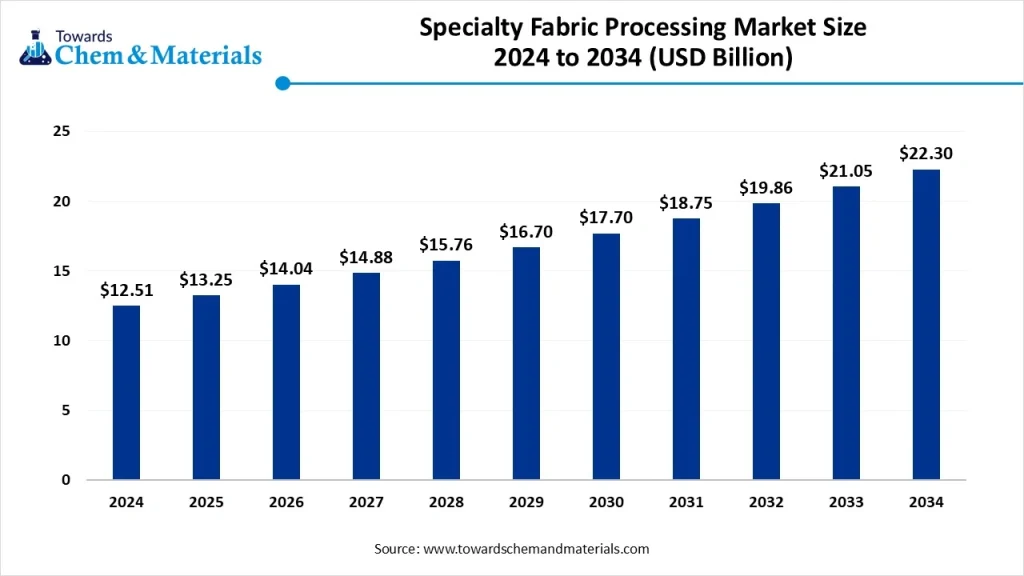
According to towards chemical and materials, the global specialty fabric processing market size is calculated at USD 12.51 billion in 2024, grew to USD 13.25 billion in 2025, and is projected to reach around USD 22.3 billion by 2034. The market is expanding at a CAGR of 5.95% between 2025 and 2034. Asia Pacific dominated the specialty fabric processing market with a market share of 47% in 2024.
Market Overview
Specialty fabric processing — covering pre-treatment, dyeing, printing, finishing, coating/lamination, and functionalization — is moving from volume-led capacity to value-led capability. The industry’s center of gravity remains in Asia Pacific (47% share, 2024), while North America and Europe command high-value niches (performance wear, medical/automotive textiles, sustainable finishes).
Forecast math check: Starting at USD 13.25B in 2025 and compounding at 5.95% for nine years lands near USD 22.3B by 2034 — consistent with the growth path.
Market Growth Factors
- Technical & performance textiles boom (automotive, defense, medical, protective).
- Brand & retailer mandates for low-impact chemistries, traceability, and wastewater standards.
- Mass customization in fashion and home textiles pushing short runs and digital print.
- Urbanization & income growth in Asia driving apparel and home textile throughput.
- Upstream integration by mills and OEMs, securing finishing quality and faster lead times.
Market Trends
- Price discipline amid input volatility: Energy and specialty chemical costs are structurally higher than pre-2020; processors are repricing via indexation and tiered service levels.
- Sustainable chemistries: Enzymatic desizing/scouring, bio-based finishes, C0/C6 fluorine-free repellents, and dope-dyed synthetics reduce water/chem/energy use.
- Water-light & energy-light processes: Low-liquor ratio dyeing, foam & cold-pad batch, plasma surface modification, and heat-recovery retrofits.
- Color-on-demand: Pigment digital printing gains in cotton, blends, and poly — fewer steps, faster turns.
- Data-led operations: Inline spectrophotometry, digital recipe management, and MES/IoT trim rework and right-first-time variability.
- Functional coatings surge: Anti-microbial, flame retardant, UV-cut, hydrophilic/hydrophobic layers for medical, outdoor, workwear, and mobility interiors.
Report Scope
| Report Attribute | Details |
| Market Size in 2025 | USD 13.25 Billion |
| Expected Size by 2034 | USD 22.3 Billion |
| Growth Rate from 2025 to 2034 | CAGR 5.95% |
| Base Year of Estimation | 2024 |
| Forecast Period | 2025 – 2034 |
| Dominant Region | Asia Pacific |
| Segment Covered | By Processing Type, By Fabric Type, By Functional Property, By End-Use Industry, By Distribution Channel, By Region |
| Key Companies Profiled | Milliken & Company, Trelleborg AB, Saint-Gobain Performance Plastics, TenCate Protective Fabrics, Low & Bonar PLC, Albany International Corp., Freudenberg Performance Materials, Arvind Ltd., Techtex Industrial Nonwovens, Sioen Industries NV, Heytex Bramsche GmbH, Erez Thermoplastic Products, Apex Mills, Schoeller Textil AG, Baltex Technical Textiles |
Market Future (2025–2034)
- Value shift to capability: Buyers favor partners that blend sustainability, consistency, and speed.
- Capex rotation: Brownfield retrofits (heat recovery, ETP upgrades) and selective new lines (continuous dye ranges, digital).
- Premiumization: Higher mix of technical finishes lifts realizations even when volume stabilizes.
- Consolidation: Smaller job-dyers face compliance capex; expect M&A and cluster-based shared utilities (common ETP, steam).
- Nearshoring: Regional quick-response hubs grow in Mexico, Turkey, Eastern Europe, complementing Asia hubs.
Market Dynamics
1) Drivers
- Compliance and brand scorecards (ZDHC, wastewater limits) create upgrade cycles.
- Automotive/medical/protective end-markets demand consistent, tested performance.
- Digital commerce shortens fashion cycles → more small-batch specialty runs.
2) Restraints
- Energy & water intensity; environmental permitting delays.
- Skilled labor shortages in color management and process control.
- Capex burden for advanced ETPs and low-liquor machinery.
3) Opportunities
- Enzymatic, plasma, supercritical CO₂ and dope dyeing for sustainability and cost.
- Service analytics (recipe libraries, SPC dashboards) as value-add.
- Eco-label partnerships to command premiums (GOTS/OEKO-TEX pathways).
4) Challenges
- Feedstock variability (recycled fibers, blends) complicates shade and handle.
- Chemical stewardship amid evolving restricted substance lists.
- Fragmented supply bases and uneven grid reliability in emerging hubs.
Price Trend & Outlook
What’s moving prices?
- Upward pressure: Energy, specialty chemicals, labor, effluent treatment, and audit/compliance overhead.
- Downward offsets: Low-liquor machines, heat recovery, process digitization, water reuse, and chemistry consolidation.
Practical implications
- Expect mid-single-digit annual increases in average processing realisations in most hubs, with narrower bands for long-term offtake partners tied to efficiency and sustainability KPIs.
- Index-linked contracts (energy/chem) and bonus–malus for quality/sustainability outcomes are becoming standard.
Regional Market Insights
The Asia Pacific region dominates the market with a commanding 47% share in 2024, led by strong demand from China, Japan, India, and South Korea. Rapid industrialization, expanding manufacturing capacities, and increasing adoption of advanced protective and performance fabrics are fueling growth in this region.
Download Sample : https://www.towardschemandmaterials.com/download-sample/5766
In Europe, countries such as Germany, France, Italy, and the UK are key contributors, driven by innovation in technical textiles, protective gear, and sustainable processing technologies. Meanwhile, North America, particularly the U.S., continues to invest heavily in high-performance fabrics for aerospace, defense, and healthcare sectors.
Emerging economies in Latin America (Brazil, Mexico, Argentina) and the Middle East & Africa (South Africa, UAE, Saudi Arabia) are witnessing steady growth as industrial and construction sectors expand.
Market Segmentation
Specialty fabric processing is segmented based on processing type, fabric type, functional properties, end-use industries, and distribution channels:
- By Processing Type: Coating (PU, PVC, Silicone, PTFE), Lamination, Dyeing & Printing (Digital, Sublimation, Reactive), Heat-Setting, Chemical Finishing (Anti-microbial, Flame Retardant, Water/Oil Repellent), Plasma & UV Finishing, and Bio-Based/Enzyme Finishing.
- By Fabric Type: Woven, Non-Woven, Knitted, and Composite/Multi-layered technical fabrics.
- By Functional Property: Flame retardant, water/oil repellent, anti-microbial, UV resistant, anti-static, thermal/acoustic insulation, conductive/e-textile enabled, and chemical resistance.
- By End-Use Industry: Protective clothing (military, firefighting, industrial PPE), healthcare & hygiene, automotive interiors, sportswear, industrial filtration, construction, home furnishings, and aerospace & defense.
- By Distribution Channel: Direct supply to OEMs, textile distributors & agents, and online industrial platforms.
For more information, visit the Towards Chemical and Materials website or email the team at sales@towardschemandmaterials.com| +1 804 441 9344
More Insights in Towards Chemical and Materials:
· Natural Gas Market : The global natural gas market size accounted for USD 4.19 trillion in 2024 and is predicted to increase from USD 4.41 trillion in 2025 to approximately USD 6.96 trillion by 2034, expanding at a CAGR of 5.20% from 2025 to 2034.
· Gas Separation Membrane Market : The global gas separation membrane market size was valued at approximately USD 1.85 billion in 2024 and is projected to grow at a CAGR of 6.95% from 2025 to 2034, reaching a value of USD 3.62 billion by 2034.
· Oxo Alcohol Market : The global oxo alcohol market size was valued at USD 15.48 billion in 2024, grew to USD 16.29 billion in 2025, and is expected to hit around USD 25.82 billion by 2034, growing at a compound annual growth rate (CAGR) of 5.25% over the forecast period from 2025 to 2034. Asia Pacific dominated the oxo alcohol market with a market share of 46% in 2024.
· Natural Aroma Chemicals Market : The global natural aroma chemicals market size was reached at USD 4.55 billion in 2024 and is estimated to surpass around USD 5.91 billion by 2034, growing at a compound annual growth rate (CAGR) of 2.65% during the forecast period 2025 to 2034.
· Biobased Adhesives Market : the global biobased adhesives market size is calculated at USD 6.11 billion in 2024, grew to USD 6.67 billion in 2025, and is projected to reach around USD 14.66 billion by 2034. The market is expanding at a CAGR of 9.16% between 2025 and 2034. North America dominated the biobased adhesives market with a market share of 35% in 2024.
· Biobased Insulation Material Market : The global bio-based insulation material market size is calculated at USD 70.20 billion in 2024, grew to USD 74.03 billion in 2025, and is projected to reach around USD 119.34 billion by 2034. The market is expanding at a CAGR of 5.45% between 2025 and 2034. Europe dominated the bio-based insulation material market with a market share of 35% in 2024.
· Europe Bioplastics Market : The Europe bioplastics market volume is calculated at 7.45 million tons in 2024, grew to 8.82 million tons in 2025, and is projected to reach around 40.16 million tons by 2034. The market is expanding at a CAGR of 18.35% between 2025 and 2034.
· Bio-Renewable Chemicals Market : The global bio-renewable chemicals market size was valued at USD 15.11 billion in 2024 and is growing to approximately USD 39.01 billion by 2034, with a developing compound annual growth rate (CAGR) of 9.95% over the forecast period 2025 to 2034.
· Green Nanotechnology Market : The global green nanotechnology market size was valued at USD 103.95 billion in 2024, grew to USD 118.04 billion in 2025, and is expected to hit around USD 370.42 billion by 2034, growing at a compound annual growth rate (CAGR) of 13.55% over the forecast period from 2025 to 2034. Asia Pacific dominated the green nanotechnology market with a market share of 40% in 2024.
· Plastics Extruded Market : The global plastics extruded market size is calculated at USD 175.96 billion in 2024, grew to USD 182.91 billion in 2025, and is projected to reach around USD 259.21 billion by 2034. The market is expanding at a CAGR of 3.95% between 2025 and 2034. Asia Pacific dominated the plastic extruded market with a share of 175.96% in 2024.
Price Trends and Forecast
Pricing in the specialty fabric processing market is influenced by:
- Raw Material Costs: Fluctuations in polymer, chemical, and fiber prices.
- Technological Advancements: Growing use of digital printing, plasma finishing, and bio-based processing reduces costs and boosts adoption.
- Sustainability Initiatives: Demand for eco-friendly, bio-based, and recyclable fabrics is reshaping pricing strategies.
- End-Use Expansion: Aerospace & defense and healthcare demand premium-priced specialty fabrics, while mass markets like sportswear and automotive push for cost efficiency.
Looking ahead, prices are expected to stabilize with increasing investments in automation and sustainable processing technologies. The highest growth will likely be observed in Asia Pacific and North America, where manufacturers are scaling production to meet rising industrial demand.
Conclusion
The specialty fabric processing market is witnessing strong expansion, driven by innovation in protective, sustainable, and functional textiles. With Asia Pacific at the forefront and rapid advancements in bio-based and digital processing technologies, the next decade promises significant opportunities for manufacturers, distributors, and investors worldwide.
Immediate Delivery Available | Buy This Premium Research Report@ https://www.towardschemandmaterials.com/price/5766
About Us
Towards Chemical and Materials is a leading global consulting firm specializing in providing comprehensive and strategic research solutions across the chemical and materials industries. With a highly skilled and experienced consultant team, we offer a wide range of services designed to empower businesses with valuable insights and actionable recommendations.
Our Trusted Data Partners
Precedence Research | Statifacts | Towards Packaging | Towards Healthcare | Towards Food and Beverages | Towards Chemical and Materials | Towards Consumer Goods | Nova One Advisor |
For Latest Update Follow Us: https://www.linkedin.com/company/towards-chem-and-materials/
USA: +1 804 441 9344
APAC: +61 485 981 310 or +91 87933 22019
Europe: +44 7383 092 044


Leave a Reply