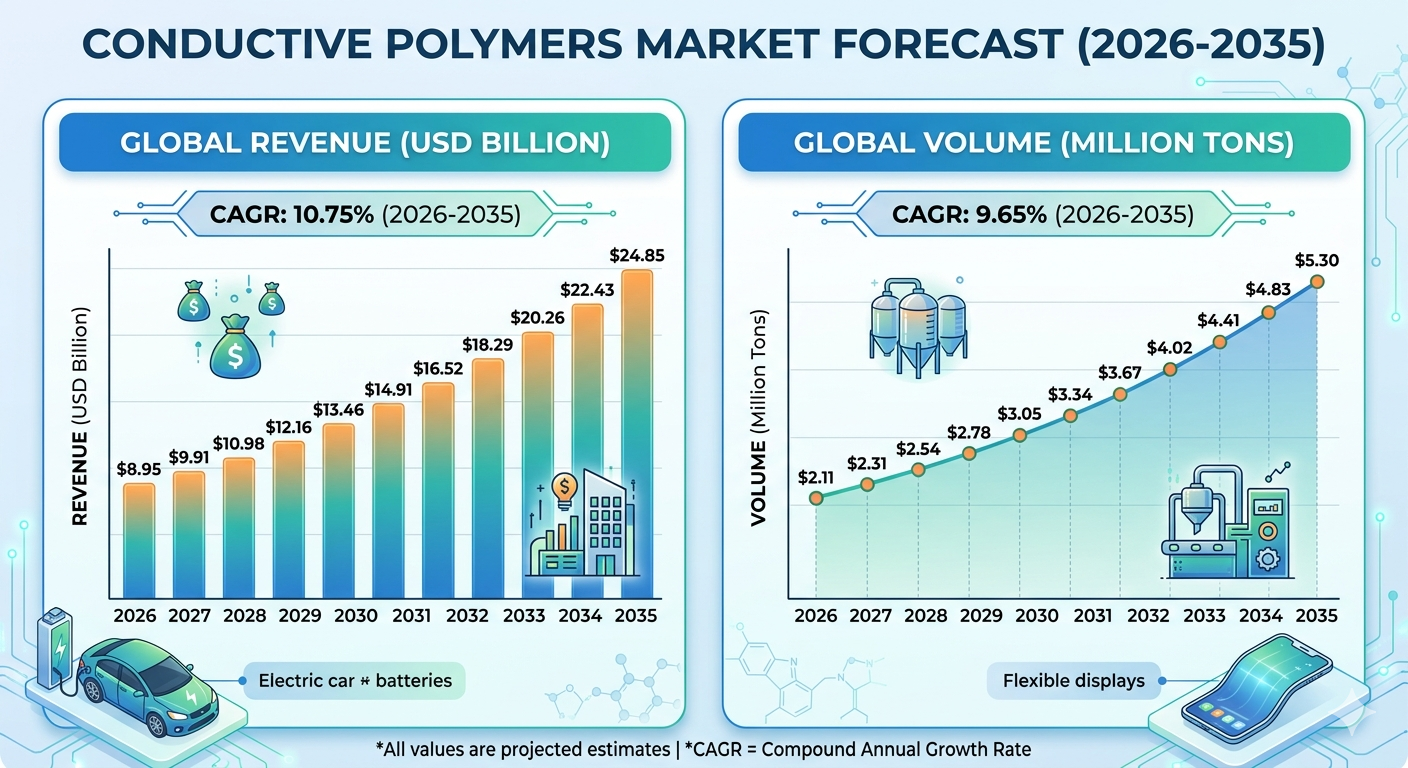
The global Conductive Polymers Market is poised for significant expansion, transitioning from a specialized material to a cornerstone of modern electronics and energy storage. Valued at USD 8.95 billion in 2025, the market is projected to reach USD 9.91 billion in 2026 and scale to USD 24.85 billion by 2035. This represents a steady CAGR of 10.75%. By 2032, the market is expected to surpass a valuation of USD 18.30 billion, driven by the relentless integration of electronic components into everyday objects and the global shift toward electrification.
Market Overview: What defines the Conductive Polymers landscape?
Conductive polymers, often termed “electroactive polymers,” represent a unique class of organic materials that combine the mechanical flexibility and processing ease of plastics with the electrical conductivity typically reserved for metals. This market encompasses intrinsically conducting polymers (ICPs) like PEDOT, polyaniline, and polypyrrole. These materials are revolutionizing sectors by providing lightweight, corrosion-resistant alternatives to traditional copper or silicon components. As an analyst with 15 years in the chemicals sector, I view this shift as a fundamental move toward “soft electronics,” where conductivity is no longer rigid but adaptable to wearable, foldable, and biocompatible applications.
What is the projected Market Growth?
The market is experiencing a dual-track growth in both value and volume. Revenue is set to grow at a 10.75% CAGR, while market volume is anticipated to rise from 2.11 million tons in 2025 to 5.3 million tons by 2035 (9.65% CAGR). Pricing is also on an upward trajectory with a 4.33% CAGR, reflecting the shift toward high-purity, specialized polymer grades required for advanced semiconductor and medical applications.
What are the Key Market Trends?
-
Integration in Next-Gen Batteries: Conductive polymers are being used as binders and coatings in lithium-ion and solid-state batteries to improve charge-discharge rates.
-
The Rise of Wearable Bio-electronics: Their biocompatibility makes them ideal for skin-interfaced sensors and neural implants.
-
Advancements in Transparent Conductive Films: PEDOT:PSS is increasingly replacing ITO (Indium Tin Oxide) in flexible displays and solar cells.
-
Miniaturization of Microelectronics: The demand for high-performance electromagnetic interference (EMI) shielding in 5G devices is surging.
-
Green Synthesis Methods: Growing R&D focus on aqueous-based processing to reduce the environmental impact of polymer manufacturing.
What are the Recent Government Initiatives?
Governments are increasingly viewing conductive polymers as critical materials for national security and “green” transitions. In the United States, the CHIPS and Science Act provides indirect momentum by subsidizing the domestic semiconductor ecosystem, where conductive polymers are essential for anti-static packaging and photoresist materials. The European Union’s Green Deal and its focus on the Circular Economy Action Plan are pushing for lightweight automotive materials to increase EV range, a primary use case for conductive composites. Furthermore, in China, the 14th Five-Year Plan specifically highlights “advanced electronic materials,” providing tax incentives and R&D grants for domestic producers of ICPs to reduce reliance on imported high-tech materials. These legislative frameworks are not just supportive; they are actively mandating the transition toward the lightweight, efficient materials that conductive polymers provide.
What are the Benefits of Using Conductive Polymers?
The primary advantage lies in the weight-to-conductivity ratio. Traditional metal conductors are heavy and prone to oxidation; conductive polymers offer a lightweight alternative that is inherently resistant to corrosion. From a manufacturing perspective, these materials can be processed via solution-based methods like inkjet printing or roll-to-roll coating, significantly lowering production costs compared to vacuum-deposition of metals. Additionally, their “tunable” nature allows engineers to precisely adjust conductivity levels by varying dopant concentrations, making them versatile for everything from simple anti-static coatings to complex organic light-emitting diodes (OLEDs).
What Are the Key Factors Driving the Market?
The surge in Electric Vehicle (EV) adoption is a massive driver, specifically the need for conductive polymers in battery management systems and lightweight shielding. Secondly, the expansion of 5G infrastructure requires advanced EMI shielding materials to prevent signal interference in densely packed electronic housings. The healthcare sector’s push for remote patient monitoring is also fueling demand for polymer-based biosensors. Finally, the move away from rigid electronics toward flexible and foldable consumer devices is creating a vacuum that only conductive polymers can fill effectively.
Key Segments & Trends
The market is characterized by diverse segmentation. By type, Intrinsically Conductive Polymers (ICPs) held a 46% share in 2025, while Conductive Polymer Composites are the fastest-growing sub-segment at a 10.10% CAGR. Regionally, Asia-Pacific dominates with a 45% market share, fueled by the electronics manufacturing hubs in Taiwan, South Korea, and China. However, the Middle East & Africa is emerging as a high-growth frontier with an 11.90% CAGR, driven by localized industrialization and infrastructure development. Application-wise, Antistatic Packaging is the current leader (18% share), but the Batteries segment is the one to watch, projected to grow at a 12.30% CAGR.
Competitive Landscape: Top Companies
The competitive arena is shifting from pure-play polymer manufacturers to integrated material science giants. Key players are focusing on strategic collaborations with tech firms to develop application-specific inks and films.
1. Heraeus Holding
-
About: A global Fortune 500 technology group headquartered in Germany.
-
Products: Clevios™ (PEDOT:PSS) conductive polymers for displays and sensors.
-
Market Cap: Private (Annual Revenue ~$29 Billion).
2. Solvay S.A.
-
About: A Belgian multinational chemical company focused on high-performance polymers.
-
Products: Specialized polyaniline and conductive compounds for aerospace and energy.
-
Market Cap: ~USD 4.5 Billion (Following recent demergers).
3. Agfa-Gevaert Group
-
About: A leader in imaging technology and functional materials.
-
Products: Orgacon™ conductive transparent films and inks.
-
Market Cap: ~USD 300–400 Million.
4. Sabic (Saudi Basic Industries Corporation)
-
About: A global leader in diversified chemicals and plastics.
-
Products: LNP™ STAT-KON™ and STAT-LOY™ conductive compounds.
-
Market Cap: ~USD 75 Billion.
Data Presentation & Recent Developments
The following table structure is recommended for visualizing the growth trajectory:
-
Average Manufacturing Price (2025): USD 6,210/Ton
-
Average Selling Price (2025): USD 8,160/Ton
-
Top Share Region: Asia Pacific (45%)
-
Fastest Growing Industry: Healthcare (12.10% CAGR)
-
Fastest Growing Form: Inks (12.40% CAGR)
Recent Developments:
-
2024-2025: Significant breakthroughs in 3D-printable conductive inks have allowed for the direct printing of circuits onto curved surfaces.
-
Strategic Move: Major players are acquiring smaller “green-chem” startups to integrate bio-based monomers into the conductive polymer chain, addressing the growing demand for sustainable electronics.
Which segment accounted for the largest Market share?
In 2025, the Electrical & Electronics end-use industry accounted for the largest market share at 34%. Within the conductivity mechanisms, Electronic Conductive Polymers dominated with a massive 63% share, as they are the standard for most consumer electronics and shielding applications.
What is the Future of the Market?
The future lies in “Smart Systems.” We are moving toward a world where conductive polymers enable structural electronics—where the body of a car or the casing of a phone is the circuit itself. As we move toward 2035, the convergence of AI and material science will likely lead to “self-healing” conductive polymers that can repair circuit breaks autonomously, significantly extending the lifespan of electronic waste.
Why Is This Market Important?
This market is the bridge between the biological and digital worlds. Without conductive polymers, flexible heart monitors, foldable smartphones, and lightweight high-capacity batteries would remain theoretical. They are the essential enabling technology for the next generation of human-machine interfaces.
About Us
Towards Chemical and Materials is a leading global consulting firm specializing in providing comprehensive and strategic research solutions across the chemical and materials industries. With a highly skilled and experienced consultant team, we offer a wide range of services designed to empower businesses with valuable insights and actionable recommendations.
Our Trusted Data Partners
Precedence Research | Statifacts | Towards Packaging | Towards Healthcare | Towards Food and Beverages | Towards Chemical and Materials | Towards Consumer Goods | Nova One Advisor |
For Latest Update Follow Us: https://www.linkedin.com/company/towards-chem-and-materials/
USA: +1 804 441 9344
APAC: +61 485 981 310 or +91 87933 22019
Europe: +44 7383 092 044




Leave a Reply