Executive Summary
The global 3D Printing Plastics Market is witnessing strong momentum due to increasing adoption of additive manufacturing across automotive, aerospace, healthcare, and industrial production. The market is expected to register robust double digit growth through 2035, supported by advancements in polymer science, industrial scale printing capabilities, and demand for customized production solutions.
North America accounted for the largest market share of 33% in 2025, while Asia Pacific is projected to emerge as the fastest growing region with a CAGR of 20.70% through the forecast period. Growing investments in smart manufacturing, Industry 4.0 technologies, and digital production ecosystems continue to reshape the future of the market.
Market Overview
What is the 3D Printing Plastics Market?
The 3D Printing Plastics Market encompasses polymer materials specifically designed for additive manufacturing processes. These plastics are used to create prototypes, functional parts, tooling components, and end use products through layer by layer fabrication techniques.
Materials such as photopolymers, PLA, PETG, ABS, and polyamide enable manufacturers to produce lightweight, complex, and highly customized products while reducing waste and shortening development cycles. The growing demand for rapid product development and decentralized manufacturing is accelerating market expansion across industries worldwide.
What is Market Growth?
The market continues to grow due to increasing adoption of additive manufacturing in industrial production environments.
Major Growth Indicators
- Rising industrial automation
- Expansion of digital manufacturing facilities
- Growing demand for lightweight materials
- Increased healthcare applications
- Strong investment in aerospace innovation
- Rapid adoption of customized production technologies
North America maintained leadership with a 33% market share in 2025, while Asia Pacific is expected to record the fastest growth owing to government backed manufacturing initiatives and increasing industrial investments.
What Are the Key Factors Driving the Market?
The market is primarily driven by the transition from conventional manufacturing toward digital production methods. Industries increasingly seek cost effective, lightweight, and customizable solutions that improve operational efficiency.
Growing demand for rapid prototyping, reduced material waste, shorter product development cycles, and localized manufacturing are supporting adoption. In addition, advancements in polymer formulations are enabling the production of stronger, heat resistant, and application specific components suitable for demanding industrial environments.
What are the Key Market Trends?
High Performance Plastic Development
Manufacturers are investing heavily in advanced polymers capable of replacing metal components in selected applications.
Sustainable Materials Innovation
Bio based and recyclable materials are becoming increasingly important as sustainability goals gain priority.
Healthcare Personalization
Customized implants, surgical models, and medical devices are expanding rapidly through additive manufacturing technologies.
Industrial Scale Production
The market is moving beyond prototyping toward full scale manufacturing applications across aerospace, automotive, and industrial sectors.
Market Recent Government Initiatives
United States
- Advanced Manufacturing National Program expansion
- Support for additive manufacturing research centers
- Funding for aerospace innovation initiatives
China
- National intelligent manufacturing programs
- Government backed additive manufacturing industrial parks
- Semiconductor and advanced materials investments
India
- Make in India manufacturing initiatives
- Support for Industry 4.0 adoption
- Incentives for advanced manufacturing startups
European Union
- Sustainable manufacturing programs
- Digital industrial transformation investments
- Circular economy initiatives supporting additive manufacturing
What are the Benefits of Using 3D Printing Plastics?
The adoption of 3D printing plastics provides substantial advantages across industries.
- Faster product development
- Reduced material waste
- Lightweight product design
- Cost efficient prototyping
- Enhanced design flexibility
- Improved supply chain efficiency
- Lower tooling costs
- Greater customization capabilities
These benefits make additive manufacturing an increasingly attractive alternative to traditional production methods.
Why Is the Market Important?
The market plays a critical role in transforming global manufacturing systems. By enabling rapid design iterations, localized production, and highly customized products, 3D printing plastics help companies remain competitive in increasingly dynamic markets.
The technology also supports sustainability goals by minimizing material waste and reducing transportation requirements through distributed manufacturing networks.
Market Dynamics
Drivers
- Growing industrial automation
- Rising demand for customized products
- Expansion of aerospace applications
- Healthcare innovation
- Smart manufacturing adoption
Restraints
- High equipment investment costs
- Limited material standardization
- Technical skill shortages
- Regulatory challenges for medical applications
Opportunities
- Sustainable polymer development
- AI driven manufacturing optimization
- Growth in emerging economies
- Expansion of healthcare applications
Market Segmentation Analysis
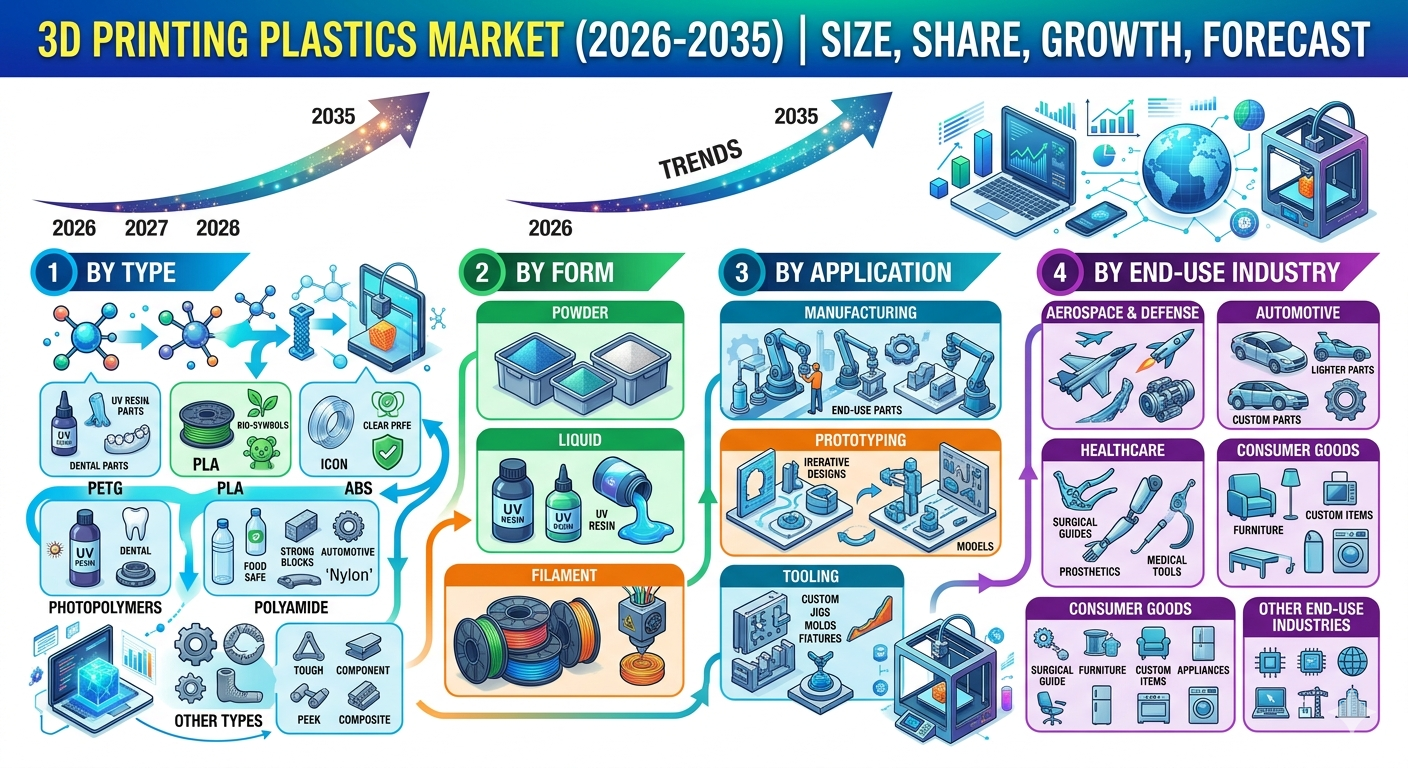
By Type
Photopolymers
The largest segment with 29% market share in 2025 due to increasing adoption in SLA and DLP printing technologies requiring high precision and surface quality.
PETG
Expected to witness the fastest growth with a CAGR of 19.6% owing to superior durability, chemical resistance, and functionality in industrial applications.
Other segments include:
- PLA
- ABS
- Polyamide
- Other specialty plastics
By Form
Filament
Dominated the market with 43% share in 2025 due to widespread use in FDM printing systems and cost effectiveness.
Liquid
Expected to grow at the fastest CAGR of 19.2% due to increasing use in medical and precision manufacturing applications.
Powder
Widely utilized in industrial additive manufacturing systems.
By Application
Manufacturing
Largest and fastest growing segment with 42% market share in 2025 and expected CAGR of 20.10%.
Prototyping
Continues to be a major application area for product development.
Tooling
Increasing adoption for customized industrial tooling solutions.
By End Use Industry
Automotive
Dominated the market with 27% share in 2025 due to lightweight component development and rapid prototyping.
Healthcare
Expected to grow at the fastest CAGR of 21.40% through 2035 due to personalized medical devices and surgical planning applications.
Other industries include:
- Aerospace and Defense
- Consumer Goods
- Industrial Manufacturing
Suggested Data Table Placement
Insert a comparison table here:
| Segment | Market Share 2025 | Growth Outlook |
|---|---|---|
| Photopolymers | 29% | High |
| Filament | 43% | Strong |
| Manufacturing | 42% | Very High |
| Automotive | 27% | Strong |
| Healthcare | 21% | Fastest Growing |
Which Segment Accounted for the Largest Market Share?
The Photopolymers segment held the largest type share at 29% in 2025 due to demand from high precision industrial printing applications. Among forms, filament dominated with 43% market share, while manufacturing remained the largest application segment with 42% market share. Automotive led end use industries with 27% market share globally.
Top Companies in the 3D Printing Plastics Market
Stratasys Ltd.
About:
Leading additive manufacturing company specializing in industrial 3D printing systems and materials.
Products:
FDM materials, photopolymers, additive manufacturing solutions.
Market Cap:
Approximately USD 1 billion plus.
3D Systems Corporation
About:
Pioneer in additive manufacturing technologies and materials innovation.
Products:
Industrial resins, plastics, healthcare printing solutions.
Market Cap:
Publicly traded technology company.
BASF SE
About:
Global leader in specialty chemicals and advanced additive manufacturing materials.
Products:
Ultrafuse filaments and engineering polymers.
Market Cap:
Over USD 40 billion.
Arkema
About:
Major supplier of specialty materials for industrial additive manufacturing.
Products:
High performance resins and engineering thermoplastics.
Market Cap:
Multi billion dollar specialty chemicals company.
Evonik Industries AG
About:
Leading producer of advanced polymers and specialty materials.
Products:
Polyamide powders and industrial additive manufacturing materials.
Market Cap:
Large cap global chemical manufacturer.
Competitive Landscape
The 3D printing plastics market is highly competitive with material manufacturers, additive manufacturing equipment providers, and specialty chemical companies actively expanding their portfolios. Leading participants are investing heavily in advanced polymers, sustainable materials, and high performance thermoplastics capable of serving aerospace, automotive, and healthcare applications. Strategic partnerships between printer manufacturers and material suppliers are accelerating commercialization efforts. Companies are also focusing on bio based polymers, industrial scale additive manufacturing systems, and AI enabled production platforms to strengthen their competitive positions. As industrial adoption increases, competition is expected to intensify around material performance, sustainability, and production scalability.
Recent Developments by Major Companies
Recent industry developments focus heavily on sustainable materials, industrial production capabilities, and healthcare innovation. Several leading companies have introduced next generation photopolymers, recyclable filaments, and high performance engineering plastics designed for demanding applications. Automotive manufacturers are increasingly collaborating with additive manufacturing companies to develop lightweight components that improve fuel efficiency and vehicle performance. Healthcare organizations continue expanding the use of customized implants and patient specific medical devices. Meanwhile, aerospace companies are adopting advanced polymers to reduce aircraft weight and improve manufacturing flexibility, creating new growth opportunities for market participants.
What is the Future of the Market?
The future of the 3D Printing Plastics Market appears exceptionally strong as additive manufacturing transitions from prototyping toward mainstream industrial production. Advances in material science, artificial intelligence, automation, and sustainable manufacturing will continue expanding market opportunities.
Growing demand for localized production, customized products, and environmentally responsible manufacturing processes will position 3D printing plastics as a critical component of next generation industrial ecosystems.
Conclusion
The 3D Printing Plastics Market is entering a new phase of industrial transformation driven by manufacturing scalability, healthcare innovation, and advanced material development. With strong growth expected through 2035, companies investing in high performance plastics, sustainable materials, and digital manufacturing capabilities will be best positioned to capitalize on future opportunities. The convergence of additive manufacturing, artificial intelligence, and advanced polymer technologies will continue reshaping global production landscapes.


Leave a Reply