Executive Summary
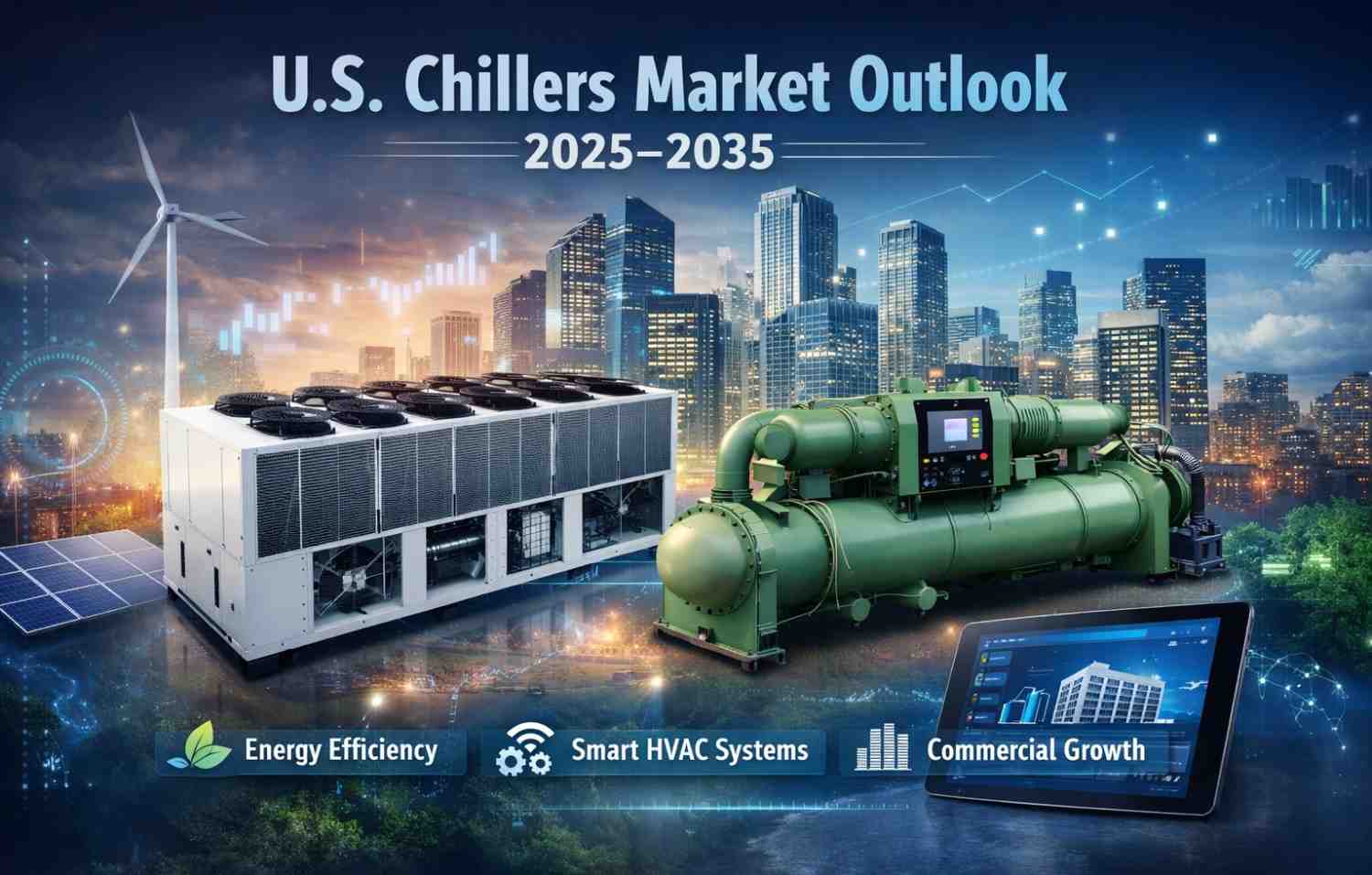
The U.S. chillers market is entering a steady growth phase, supported by infrastructure modernization, energy efficiency mandates, and rising demand from commercial and industrial sectors. The market is projected to grow from USD 1.85 billion in 2025 to USD 1.94 billion in 2026, reaching approximately USD 2.94 billion by 2035, registering a CAGR of 4.75% during 2026–2035.
What stands out is not explosive growth, but consistent, resilient expansion driven by regulatory shifts and technological upgrades. The market is increasingly defined by low-GWP refrigerants, smart HVAC integration, and lifecycle cost optimization.
What is Driving Growth in the U.S. Chillers Market?
1. Energy Efficiency Regulations and Sustainability Mandates
The U.S. regulatory environment is tightening around HVAC systems:
- Increasing adoption of ASHRAE standards and DOE efficiency norms
- Push toward low-global-warming-potential (GWP) refrigerants
- Federal and state-level incentives for energy-efficient retrofits
This is forcing end-users to replace legacy systems with high-efficiency chillers, particularly in commercial buildings.
2. Growth in Data Centers and Mission-Critical Infrastructure
The surge in data center construction is a major catalyst:
- Hyperscale facilities demand precise thermal management
- Liquid cooling and hybrid chiller systems are gaining traction
- High uptime requirements are pushing demand for redundant and modular chiller systems
3. Commercial Real Estate and Institutional Expansion
Key sectors fueling demand include:
- Healthcare (hospitals, labs)
- Education campuses
- Retail complexes and mixed-use developments
These segments prioritize reliable, centralized cooling systems, making chillers indispensable.
What Are the Key Market Segments?
By Product Type
- Air-Cooled Chillers
- Dominant in smaller and mid-sized applications
- Lower installation complexity
- Water-Cooled Chillers
- Preferred for large commercial and industrial facilities
- Higher efficiency over long operating cycles
By Application
- Commercial
- Offices, malls, hotels
- Largest revenue contributor due to widespread HVAC usage
- Industrial
- Food & beverage processing
- Pharmaceuticals
- Chemicals and petrochemicals
- Institutional
- Hospitals and universities
- Government buildings
Suggested Data Table Placement
Insert a table here comparing market size (USD billion) by application segment from 2025 to 2035 for clearer visualization of demand distribution.
What Technological Trends Are Shaping the Market?
1. Shift Toward Low-GWP Refrigerants
- Transition from HFCs to alternatives like HFOs and natural refrigerants
- Compliance with Kigali Amendment goals
2. Smart Chillers and IoT Integration
- Predictive maintenance through AI-enabled monitoring systems
- Integration with Building Management Systems (BMS)
- Real-time energy optimization
3. Modular and Magnetic Bearing Chillers
- Oil-free magnetic bearing compressors improving efficiency
- Compact modular systems enabling scalability
How is Regional Demand Distributed Across the U.S.?
High-Growth Regions
- Sun Belt States (Texas, Florida, Arizona)
- High cooling demand due to climate
- Rapid urbanization
- California
- Strong regulatory push for energy-efficient systems
- High retrofit activity
Mature but Stable Markets
- Northeast & Midwest
- Replacement-driven demand
- Institutional upgrades
What Does the Competitive Landscape Look Like?
The U.S. chillers market is moderately consolidated, with global HVAC leaders and specialized manufacturers competing on efficiency, service networks, and innovation.
Key Players
- Carrier Global Corporation
- Trane Technologies
- Johnson Controls International
- Daikin Industries
- Mitsubishi Electric
Recent Strategic Moves
- Product Innovation: कंपनियाँ focusing on low-GWP refrigerant chillers and high-efficiency centrifugal systems
- Digital Integration: Expansion of smart HVAC platforms with remote diagnostics
- Partnerships: Collaborations with data center developers and ESCOs (Energy Service Companies)
- Aftermarket Focus: Growth in service contracts and lifecycle management offerings
What Challenges Could Impact Market Growth?
- High upfront costs of advanced chillers
- Skilled labor shortages for installation and maintenance
- Volatility in raw material prices (steel, copper)
- Regulatory complexity across states
Despite these challenges, the total cost of ownership (TCO) advantage of efficient systems continues to drive adoption.
Future Outlook: Where is the Market Heading?
Looking ahead, the U.S. chillers market will be shaped by a convergence of sustainability, digitalization, and infrastructure expansion.
Key forward-looking insights:
- Electrification of HVAC systems will accelerate
- Chillers will become integrated energy assets, not just cooling equipment
- Growth in district cooling systems in urban clusters
- Increasing adoption of cooling-as-a-service (CaaS) business models
Conclusion
The U.S. chillers market is not a high-growth, disruptive space—but it is strategically critical and evolution-driven. With a projected value of USD 2.94 billion by 2035, the industry offers stable opportunities anchored in efficiency upgrades, regulatory compliance, and digital transformation.
For stakeholders, success will hinge on:
- Aligning with sustainability mandates
- Investing in smart, connected systems
- Expanding service-based revenue streams
In essence, the market’s future belongs to players who can blend engineering excellence with intelligent system integration.
Contact Us https://www.towardschemandmaterials.com/contact-us
About Us
Towards Chem and Materials is a leading global consulting firm specializing in providing comprehensive and strategic research solutions across the chemical and materials industries. With a highly skilled and experienced consultant team, we offer a wide range of services designed to empower businesses with valuable insights and actionable recommendations.
Email: [email protected]
Web: https://www.towardschemandmaterials.com/
For Latest Update Follow Us: https://www.linkedin.com/company/towards-chem-and-materials/?viewAsMember=true


Leave a Reply