Executive Summary
The global pollution-free construction market is entering a transformative decade, driven by stringent environmental regulations, rapid urbanization, and a structural shift toward sustainable infrastructure.
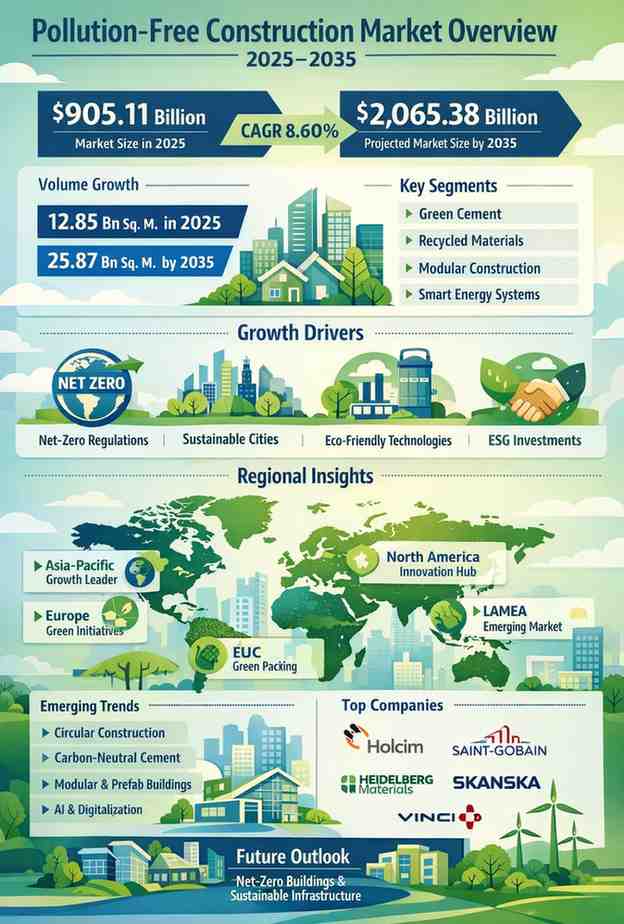
- The market was valued at USD 905.11 billion in 2025
- It is projected to reach USD 2,065.38 billion by 2035
- Registering a CAGR of 8.60% (2026–2035)
In volume terms:
- Expected growth from 12.85 billion sq. meters (2025) to 25.87 billion sq. meters (2035)
- Volume CAGR stands at 7.25%
By 2032 (mid-forecast benchmark):
- The market is estimated to surpass ~USD 1.55 trillion, indicating strong mid-cycle momentum.
This growth trajectory reflects a global pivot toward low-emission materials, circular construction practices, and net-zero building mandates, particularly across North America, Europe, and Asia-Pacific.
What is the Pollution-Free Construction Market?
Pollution-free construction refers to building practices, materials, and technologies designed to minimize environmental impact, including:
- Reduced carbon emissions
- Minimal air and water pollution
- Sustainable resource utilization
- Waste reduction and recycling
It encompasses green buildings, low-carbon cement, recycled aggregates, prefabrication, and energy-efficient infrastructure systems.
What Are the Primary Drivers of This Market?
1. Regulatory Push Toward Net-Zero Buildings
Governments worldwide are mandating:
- Carbon-neutral construction targets
- Green building certifications (LEED, BREEAM)
- Restrictions on high-emission materials
2. Rapid Urbanization with Sustainability Mandates
Emerging economies (India, China, Southeast Asia) are:
- Building smart cities
- Integrating sustainable infrastructure at scale
3. Technological Advancements in Materials
Innovations include:
- Carbon capture cement
- Bio-based construction materials
- Self-healing concrete
4. ESG & Investor Pressure
Institutional investors are prioritizing:
- Low-carbon assets
- Sustainable real estate portfolios
What Are the Key Market Segments?
By Material Type
- Green Cement & Concrete
- Recycled Construction Materials
- Low-VOC Paints & Coatings
- Sustainable Insulation Materials
By Construction Type
- Residential Buildings
- Commercial Infrastructure
- Industrial Facilities
- Public Infrastructure (roads, bridges, transit systems)
By Technology
- Prefabrication & Modular Construction
- 3D Printing in Construction
- Smart Energy Systems
Which Regions Are Leading the Market Growth?
Asia-Pacific: The Growth Engine
- Dominates volume consumption
- Driven by China, India, and ASEAN
- Government-backed green infrastructure programs
Europe: Regulatory Leadership
- Strict carbon neutrality laws
- High adoption of circular construction
North America: Innovation Hub
- Strong presence of green tech startups
- ESG-driven commercial real estate sector
LAMEA (Latin America, Middle East & Africa): Emerging Opportunity
- Sustainable urban development projects
- Smart city investments in the Middle East
What Are the Emerging Trends Shaping the Industry?
1. Circular Construction Economy
- Reuse of demolition waste
- Closed-loop material systems
2. Carbon-Neutral Cement Revolution
- Alternative binders (geopolymers)
- Carbon capture integration
3. Rise of Modular & Prefabricated Buildings
- Reduced on-site emissions
- Faster project timelines
4. Digitalization of Construction
- AI-driven design optimization
- Building Information Modeling (BIM)
5. Green Hydrogen in Construction Processes
- Decarbonizing heavy machinery and material production
Competitive Landscape: Who Are the Key Players?
The market is moderately fragmented, with a mix of global construction giants, material innovators, and niche sustainability-focused firms.
Leading Companies
- Holcim Group
- Heidelberg Materials
- Saint-Gobain
- Skanska AB
- Vinci SA
- China State Construction Engineering Corporation
Recent Strategic Moves
- Holcim expanding its low-carbon cement portfolio through acquisitions
- Heidelberg Materials investing heavily in carbon capture and storage (CCS)
- Saint-Gobain focusing on lightweight and energy-efficient materials
- Skanska integrating green construction practices across all major projects
These players are increasingly competing on carbon footprint reduction rather than just cost efficiency, signaling a paradigm shift in competitive dynamics.
What Challenges Could Restrain Market Growth?
- High initial costs of sustainable materials
- Limited availability of green alternatives in developing regions
- Lack of standardized global regulations
- Skilled labor shortages for advanced construction techniques
Future Outlook: Where Is the Market Headed?
The pollution-free construction market is expected to evolve from a regulation-driven niche to a mainstream industry standard.
Key Future Developments
- Net-zero buildings becoming mandatory across major economies
- Integration of AI and automation in sustainable construction
- Expansion of carbon trading markets influencing construction decisions
- Increased collaboration between governments and private players
Conclusion
The global pollution-free construction market is no longer a peripheral trend—it is becoming the foundation of next-generation infrastructure development. With a projected value exceeding USD 2 trillion by 2035, the industry is undergoing a structural transformation driven by sustainability, innovation, and policy alignment.
For stakeholders—whether material suppliers, developers, or investors—the opportunity lies in early adoption of green technologies, strategic partnerships, and aligning portfolios with global decarbonization goals.
The next decade will not just redefine how we build—but what we build for: a cleaner, circular, and climate-resilient future.


Leave a Reply