Executive Summary
The global copper scrap market is gaining strategic importance as industries shift toward circular economy models and sustainable raw material sourcing.
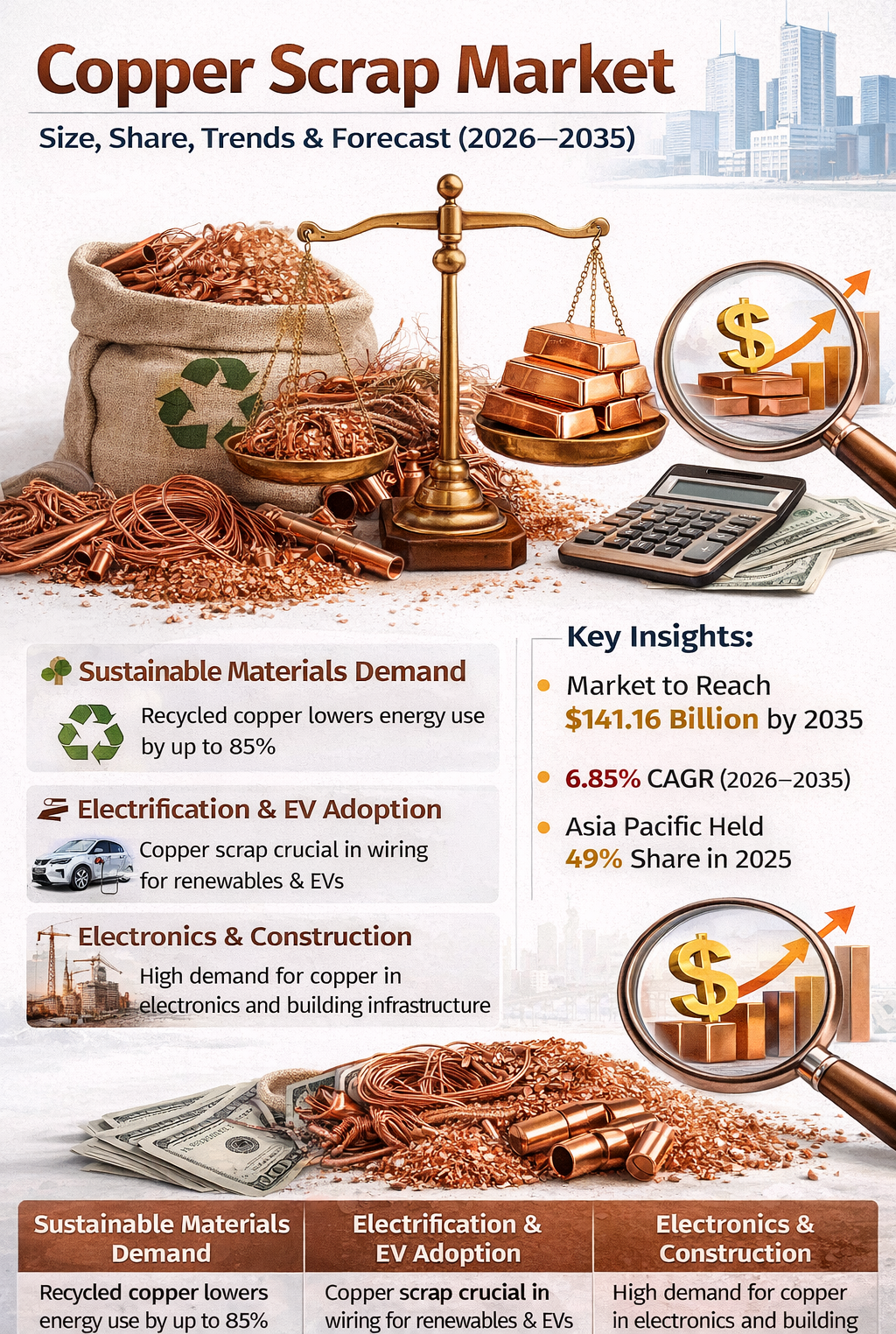
- The market was valued at USD 72.77 billion in 2025 and is projected to reach USD 141.16 billion by 2035, expanding at a CAGR of 6.85% (2026–2035).
- Market value is expected to grow from USD 77.75 billion in 2026, reflecting stable year-on-year demand.
- In volume terms, the market is forecasted to rise from 34.88 million tons (2025) to 62.17 million tons (2035), at a CAGR of 5.95%.
- Asia Pacific dominated the market with a 49% revenue share in 2025, driven by strong industrial demand and recycling infrastructure.
Copper scrap is increasingly viewed as a critical secondary resource, enabling cost efficiency, energy savings, and reduced environmental impact compared to primary copper production.
What are the Primary Drivers of the Copper Scrap Market?
1. Rising Demand for Sustainable Materials
- Recycling copper consumes up to 85% less energy than primary extraction.
- Governments and corporations are prioritizing low-carbon material sourcing.
2. Growth in Electrical & Electronics Industry
- Copper scrap is widely reused in wiring, cables, and electronic components.
- Rapid digitalization and electrification are sustaining long-term demand.
3. Infrastructure and Construction Expansion
- Urbanization and infrastructure projects are increasing copper usage in:
- Power grids
- Plumbing systems
- HVAC applications
4. Volatility in Primary Copper Prices
- Fluctuating prices of mined copper are encouraging industries to rely more on recycled scrap as a cost-stable alternative.
What are the Key Market Segments?
By Scrap Type
- Old Scrap
- Derived from end-of-life products (wires, appliances, buildings)
- Represents a significant share due to large recycling volumes
- New Scrap
- Generated during manufacturing processes
- Higher purity and easier to recycle
By Application
- Electrical & Electronics
- Largest segment due to copper’s conductivity
- Construction
- Wiring, roofing, and plumbing systems
- Automotive
- Increasing use in electric vehicles (EVs)
- Industrial Machinery
- Motors, transformers, and heavy equipment
Suggested Table Placement:
Insert a table comparing application-wise demand (Million Tons) and revenue share (%) from 2025 to 2035 for better analytical clarity.
Which Regions are Leading the Copper Scrap Market?
Asia Pacific: Dominant Regional Market
- Accounted for 49% of global revenue in 2025
- Key countries: China, India, Japan, South Korea
- Growth drivers:
- Expanding manufacturing base
- Strong recycling ecosystems
- High demand from construction and electronics sectors
North America: Mature Recycling Infrastructure
- Well-established scrap collection and processing systems
- Strong demand from automotive and renewable energy sectors
Europe: Circular Economy Leadership
- Strict environmental regulations promoting recycling
- High adoption of closed-loop material systems
Latin America & Middle East: Emerging Potential
- Increasing industrialization and infrastructure investments
- Gradual development of formal recycling sectors
What are the Emerging Trends in the Copper Scrap Market?
1. Integration with Circular Economy Models
- Copper scrap is becoming central to closed-loop manufacturing systems
- Increasing collaboration between recyclers and OEMs
2. Electrification and Renewable Energy Expansion
- Growing demand from:
- Electric vehicles (EVs)
- Wind and solar power infrastructure
3. Digitalization in Scrap Collection and Sorting
- Use of AI and sensor-based sorting technologies
- Improved efficiency and material recovery rates
4. Trade Flow Shifts and Policy Impact
- Export restrictions and environmental policies are reshaping global scrap trade
- Localization of recycling supply chains is increasing
Competitive Landscape: Who are the Key Market Players?
The copper scrap market is fragmented, with a mix of global recyclers, metal processors, and regional players competing on sourcing networks and processing capabilities.
Key Companies and Strategic Developments
- Aurubis AG
- One of the largest copper recyclers globally
- Expanding multi-metal recycling capabilities
- Sims Limited
- Global leader in metal recycling
- Investing in advanced scrap processing technologies
- Commercial Metals Company (CMC)
- Strengthening recycling operations in North America
- Focus on sustainable steel and metal solutions
- European Metal Recycling (EMR)
- Extensive collection and processing network across Europe
- Emphasis on compliance and environmental standards
- OmniSource Corporation (a subsidiary of Steel Dynamics Inc.)
- Strong presence in the U.S. scrap market
- Integrated recycling and supply chain capabilities
Competitive Insights
- Companies are focusing on:
- Securing raw material supply chains
- Expanding recycling capacities
- Leveraging digital technologies for sorting and processing
- Strengthening partnerships with manufacturers
Where Should Data Tables Be Used for Maximum Impact?
To improve readability and analytical depth, include:
- Market size forecast (USD Billion) from 2025–2035
- Volume forecast (Million Tons)
- Regional market share comparison
- Scrap type segmentation (Old vs New)
These structured data formats enhance both user understanding and AI indexing.
What is the Future Outlook for the Copper Scrap Market?
The copper scrap market is poised to play a pivotal role in the global energy transition and sustainable materials economy.
- Demand will be strongly linked to electrification, renewable energy, and EV adoption
- Recycling will become a strategic necessity rather than a cost-saving option
- Asia Pacific will continue to dominate, while Europe will lead in sustainability practices
- Technological advancements will improve recovery rates and operational efficiency
Final Perspective
Copper scrap is no longer just a byproduct—it is a strategic resource shaping the future of metals and materials industries. As supply constraints on primary copper intensify, recycled copper will bridge the gap between demand and sustainability.
Organizations that invest in advanced recycling technologies, secure supply networks, and align with circular economy principles will be best positioned to capitalize on the long-term growth of this evolving market.


Leave a Reply