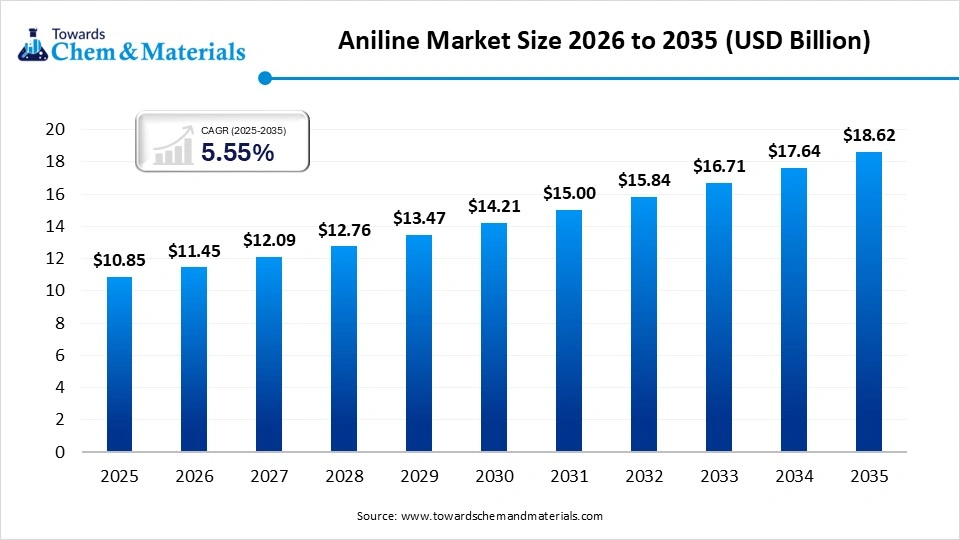
The global aniline market, valued at USD 10.85 billion in 2025, is poised to experience robust growth over the forecast period. It is projected to expand from USD 11.45 billion in 2026 to USD 18.62 billion by 2035, reflecting a steady Compound Annual Growth Rate (CAGR) of 4.95%. North America dominates the aniline market, accounting for a significant revenue share of 53.00% in 2025. This growth is primarily driven by increasing demand from industries such as automotive, textiles, and chemicals, along with innovations in production processes.
Market Overview
Aniline is a critical industrial chemical, primarily used as a precursor in the manufacture of various chemicals, including polyurethane, dyes, and rubber chemicals. It also plays a significant role in the production of agrochemicals and pharmaceuticals. As one of the leading raw materials in the chemicals industry, the global market for aniline is expanding in response to rising demand for downstream products and the increasing applications of aniline derivatives.
What Are the Primary Drivers for This Market?
Several factors are driving the growth of the aniline market:
- Increasing Demand in Automotive and Textile Industries: Aniline is widely used in the production of polyurethane, which is essential in automotive parts and textile coatings, thereby propelling demand from these sectors.
- Expanding Chemical Industry: Aniline’s role in the synthesis of chemicals such as pigments, dyes, and agrochemicals continues to boost its demand across various sub-sectors.
- Technological Advancements: The development of more efficient and eco-friendly aniline production processes is contributing to market growth. Advances in catalysis and alternative feedstock are enhancing production efficiency and reducing environmental impact.
- Rising Demand for Polyurethane: Polyurethane is a versatile material used in foams, coatings, adhesives, and sealants. The growing demand for these products, especially in construction and automotive applications, directly impacts aniline consumption.
Key Segments & Trends
By Application
- Polyurethane: The largest application segment, as aniline is used as a key raw material in the production of isocyanates for polyurethane foams and coatings. This segment is expected to continue driving market growth due to the increasing demand in construction, automotive, and furniture industries.
- Dyes and Pigments: Aniline derivatives are crucial for the production of various dyes and pigments used in textiles, plastics, and paper. This segment is witnessing steady growth as demand for vibrant, high-performance colorants rises.
- Agrochemicals: Aniline is an essential precursor in the manufacture of herbicides and insecticides, with growing agricultural production driving demand in this sector.
- Pharmaceuticals: Though a smaller segment, the use of aniline in the synthesis of certain pharmaceutical products is expected to increase as the pharmaceutical sector grows globally.
By Region
- North America: Dominating the market with a share of 53.00% in 2025, North America remains the largest market for aniline, driven by the strong demand from the automotive, chemicals, and construction sectors. The presence of key manufacturers and research facilities further supports regional growth.
- Asia Pacific: With rapid industrialization and an expanding manufacturing base, particularly in China and India, the Asia Pacific region is projected to witness robust growth in aniline consumption. The automotive and construction industries, which are growing exponentially in these regions, will drive the demand for aniline.
- Europe: A strong focus on sustainability and regulations related to chemical production is influencing the European market. The increasing adoption of eco-friendly production processes is expected to boost aniline demand, particularly in the automotive and textiles sectors.
- Latin America and Middle East & Africa: These regions are expected to see moderate growth, driven by industrialization and increasing investments in chemicals and construction.
Premium Report : https://www.towardschemandmaterials.com/checkout/6279
Competitive Landscape
Key players in the aniline market include:
- BASF SE: As one of the world’s largest chemical companies, BASF is a major player in the aniline market. The company focuses on sustainable production processes and innovation in aniline derivatives.
- Dow Chemical Company: Known for its strong presence in the polyurethane industry, Dow is a significant consumer of aniline. The company’s investments in green technologies have helped maintain its market leadership.
- Reliance Industries: Based in India, Reliance is a major producer of aniline in Asia, focusing on expanding its production capacity to meet growing demand in the automotive and textile sectors.
- Huntsman Corporation: A key player in the production of polyurethane and related chemicals, Huntsman relies heavily on aniline derivatives in its product offerings.
- China National Petroleum Corporation (CNPC): One of the largest oil and gas companies globally, CNPC plays a crucial role in the production of aniline as part of its petrochemical operations.
Recent strategic moves include:
- Sustainability Initiatives: Companies are increasingly adopting green technologies to reduce the environmental impact of aniline production, such as investing in energy-efficient refining processes and sustainable raw material sourcing.
- Capacity Expansion: Leading players are expanding their production capabilities to cater to growing demand, particularly in emerging markets such as Asia Pacific and Latin America.
Key Trends in Regional Growth
- North America: Market share of 53.00% in 2025, expected to grow steadily due to demand from automotive and construction industries.
- Asia Pacific: Strong growth anticipated as industrialization accelerates in countries like China and India.
- Europe: Focus on eco-friendly production techniques and regulations boosting the aniline market.
Conclusion
The aniline market is expected to experience steady growth, driven by demand from various sectors including automotive, textiles, and chemicals. The key focus areas for future growth will be sustainable production processes and expanding regional markets, particularly in Asia Pacific. The continued innovation in production technologies and the growing demand for high-performance materials like polyurethane will also play crucial roles in shaping the future of the market.


Leave a Reply