The global electric field-responsive polymers market is experiencing steady growth as industries increasingly adopt smart materials that respond dynamically to electrical stimuli. These materials—primarily electroactive polymers (EAPs)—can change their shape, size, or electrical properties when exposed to an electric field, enabling advanced applications in robotics, sensors, actuators, and flexible electronics.
Download a sample of this report @ https://www.towardschemandmaterials.com/download-sample/6222
Market Size and Share
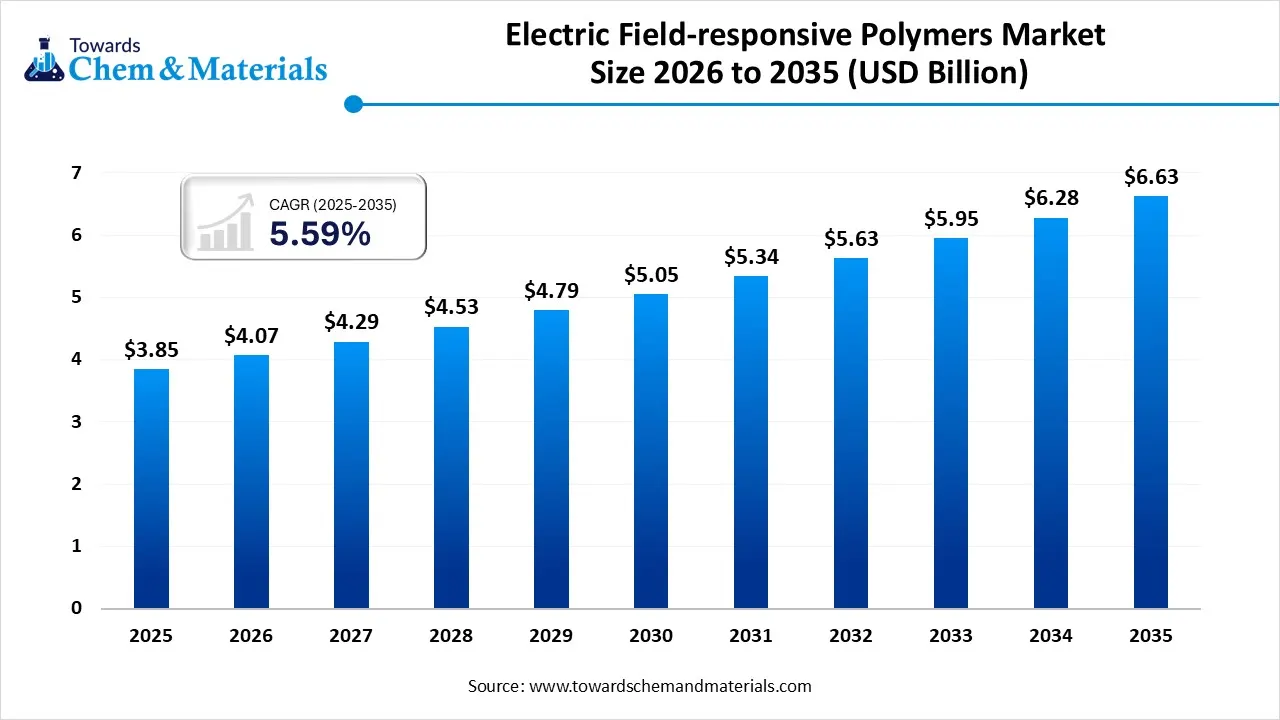
The global electric field-responsive polymers market size was valued at USD 3.85 billion in 2025 and is projected to grow from USD 4.07 billion in 2026 to USD 6.63 billion by 2035, expanding at a CAGR of 5.59% during the forecast period from 2026 to 2035. Growth is mainly driven by the increasing demand for lightweight sensors, flexible actuators, and energy-efficient smart materials in automotive and electronics industries.
Asia Pacific dominated the electric field-responsive polymers market with the largest revenue share of 42.00% in 2025. The dominance of the region can be attributed to the rising demand for flexible and lightweight materials in sectors such as consumer electronics, automotive manufacturing, and industrial automation. Increasing investments in printed electronics, roll-to-roll processing technologies, and integrated system manufacturing are also accelerating the commercialization of electroactive polymer technologies across the region.
Market Highlights
Asia Pacific accounted for the largest share of the electric field-responsive polymers market in 2025 with 42.00% revenue share. The region’s dominance is driven by strong demand for lightweight and flexible smart materials across the electronics, automotive, and automation industries.
By product, the conductive plastics segment dominated the market and accounted for the largest revenue share of 48.00% in 2025. This dominance can be attributed to the rising adoption of smart and intelligent materials and the increasing production of electric vehicles that require conductive polymer components.
By end use, the consumer electronics segment led the market with the largest share of 30.00% in 2025, mainly due to the growing demand for haptic technology in flexible displays, wearable electronics, and touch-based devices.
Trade Analysis of the Electric Field-Responsive Polymers Market
Global trade in electronic components—which often incorporate advanced polymer materials—has increased significantly. According to United States electronics component import data, global buyers imported 3,184 shipments between June 2024 and May 2025, involving 386 verified buyers sourcing from 363 global exporters.
Vietnam, India, and Russia have emerged as the top three importers of electronic components, while Germany, Costa Rica, and Thailand are the leading exporters in the global market.
India has also strengthened its position in electronics trade. In fiscal year 2025, electronic goods became India’s third-largest export category, reaching USD 38.56 billion, which represents nearly an eight-fold increase over the past decade. However, imports of electronic components remained high at USD 36.8 billion, reflecting strong domestic demand for advanced materials and components used in electronic manufacturing.
How Cutting-Edge Technologies Are Transforming the Market
Advanced technologies are transforming the electric field-responsive polymers market by converting traditional single-material actuators into multifunctional systems. Innovations in 3D and 4D printing, nanotechnology, and molecular engineering are enabling the development of highly responsive polymer structures with integrated sensing and actuation capabilities.
Researchers and manufacturers are also developing electric field-responsive surfaces for advanced automotive interfaces, including haptic dashboards that improve user interaction while reducing mechanical components. Continuous research is focused on reducing drive voltages, improving durability, and enhancing response speed, which will significantly expand the application potential of electroactive polymers in electronics and biomedical devices.
Key Market Trends
Growing adoption in healthcare applications
The increasing use of electric field-responsive polymers in healthcare is a major trend shaping the market. These materials are being integrated into medical devices such as actuators, sensors, artificial muscles, and smart prosthetics, helping improve patient monitoring and treatment outcomes.
Rising demand for smart materials
The demand for smart materials is growing rapidly across industries. Electric field-responsive polymers are increasingly used in actuators, robotics, sensors, and artificial muscles, particularly in advanced healthcare and robotics applications.
Shift toward sustainable and energy-efficient materials
Strict environmental regulations, particularly in Europe, are encouraging the adoption of recyclable and energy-efficient smart materials instead of conventional lead-based piezoelectric ceramics. This transition toward sustainable materials is positively influencing market expansion.
To own our research study instantly, Click here @ https://www.towardschemandmaterials.com/checkout/6222
Electric Field-Responsive Polymers Market Value Chain Analysis
The value chain begins with feedstock procurement, which involves sourcing essential raw materials such as polymers, monomers, solvents, and conductive additives required for producing electroactive polymers. Major chemical companies including Arkema and BASF SE play a key role in supplying these materials.
The next stage involves chemical synthesis and processing, where specialized manufacturing techniques are used to produce conductive plastics, dielectric elastomers, and ionic polymers that respond to electrical stimuli. Companies such as BASF SE and Celanese Corporation are prominent participants in this stage.
Following production, materials move to packaging and labeling, where responsive polymers are integrated into intelligent and active packaging systems capable of changing shape, size, or optical properties when exposed to electric fields. Companies including Wacker Chemie AG and Arkema contribute to this stage.
The final stage involves regulatory compliance and safety monitoring, ensuring that polymer products meet environmental and safety regulations before commercialization. Companies such as Dow Inc. and Evonik play important roles in maintaining compliance with international regulatory standards.
Regulatory Landscape
The electric field-responsive polymers market operates within a strict regulatory environment across major regions. In the European Union, the REACH regulation requires registration and safety evaluation of chemical substances, including emerging polymer categories. In the United States, the Toxic Substances Control Act (TSCA) governs the manufacturing and import of new polymer materials and includes specific compliance pathways for certain biopolymers.
China has implemented industrial standards to evaluate potential endocrine-disrupting effects of chemical additives used in polymers, while Canada requires manufacturers to follow the New Substances Notification (NSN) regulations for polymers not listed on the Domestic Substances List, especially those with potential environmental exposure risks.
Product Insights
The conductive plastics segment dominated the market with the largest revenue share of 48.00% in 2025. Growth of this segment is driven by rising adoption of intelligent materials and the increasing production of electric vehicles, which require conductive materials for electronic systems. Conductive plastics also enable adaptive functions in consumer electronics, enhancing user experience through improved responsiveness and performance.
The dielectric elastomer segment is expected to grow at the fastest rate during the forecast period. The growth of this segment is supported by rapid advancements in material science that allow faster response times and improved flexibility. These polymers are increasingly used in automotive sensing technologies, vibration control systems, adaptive interiors, and active noise-dampening components.
End-Use Insights
The consumer electronics segment held the largest market share of 30.00% in 2025. The strong growth of this segment is primarily linked to rising demand for haptic technologies used in flexible displays, touchscreens, soft robotics, and wearable devices. Additionally, the shift toward high-performance and low-voltage materials in portable electronics is further accelerating product adoption.
The healthcare and medical devices segment is expected to grow at the fastest CAGR during the forecast period. Increasing demand for biocompatible smart materials in wearable medical devices, advanced prosthetics, drug delivery systems, and soft robotics is driving the growth of this segment. Government investments in research are also improving the durability, performance, and manufacturing efficiency of electroactive polymers used in healthcare applications.
You can place an order or ask any questions, please feel free to contact us at [email protected]
Regional Insights
Asia Pacific dominated the global market with a 42.00% share in 2025 and continues to lead due to strong demand from consumer electronics, automotive manufacturing, and industrial automation sectors. The regional market was valued at USD 1.62 billion in 2025 and is projected to reach USD 2.82 billion by 2035, growing at a CAGR of 5.64%. Increasing investments in smart device manufacturing and printed electronics technologies are supporting regional market expansion.
In China, market growth is driven by rising demand for smart materials used in wearable electronics and automotive applications. The rapid transition toward electric vehicles and smart mobility solutions is also increasing the adoption of electroactive polymers for vibration control systems and advanced vehicle interiors.
North America accounted for 20.00% of the market share in 2025 and is expected to grow at the fastest rate during the forecast period. The region benefits from strong research infrastructure and increasing investments in advanced polymer technologies. The United States leads the regional market due to high demand for energy-efficient materials and significant government investments in defense, mobility, and advanced electronics technologies.
Europe held 25.00% of the global market share in 2025. The region’s growth is supported by strong research capabilities, strict sustainability regulations, and advanced manufacturing industries. Countries such as Germany, France, and the United Kingdom are increasingly integrating smart polymer materials into automotive systems, industrial automation, and medical devices. Germany, in particular, is experiencing growing demand from aerospace, automotive, and electronics sectors for lightweight and conductive materials.
Recent Industry Development
In October 2025, Chinese automaker Chery introduced a proprietary solid-state battery prototype with an energy density of 600 Wh/kg. The technology is expected to begin pilot operations in 2026 and reach full commercial rollout by 2027. Such advancements in battery and energy storage technologies are expected to increase demand for advanced polymer materials used in smart electronic systems.
Key Companies in the Electric Field-Responsive Polymers Market
Several leading companies are actively investing in research and innovation to develop high-performance electroactive polymers with improved flexibility, durability, and electrical responsiveness. Key players operating in the market include 3M, Arkema, BASF SE, Celanese Corporation, Covestro AG, Dow Inc., Evonik, Heraeus, Parker Hannifin, RTP Company, and Solvay S.A.
These companies focus on developing advanced dielectric elastomers, conductive plastics, and electroactive polymer technologies for applications in robotics, wearable electronics, automotive systems, industrial automation, and medical devices. Continuous research and development initiatives are expected to further expand the commercial potential of electric field-responsive polymers in the coming years.
About Us
Towards Chemical and Materials is a leading global consulting firm specializing in providing comprehensive and strategic research solutions across the chemical and materials industries. With a highly skilled and experienced consultant team, we offer a wide range of services designed to empower businesses with valuable insights and actionable recommendations.
Explore the comprehensive statistics and insights on healthcare industry data and its associated segmentation: Get a Subscription


Leave a Reply