The global biorefinery market is witnessing strong expansion as industries transition toward sustainable fuels, chemicals, and materials. A biorefinery integrates biomass conversion technologies to produce energy, fuels, and value-added products from renewable resources, similar to how petroleum refineries convert crude oil into multiple products.
Download a sample of this report @ https://www.towardschemandmaterials.com/download-sample/5718
Current Biorefinery Market Size and Share
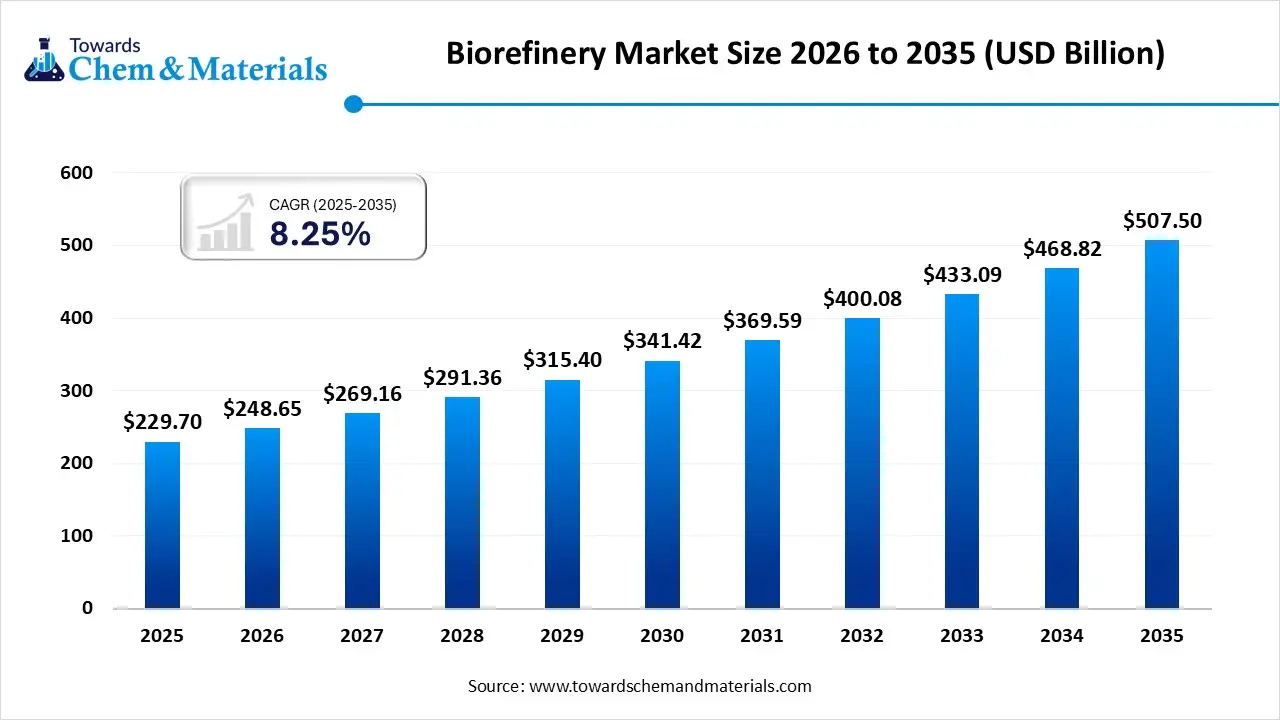
The global biorefinery market size was valued at USD 229.70 billion in 2025 and is projected to grow from USD 248.65 billion in 2026 to USD 507.50 billion by 2035, expanding at a CAGR of 8.25% from 2026 to 2035.
In 2025, Asia Pacific accounted for the largest market share of 43%, driven by expanding biofuel production, growing environmental awareness, and strong government support for renewable energy.
Rising concerns about climate change, increasing adoption of renewable fuels, and supportive policy frameworks are accelerating the global shift toward biomass-based production systems.
Key Takeaways
-
Asia Pacific dominated the global market with 43% revenue share in 2025.
-
By feedstock type, lignocellulosic biomass held the largest share of 42%.
-
By technology, biochemical conversion accounted for 45% of market revenue.
-
By product type, biofuels led with 35% share.
-
By end-use industry, transportation dominated with 47% share.
-
By refinery type, second-generation biorefineries held 46% share.
Advancements in Biorefining Technologies Driving Market Expansion
A biorefinery integrates multiple biomass conversion processes to produce fuels, chemicals, electricity, heat, and biomaterials from renewable feedstocks. Similar to petroleum refineries, these facilities transform raw biomass into a diverse portfolio of valuable products.
Recent innovations in microbial optimization, enzyme engineering, and process integration are significantly improving the efficiency and cost-effectiveness of biorefining technologies. These advancements allow producers to maximize biomass utilization while lowering production costs.
As a result, biorefineries are evolving beyond simple biofuel production and now include biochemicals, bioplastics, biomaterials, and renewable energy, expanding their applications across multiple industries.
Key Trends Influencing the Biorefinery Market
Growing Environmental Awareness
Increasing global awareness regarding air, water, and soil pollution is driving investments in sustainable production systems. Governments worldwide are establishing ambitious carbon-reduction targets, which are accelerating investments in renewable fuels and biorefineries.
Technological Advancements
Innovations in enzyme engineering, microbial fermentation, and biomass pretreatment technologies are improving conversion efficiency and lowering operational costs. These developments are enabling the commercialization of advanced biofuels and specialty biochemicals.
Expansion of Bio-Based Product Portfolios
Biorefineries are diversifying their product outputs to include biofuels, bioplastics, specialty chemicals, and renewable materials that serve industries such as packaging, automotive, and personal care.
Abundant Biomass Availability
Biomass from agricultural residues, forestry waste, organic waste, and microorganisms is widely available and renewable. This abundance ensures a stable feedstock supply while reducing dependence on fossil fuels.
Market Opportunity: Growing Investment in Green Energy
Significant investments from governments, private companies, and research institutions in renewable energy technologies are creating major opportunities for the biorefinery industry.
Biorefineries support the circular economy by converting waste biomass into valuable products, reducing landfill waste and greenhouse gas emissions. Additionally, the ability to produce biofuels, bio-based chemicals, and sustainable materials positions biorefineries as a key component in global climate mitigation strategies.
Market Challenges: High Capital Investment
Despite promising growth prospects, high initial capital investment remains a major barrier to market expansion. Establishing a biorefinery requires substantial investment in infrastructure, specialized equipment, and advanced technologies.
Moreover, maintaining consistent product quality from diverse biomass feedstocks can be technically challenging, requiring robust process control and quality assurance systems.
Segmental Insights
By Technology
Biochemical Conversion Dominated the Market
The biochemical conversion segment accounted for 45% of the market share in 2025, making it the leading technology. This dominance is attributed to its low energy requirements, high product selectivity, and compatibility with existing industrial infrastructure.
Processes such as fermentation and enzymatic hydrolysis efficiently convert sugars, starches, and lignocellulosic biomass into bioethanol, organic acids, and bioplastics. These processes operate under relatively mild conditions, reducing energy consumption and production costs.
Thermochemical Conversion to Grow Rapidly
The thermochemical conversion segment is expected to witness the fastest growth during the forecast period. Technologies such as gasification, pyrolysis, and hydrothermal liquefaction can convert a wide range of non-food biomass feedstocks into fuels and chemicals.
These technologies are particularly suited for large-scale industrial production and are gaining traction in aviation and transportation sectors.
By Feedstock Type
Lignocellulosic Biomass Led the Market
The lignocellulosic biomass segment held 42% market share in 2025. This feedstock includes agricultural residues, forestry waste, and non-food plant materials.
Advancements in pretreatment technologies have improved the efficiency of converting lignocellulosic biomass into biofuels and biochemicals, strengthening its dominance.
Aquatic Biomass Expected to Grow Fastest
The aquatic biomass segment is expected to grow rapidly due to innovations in photobioreactor technology and algae-based biofuel production.
By Product Type
Biofuels Dominated the Market
The biofuels segment held the largest market share of 35% in 2025, with bioethanol representing the most widely produced fuel.
Government mandates for ethanol blending in gasoline, combined with the widespread availability of feedstocks, have significantly boosted demand.
Biochemicals to Witness Fastest Growth
The biochemicals segment is expected to grow rapidly due to rising demand for sustainable materials, specialty chemicals, and bio-based polymers across industries including cosmetics, packaging, and pharmaceuticals.
By End-Use Industry
Transportation Segment Dominated
The transportation sector accounted for 47% of the market share in 2025. Biofuels such as bioethanol, biodiesel, and sustainable aviation fuel (SAF) are increasingly being adopted to reduce carbon emissions.
Packaging to Grow Rapidly
The packaging sector is projected to experience strong growth due to increasing demand for bio-based plastics and sustainable packaging materials.
By Refinery Type
Second-Generation Biorefineries Dominated
The second-generation biorefineries segment held 46% market share in 2025. These facilities use non-food biomass such as agricultural residues and forestry waste, making them more sustainable compared to food-based feedstocks.
Third-Generation Biorefineries to Grow Fastest
The third-generation biorefineries segment focuses on microalgae and aquatic biomass, offering higher productivity and carbon-capture potential.
To own our research study instantly, Click here @ https://www.towardschemandmaterials.com/checkout/5718
Regional Insights
Asia Pacific
The Asia Pacific biorefinery market was valued at USD 98.77 billion in 2025 and is projected to reach USD 220.76 billion by 2035, growing at a CAGR of 8.27%.
Rapid urbanization, industrialization, and population growth in countries such as China and India are driving regional demand. Large agricultural sectors also provide abundant feedstocks such as corn, sugarcane, and palm oil.
China leads the region due to its technological advancements, sustainability initiatives, and commitment to carbon neutrality.
North America
North America is witnessing substantial growth due to strong government policies and abundant biomass resources. The U.S. Renewable Fuel Standard and incentives for sustainable aviation fuel (SAF) are key drivers.
The United States remains a global leader in bioethanol and biodiesel production, with ongoing investments in advanced biorefinery technologies.
Europe
Germany leads the European market due to rising environmental awareness and strong demand for sustainable materials across sectors such as transportation, packaging, and pharmaceuticals.
Latin America
Latin America is emerging as a key market due to its vast agricultural resources and strong biofuel policies. Countries such as Brazil are major producers and exporters of sugarcane ethanol and are advancing second-generation biofuel production.
Middle East and Africa
The region is gradually adopting biorefineries to diversify energy sources and reduce reliance on fossil fuels. Countries such as the UAE and Saudi Arabia are investing in waste-to-fuel technologies and sustainable aviation fuels.
You can place an order or ask any questions, please feel free to contact us at [email protected]
Recent Developments
-
January 2026: Haffner Energy introduced its C-iC modular industrial units, enabling decentralized biofuel projects to become more financially viable without heavy subsidies.
-
December 2025: UPM-Kymmene Corporation began producing industrial sugars at its Leuna biorefinery in Germany, marking a milestone in Europe’s largest biochemicals investment.
Leading Companies in the Biorefinery Market
Key players operating in the global market include:
-
Neste Corporation
-
Abengoa Bioenergy
-
Clariant AG
-
POET LLC
-
TotalEnergies SE
-
Archer Daniels Midland Company
-
UPM-Kymmene Corporation
-
Renewable Energy Group
-
Gevo Inc.
-
BASF SE
-
Borregaard ASA
-
Enerkem Inc.
-
Valero Energy Corporation
-
Algenol Biotech LLC
-
Ørsted
-
GranBio
-
St1 Nordic Oy
-
LanzaTech
-
Cargill Incorporated
About Us
Towards Chemical and Materials is a leading global consulting firm specializing in providing comprehensive and strategic research solutions across the chemical and materials industries. With a highly skilled and experienced consultant team, we offer a wide range of services designed to empower businesses with valuable insights and actionable recommendations.
Explore the comprehensive statistics and insights on healthcare industry data and its associated segmentation: Get a Subscription


Leave a Reply