The cellulose nanocrystal reinforced biopolymers market is experiencing strong growth as industries increasingly seek high-performance, sustainable materials that can replace traditional petroleum-based plastics. Cellulose nanocrystals (CNCs), derived from renewable biomass sources, offer exceptional mechanical strength, low density, biodegradability, and enhanced barrier properties when incorporated into bio-based polymers. These attributes make CNC-reinforced biopolymers a promising solution for environmentally responsible product design across multiple industries.
Download a sample of this report @ https://www.towardschemandmaterials.com/download-sample/6212
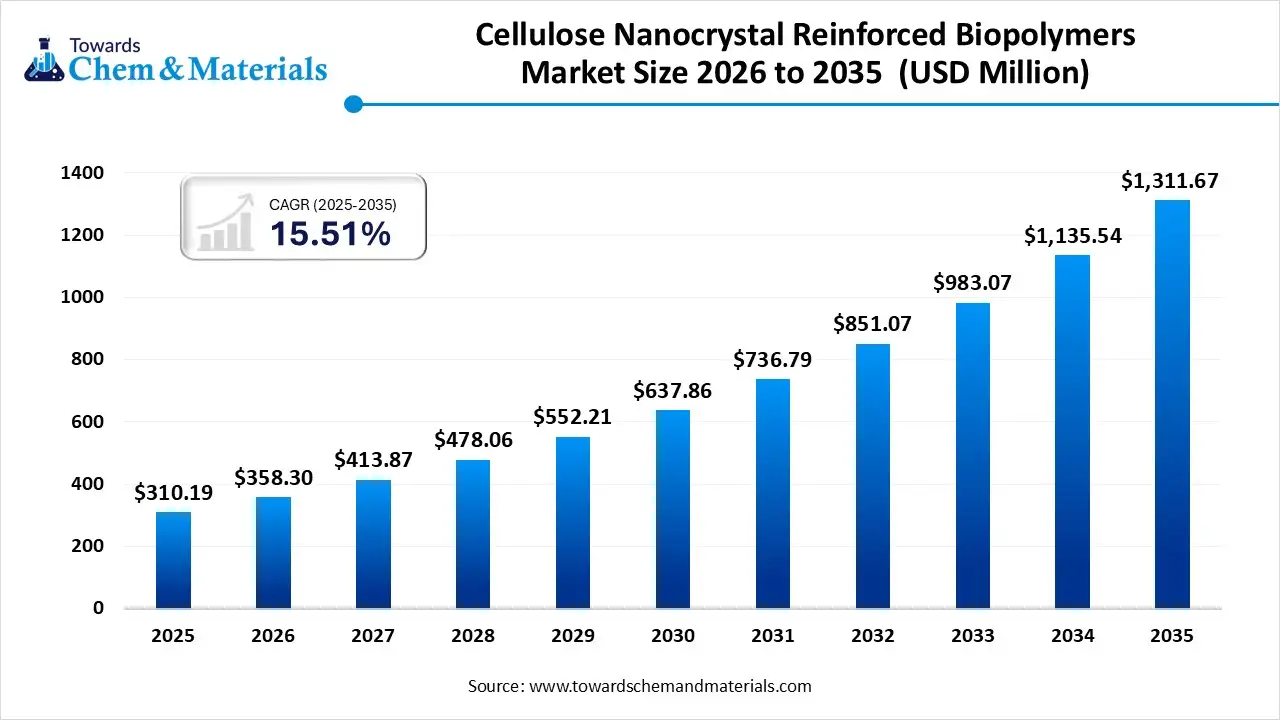
The global cellulose nanocrystal reinforced biopolymers market size was estimated at USD 310.19 million in 2025 and is expected to increase from USD 358.30 million in 2026 to approximately USD 1,311.67 million by 2035, expanding at a CAGR of 15.51% from 2026 to 2035. Rapid technological advancements in nanocellulose production, growing investments in pilot plants, and the increasing adoption of biodegradable materials in packaging, automotive, and biomedical sectors are key factors driving market growth.
Regionally, North America dominated the market with the largest revenue share of 39.00% in 2025, supported by strong research infrastructure, early commercialization initiatives, and significant investments in nanocellulose manufacturing capacity.
Market Highlights
-
North America accounted for the largest market share of 39.00% in 2025, supported by investments in pilot plants and scalable manufacturing infrastructure for nanocellulose production.
-
By product, the PLA + CNC segment dominated the market with a 42.82% revenue share in 2025, driven by strong demand in packaging, FDM 3D printing, and medical applications.
-
The PHA + CNC segment is projected to grow at the fastest CAGR of 15.9% from 2026 to 2035, owing to its expanding use in single-use biodegradable products, biomedical devices, and lightweight composites.
-
By end use, the packaging segment led the market with 37.83% revenue share in 2025, supported by stricter environmental regulations on landfill waste and rising consumer demand for biodegradable packaging solutions.
-
The biomedical & healthcare segment is expected to register a CAGR of 16.0%, reflecting rapid adoption of CNC-reinforced biomaterials in medical devices, drug delivery systems, and tissue engineering applications.
Key Technological Shifts in the Cellulose Nanocrystal Reinforced Biopolymers Market
The market is undergoing a significant technological transformation as it moves from laboratory-scale research to early commercial-scale production. The focus of innovation is on improving CNC dispersion within polymer matrices, strengthening interfacial bonding, and lowering production costs to enable widespread industrial adoption.
Several technological trends are shaping the industry:
1. Improved CNC Dispersion Techniques
Advanced surface modification technologies are being developed to enhance the compatibility of CNCs with biopolymer matrices such as PLA and PHA. Improved dispersion leads to stronger composites with enhanced mechanical and barrier properties.
2. Surface Functionalization of Nanocellulose
Chemical treatments and functionalization techniques help improve interfacial adhesion between CNCs and polymer matrices. This results in materials with better thermal stability, stiffness, and durability.
3. Scalable and Cost-Efficient Production
Companies are investing heavily in pilot plants and new processing technologies that enable the large-scale production of CNCs. This shift is critical to reducing costs and enabling commercial adoption across industries.
4. Sustainable Material Engineering
Manufacturers are developing advanced bio-composites where small CNC filler levels significantly enhance the performance of biodegradable polymers. These materials are increasingly being used in lightweight automotive components, flexible packaging, and biomedical devices.
Trade Analysis: Import and Export Trends
Global trade activity reflects the growing demand for cellulose-based materials and derivatives used in nanocellulose production.
According to global export data, between June 2024 and May 2025 (TTM), approximately 49,929 cellulose shipments were exported worldwide through 6,226 verified exporters and 8,610 buyers, representing a 6% year-over-year increase.
Top Importing Countries
-
India
-
United States
-
Vietnam
Top Exporting Countries
-
China – 40,665 shipments
-
United States – 40,269 shipments
-
India – 19,019 shipments
This trade activity highlights the expanding supply chain for cellulose materials used in advanced biopolymer composites.
Market Growth Trends
Shift from Laboratory Research to Commercialization
The industry is transitioning from research-focused applications to early commercial adoption. Investments in pilot plants and manufacturing facilities are improving production scalability and reducing the cost of CNC production.
Performance Optimization in Biopolymer Composites
Surface modification and chemical treatment of CNCs are enabling improved dispersion and stronger interfacial bonding with biopolymers. These advancements enhance the strength, flexibility, and barrier performance of the final materials.
Increasing Demand for Sustainable Alternatives
Companies are increasingly incorporating CNCs into biodegradable polymers to produce lightweight, high-performance composites that replace petroleum-based plastics in packaging, automotive, and healthcare applications.
To own our research study instantly, Click here @ https://www.towardschemandmaterials.com/checkout/6212
Recent Developments
In September 2025, CelluForce introduced CelluShield, a bio-sourced, water-based barrier coating designed to replace traditional multi-material laminates with recyclable mono-material structures in flexible packaging. The coating delivers high barrier performance at low coat weights and complies with FDA and Health Canada requirements. The product is also NexTrex™ certified recyclable, highlighting the industry’s move toward sustainable packaging technologies.
Top Companies in the Cellulose Nanocrystal Reinforced Biopolymers Market
Several companies are actively developing advanced nanocellulose materials and CNC-reinforced biopolymer compounds to support the growing demand for sustainable high-performance materials.
Chromatic Technologies Inc.
Produces advanced CNC additives and engineered biopolymer compounds designed for sustainable packaging, coatings, composites, and specialty polymer blends with enhanced mechanical properties.
LCR Hallcrest
Supplies functional nanocellulose materials that reinforce biopolymers such as PLA and PHA, improving strength, barrier performance, and environmental sustainability.
RTP Company
Develops customized CNC-reinforced thermoplastic compounds for high-performance applications in automotive components, consumer goods, and engineering plastics.
Val Creations
Specializes in cellulose nanocrystal reinforced biopolymer masterbatches that improve stiffness, thermal resistance, and processing characteristics of biodegradable polymers.
BASF SE
Integrates CNC technology into bio-based polymer systems to enhance performance in packaging, automotive, and specialty polymer sectors while maintaining regulatory compliance and sustainability goals.
Other notable market participants include:
-
Kiran Holographics
-
3M Company
-
CelluForce / Borregaard AS
-
API (American Process Inc.)
You can place an order or ask any questions, please feel free to contact us at [email protected]
Market Segmentation
By Product
-
PLA + CNC
-
PHA + CNC
-
Starch-Blends + CNC
-
Other Products
By End Use
-
Packaging
-
Automotive
-
Biomedical & Healthcare
-
Consumer Goods
-
Other End Uses
By Region
North America
-
U.S.
-
Canada
-
Mexico
Europe
-
Germany
-
UK
-
France
-
Italy
-
Spain
Asia Pacific
-
China
-
India
-
Japan
-
South Korea
Latin America
-
Brazil
-
Argentina
Middle East & Africa
-
Saudi Arabia
-
South Africa
About Us
Towards Chemical and Materials is a leading global consulting firm specializing in providing comprehensive and strategic research solutions across the chemical and materials industries. With a highly skilled and experienced consultant team, we offer a wide range of services designed to empower businesses with valuable insights and actionable recommendations.
Explore the comprehensive statistics and insights on healthcare industry data and its associated segmentation: Get a Subscription


Leave a Reply